Converting Large Driftwood Into Shelves
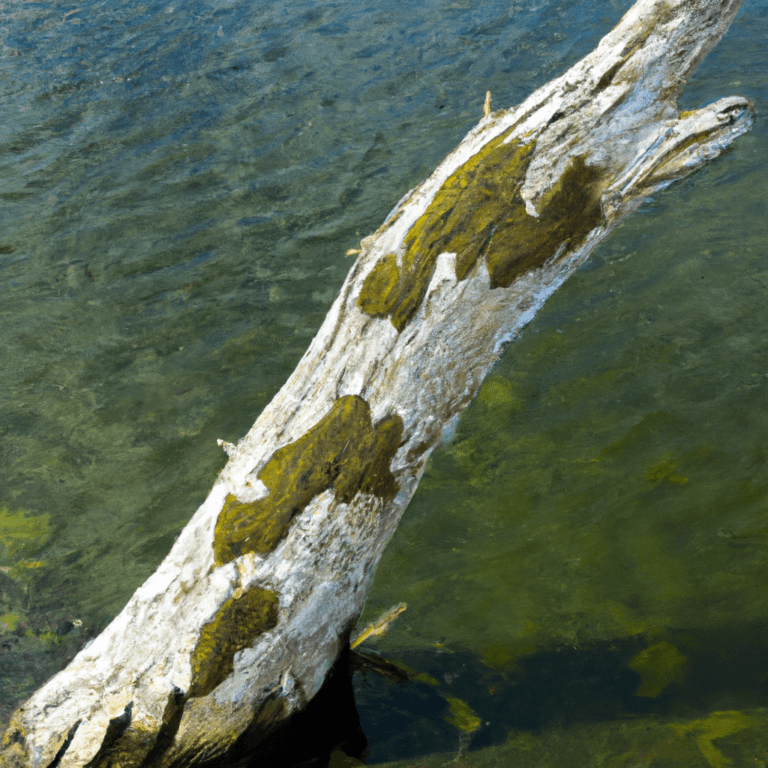
Most people see a tripping hazard; the designer sees $2,000 worth of organic architecture. What most coastal hikers step over in frustration is actually the world’s most durable building material. This heavy-duty log was a nuisance on the beach, but with a simple cleaning and a strategic mount, it becomes a structural masterpiece that will outlast the house it lives in.
[affiai]Finding a massive piece of driftwood is like discovering a skeleton of the earth. It has been tumbled by tides, sand-blasted by storms, and cured by salt until only the densest, most resilient heartwood remains. It possesses a grit that kiln-dried lumber from a big-box store simply cannot replicate.
Taking that raw, weather-beaten timber and bringing it into a modern living space requires more than just a bracket and a drill. It demands a respect for the wood’s history and an understanding of the physics required to hold a thirty-pound log against a vertical wall. You are not just hanging a shelf; you are anchoring a piece of the horizon.
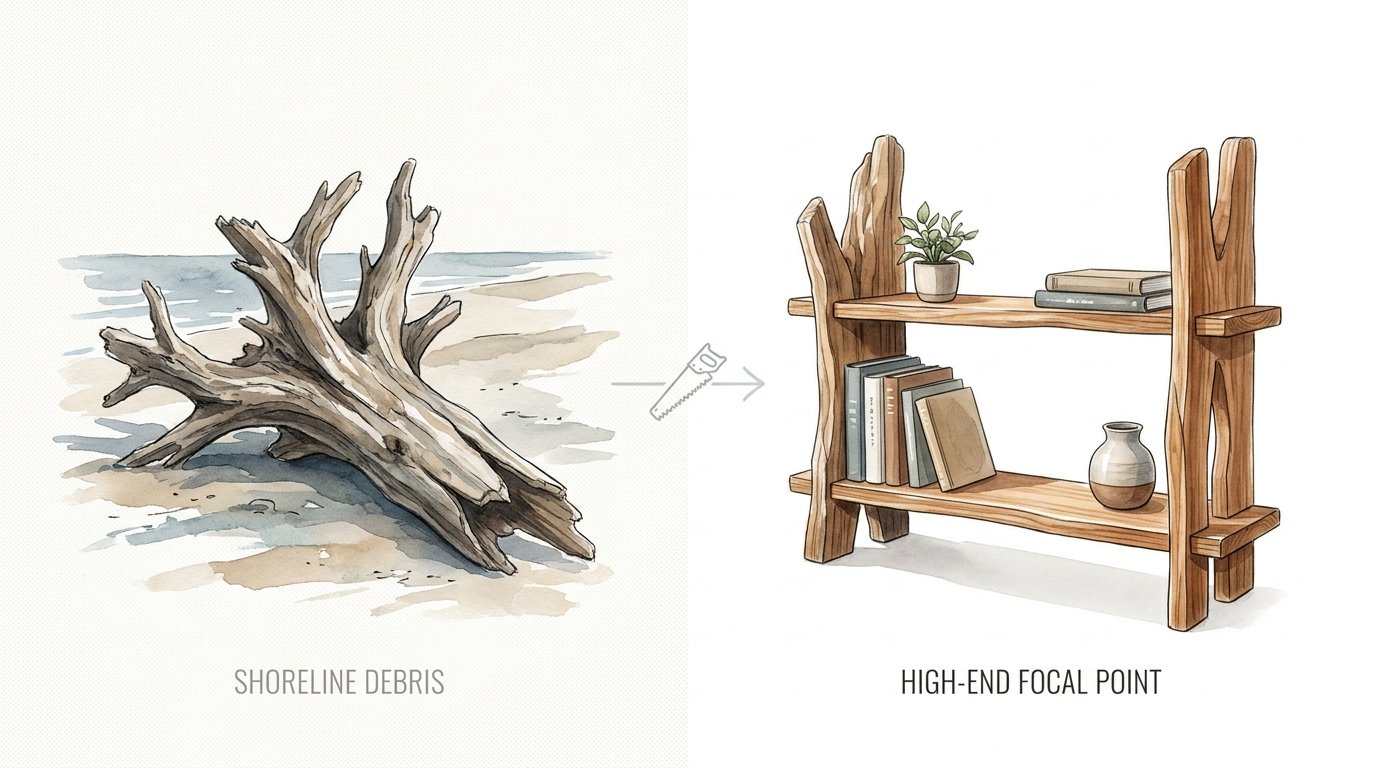
This guide will walk you through the grit and the glory of transforming shoreline debris into a high-end focal point. We will cover the remediation of the wood, the engineering of the mount, and the preservation of its silvered patina.
Converting Large Driftwood Into Shelves
Converting large driftwood into shelves is the process of reclaiming timber that has been naturally seasoned by water and air, then modifying it to serve as a functional, load-bearing surface. Unlike standard lumber, which is milled to uniform dimensions, driftwood is entirely organic. Every curve and knot tells a story of survival against the elements.
This practice exists because modern design often feels sterile. A driftwood shelf breaks the monotony of straight lines and mass-produced furniture. It brings a sense of the outdoors inside, acting as a bridge between the wild coast and the structured home. Designers use these pieces in high-end coastal retreats, mountain cabins, and minimalist urban lofts where a single “hero” piece is needed to ground the room.
Think of driftwood as the ultimate “reclaimed” material. While barn wood is reclaimed from human structures, driftwood is reclaimed from nature itself. It is wood that has been “tempered” by the sea. The salt acts as a natural preservative, and the constant motion of the water strips away the soft sapwood, leaving behind a hard, sculptural core.
In a real-world setting, a large driftwood shelf might serve as a fireplace mantel, a rugged bookshelf in a study, or a floating vanity in a bathroom. Because of its density and unique shape, it requires a different approach to installation than a flat piece of oak or pine. You are working with a three-dimensional sculpture that must somehow interface with a two-dimensional wall.
How to Process and Prepare the Timber
Preparing a large log for indoor use is a multi-stage operation that begins long before you pick up a saw. You must first ensure the wood is legally yours to take. Laws vary significantly between regions. In California, you may generally take one piece of driftwood up to 50 pounds per day for personal use, whereas in Washington, large logs are often considered critical habitat and may require specific permits. Always check local regulations to ensure your reclamation project starts on solid legal ground.
Once the wood is in your shop, the remediation process begins. Shoreline debris is often home to hidden tenants like wood-boring beetles, termites, or microscopic fungi. It is also saturated with salt, which is hygroscopic—meaning it will pull moisture out of the air and potentially rot the wood from the inside out if not properly removed.
Start by power washing the log to remove sand, loose bark, and salt crust. If the piece is small enough, soaking it in fresh water for several days—changing the water daily—will leach out the salt. For large timber that cannot be submerged, a thorough scrubbing with a 1:10 bleach-to-water solution is necessary to kill surface bacteria and mold.
Drying the wood is the most critical step. A heavy log that feels dry on the outside may still have 30% moisture content in its core. Bringing a damp log into a climate-controlled house will cause it to crack, warp, or “check” as the internal moisture escapes. Leave the timber in a well-ventilated, dry area for several weeks. Serious practitioners use a moisture meter to ensure the wood is below 10% before proceeding to the fabrication stage.
After the wood is cured, you must create a flat mating surface. A log is round or irregular, but your wall is flat. You will need to use a drawknife, a hand plane, or a chainsaw mill to “slab” the back of the log. This creates a stable surface that will sit flush against the drywall and allow for a secure mechanical connection to the wall studs.
Benefits of Driftwood Shelving
The primary advantage of using large driftwood is its incredible durability. The wood has already survived the harshest conditions imaginable. If it didn’t rot in the ocean, it likely won’t rot in your living room. This inherent resilience makes it a multi-generational piece of furniture.
Another benefit is the unique aesthetic value. No two pieces of driftwood are identical. The silver-grey patina, known as “driftwood grey,” is a result of UV exposure and salt-water leaching that cannot be perfectly mimicked with stains or chemicals. This natural beauty provides an immediate “wow factor” that elevates the value of the entire room.
Sustainability is a key factor as well. Using driftwood means you are not contributing to the demand for new-growth logging. You are essentially cleaning the beach and repurposing a natural waste product. It is a zero-carbon-footprint material that requires no industrial milling or chemical treatment beyond basic cleaning.
Finally, driftwood has a thermal stability that kiln-dried wood often lacks. Because it has been seasoned slowly by the environment, it is less prone to the dramatic seasonal expansion and contraction that can cause standard shelves to pull away from the wall. Once it is dry and mounted, it stays put.
Challenges and Common Mistakes
The weight of a large driftwood log is often underestimated. A five-foot cedar log can weigh 40 to 60 pounds before you even place a single book on it. A common mistake is trying to mount these heavy pieces using standard drywall anchors or small “L” brackets. These will inevitably fail, leading to wall damage or injury.
Another frequent error is failing to treat the wood for pests. Wood-boring beetles can lay eggs deep inside the crevices of a log. If these eggs hatch after the shelf is installed, you could end up with an infestation in your home’s structural framing. Always use a borate-based wood preservative or heat-treat the wood in a large oven (if size permits) to 140 degrees Fahrenheit to ensure all biological threats are neutralized.
Precision in leveling is a major challenge. Because the front of the log is irregular, you cannot simply put a level on top of the “shelf.” You must level the mounting hardware itself. If the holes drilled into the back of the log are even a fraction of a degree off, the shelf will tilt downward, causing items to slide off.
Neglecting the salt content is a mistake that haunts many beginners. Salt is a magnet for moisture. If you don’t desalinize the wood, your shelf may feel “clammy” on humid days, and the salt can eventually corrode the metal brackets or screws holding it to the wall. Thorough fresh-water rinsing is non-negotiable.
Limitations of This Method
Driftwood shelving is not suitable for every wall. Because of the weight and the leverage involved (the “see-saw” effect), these shelves must be anchored into solid wood studs. If your home has metal studs or if you are trying to mount the shelf on a thin partition wall without a structural backing, the project is likely unfeasible.
Moisture-rich environments like small, poorly ventilated bathrooms can also be problematic. While driftwood is tough, the high humidity can reactivate any residual salts or fungi, leading to a “musty” ocean smell that is difficult to eliminate. In these cases, the wood must be heavily sealed with a polyurethane or marine-grade varnish, which may alter its natural matte appearance.
The depth of the shelf is limited by the laws of physics. The further the shelf sticks out from the wall, the more downward force it exerts on the fasteners. Most DIY floating shelf brackets are rated for a depth of 10 to 12 inches. If your driftwood log is thicker than that, you will need custom-engineered steel supports that go deep into the wall framing.
Comparing Material Options
When deciding between driftwood and other high-end options, it helps to look at how they perform in a home environment.
| Feature | Driftwood Log | Live Edge Slab | Reclaimed Barn Beam |
|---|---|---|---|
| Cost | Free (Sourcing labor) | High ($200 – $800) | Moderate ($100 – $400) |
| Preparation | Extensive (Cleaning/Drying) | Minimal (Sanding/Finish) | Moderate (De-nailing) |
| Structure | Very Dense / Heavy | Stable / Flat | Porous / Squared |
| Aesthetic | Wild / Sculptural | Elegant / Natural | Rustic / Industrial |
While a live edge slab offers a flat surface for books, a driftwood log offers more visual depth and texture. The choice often comes down to whether you want a functional tool (the slab) or a piece of art that happens to hold things (the log).
Practical Tips for a Better Build
Use a high-quality stud finder to map out exactly where your vertical supports are located. Mark the center of each stud, not just the edges. For heavy logs, you should aim to hit at least three studs to distribute the load evenly.
When drilling the holes for your floating shelf rods, use a drill guide or a drill press if possible. The holes in the back of the log must be perfectly perpendicular to the flat mating surface. If the hole is crooked, the rod will bind, and you will never get the shelf to sit flush against the wall.
Pro Tip: If the log has a beautiful but uneven top surface, you can use a router to “inlay” a piece of tempered glass or a flat piece of wood into the top. This creates a level plane for placing lamps or glasses while keeping the rugged look of the driftwood visible from the front and sides.
Consider the finish carefully. If you love the silvered, weathered look, avoid oil-based finishes as they will turn the wood dark and “wet” looking. Instead, use a water-based ultra-matte polyurethane. This protects the wood from dust and spills without changing the color of the silver patina.
Advanced Considerations for Serious Crafters
For massive logs weighing over 75 pounds, standard floating shelf hardware is insufficient. You should look into “blind” shelf supports made of 3/4-inch cold-rolled steel rods that are welded to a 1/4-inch steel backplate. This backplate is then recessed into the back of the log so that the entire unit sits flush against the wall.
Calculating the shear force and pull-out tension is vital for heavy installations. A log that protrudes 12 inches from the wall acts as a lever. For every pound of weight you place on the edge of that shelf, the tension on the top screw in your wall stud increases exponentially. Using 3-inch or 4-inch lag bolts is often necessary to ensure the hardware doesn’t pull out of the wood framing.
If you are working with a particularly soft or “punky” piece of driftwood that has a beautiful shape but lacks structural integrity, you can use a vacuum-stabilization chamber. This process involves submerging the wood in a stabilizing resin and using a vacuum to pull the resin deep into the fibers. Once cured, the wood becomes as hard as plastic while retaining its natural look.
Installation Scenario: The Fireplace Mantel
Imagine you have found a stunning 6-foot cedar log on the Oregon coast. After three months of drying and a thorough cleaning, it is ready to become a fireplace mantel. The log weighs 55 pounds.
First, you determine the “flat back” by running the log through a bandsaw or using a hand-planer to create a 4-inch wide flat strip along the entire length. You then locate four studs above the fireplace. You choose a heavy-duty bracket with four 8-inch steel rods.
You drill four 3/4-inch holes into the back of the log, precisely aligned with the rods. Because the log is slightly bowed, you use a chisel to “relieve” some wood around the holes so the log can slide all the way onto the bracket plate. After sliding it on, you secure the log from the bottom with a small set screw to prevent it from ever sliding forward. The result is a mantel that appears to grow out of the chimney breast, capable of holding a heavy clock and several iron candle holders without a hint of sag.
Final Thoughts
Transforming a piece of shoreline debris into a high-end focal point is one of the most rewarding projects a craftsman can undertake. It requires patience, a bit of engineering, and a willingness to work with a material that refuses to be tamed. You are taking something the ocean discarded and giving it a second life in a place of honor.
The grit of the process—the scrubbing, the waiting, the heavy lifting—is what gives the final piece its soul. A driftwood shelf is more than just storage; it is a conversation piece that brings the rhythm of the tides into the stillness of your home. It serves as a reminder that beauty often hides in the things the world considers broken or washed up.
As you begin your own project, remember to respect the wood and the wall. Take the time to dry the timber properly and never skimp on the quality of your mounting hardware. When done correctly, your driftwood masterpiece will stand as a testament to the endurance of nature and the skill of the human hand. Experiment with different shapes, keep your tools sharp, and always keep an eye on the horizon for your next great find.
Sources
1 parklanejewelry.com (https://www2.parklanejewelry.com/how-to-wash-driftwood/) | 2 parklanejewelry.com (https://www2.parklanejewelry.com/how-to-clean-driftwood/) | 3 reddit.com (https://www.reddit.com/r/Washington/comments/t0hpgt/is_it_legal_to_harvest_driftwood_for_firewood/) | 4 thriftyfun.com (https://www.thriftyfun.com/Sterilizing-and-Desalinizing-Driftwood.html) | 5 fishgeeks.com (https://fishgeeks.com/driftwood-cleaning/) | 6 hometalk.com (https://www.hometalk.com/diy/decorate/rooms/q-how-to-hang-a-large-heavy-driftwood-piece-42096700) | 7 shelfology.com (https://shelfology.com/blogs/shelfology-u/how-much-weight-can-a-floating-shelf-hold) | 8 simplydiscus.com (https://www.simplydiscus.com/library/biotopes/natural/driftwood_treatment.shtml) | 9 sos.state.or.us (https://vertexaisearch.cloud.google.com/grounding-api-redirect/AUZIYQG0VQwzNlypge1cfeLYfrwgYjdJxZXlk-5EBFxGy9deafiWhHTvtCws3vY4uBk4e7VPxM4a17r1dPgdqHmGkIEI80wI4Lhr3V-uLzfGsvUD5BJzgN-VHSroiOeYdlXcyhOUS2CIgQ6h1p3b_4z8z8T8WZ5x0a42HfBYJKbnH6PSVJ1sPVTcJsqRsoqW7ylkkis=) | 10 anchorco.com (https://anchorco.com/blogs/pro-tips-and-tricks/how-to-hang-shelves-in-drywall)