Driftwood Vs Pine Shelving Durability
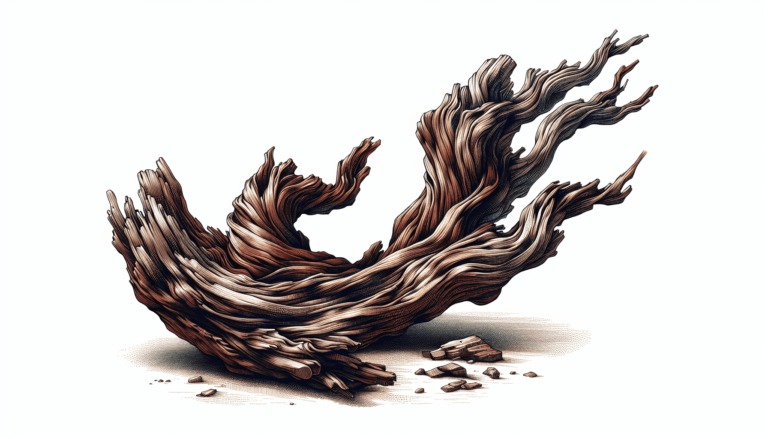
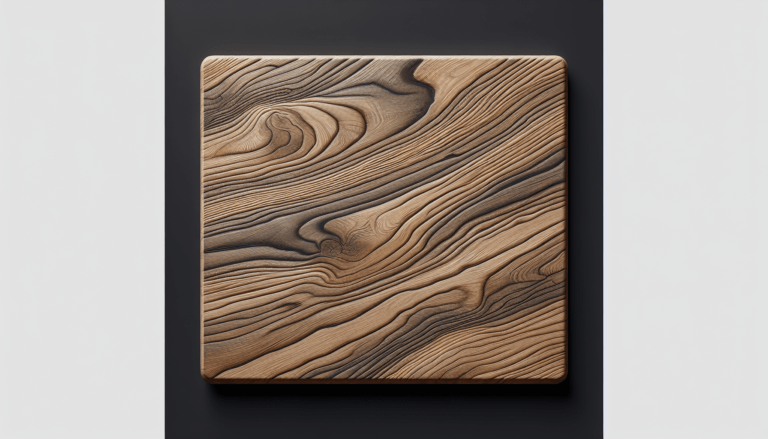
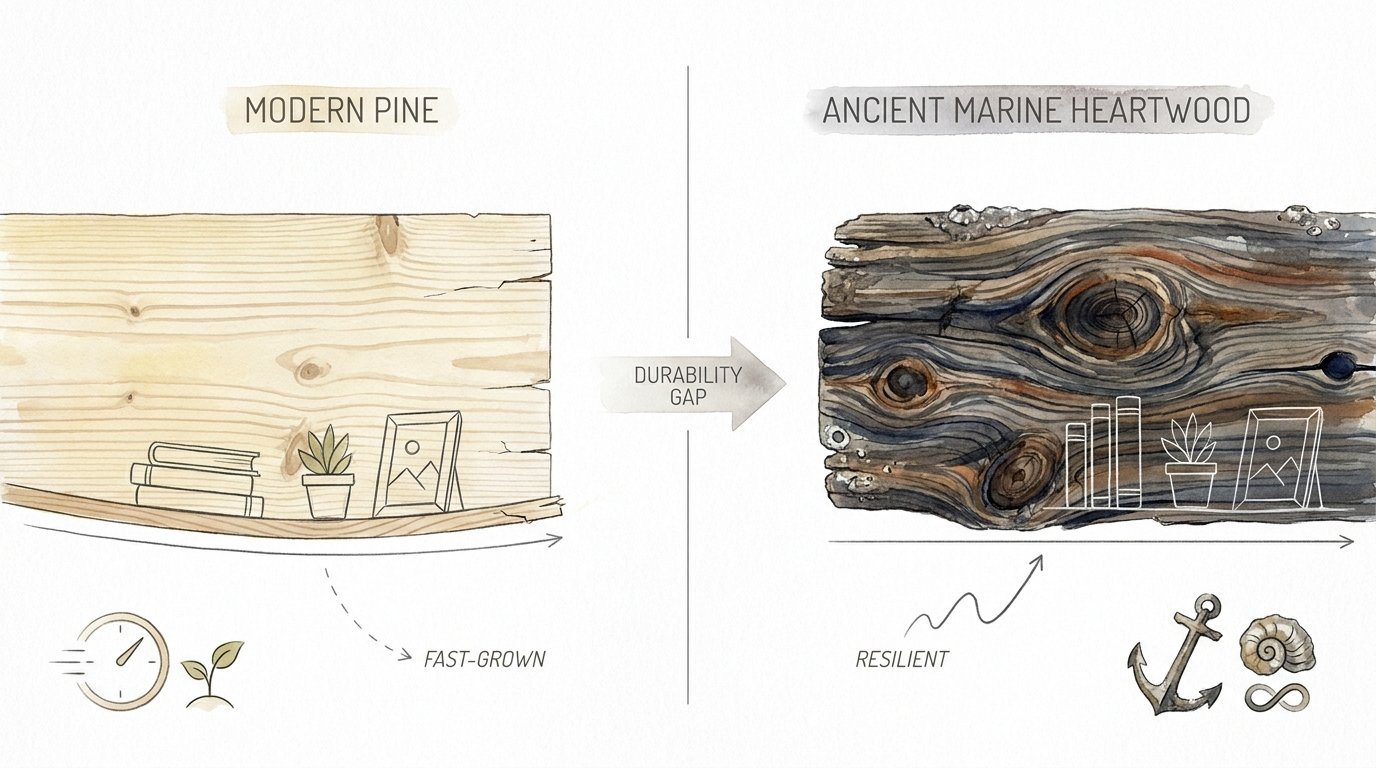
The wood on the left grew in 15 years; the wood on the right spent 40 years at sea after a century in the forest. We’ve traded the slow, mineral-dense strength of ancient timber for fast-grown, watery plantation pine. One bows under a few books; the other survived a thousand miles of ocean current without losing its structural integrity. Stop buying ‘new’ wood that acts like cardboard.
[affiai]Walking into a modern big-box hardware store can be a deceptive experience. The aisles are stacked high with clean, blonde boards that look perfect on the surface. However, beneath that smooth finish lies a biological reality that most furniture manufacturers won’t tell you about. You are looking at wood that was rushed through its life, forced to reach harvestable size in a fraction of the time nature intended.
This article explores the deep chasm between modern plantation lumber and the ancient marine heartwood that once defined craftsmanship. We will look at why your shelves sag, why “reclaimed” isn’t just a buzzword, and how the relentless pressure of the ocean can actually forge a piece of timber into something more durable than stone. If you want to build something that lasts longer than a single lease, you need to understand the material at a cellular level.
Driftwood Vs Pine Shelving Durability
Durability in woodworking is often misunderstood as simple hardness. In reality, it is a combination of density, dimensional stability, and resistance to biological decay. When we compare driftwood—specifically ancient heartwood salvaged from marine environments—to modern plantation pine, we are comparing two different classes of matter.
Modern pine shelving is typically sourced from “new-growth” forests. These trees are planted in high-density plantations where they compete for light, causing them to shoot upward at incredible speeds. This results in wide growth rings filled with “earlywood”—the soft, porous part of the wood designed to transport water. Because these trees are harvested so young, the boards are almost entirely composed of sapwood, which is the living, vulnerable outer layer of the tree.
Ancient marine heartwood, often referred to as “sinker” wood or marine-salvaged timber, represents the opposite end of the spectrum. These are logs that often grew for 200 to 500 years in a natural, competitive forest before falling into rivers or being transported by sea. The heartwood is the non-living center of the tree, which the plant naturally fills with resins, tannins, and minerals to prevent rot. When this wood spends decades submerged in salt water or buried in river silt, it undergoes a process of mineralization. The water pressure forces minerals into the cellular structure, making the wood significantly denser and harder than it was the day it fell.
In a shelving context, this difference is immediately apparent. A 12-inch span of modern pine will begin to “creep” or permanently bow under the weight of a heavy set of encyclopedias within months. Ancient marine heartwood, due to its tight growth rings and mineral content, possesses a much higher modulus of elasticity. It resists deformation and can carry significantly higher loads without the structural failure seen in “watery” plantation timber.
How the Transformation Occurs: From Forest to Sea
The journey of high-quality timber begins with time. In an old-growth forest, a sapling might spend its first fifty years in the shade of giants, growing only a few inches in diameter. This slow start creates incredibly tight growth rings. In some specimens of reclaimed heart pine, you can find 25 to 40 rings per inch. Each of those rings represents a year of survival, building a concentrated fortress of cellulose and lignin.
When these ancient trees were harvested in the 18th and 19th centuries, they were often floated down rivers to mills. Many of the densest logs, rich with heavy resins, would sink to the bottom. These “sinkers” were preserved in an anaerobic (oxygen-free) environment for over a century. The lack of oxygen prevents the fungi and bacteria that cause rot from surviving, essentially deep-freezing the wood in time.
For wood that ends up at sea, the process is even more rigorous. Saltwater is a harsh mistress; it leaches out the softer hemi-cellulose while the heartwood resins stay put. The wood is tumbled by currents, stripped of its soft sapwood, and hammered by the pressure of the depths. What remains is the “bone” of the tree—the hardest, most resinous portion that has proven it can withstand the most corrosive environment on Earth. This is why a piece of marine-salvaged timber feels like a piece of iron in the hand, while a new pine board feels like balsa.
Benefits of Ancient Marine Heartwood
Choosing ancient or marine-salvaged timber over modern plantation pine offers several practical advantages that go beyond mere aesthetics. These benefits are rooted in the physical properties developed over centuries of growth and decades of submergence.
- Unmatched Dimensional Stability: Because the wood has already “lived” through extreme moisture fluctuations for a century, it is far less likely to warp, cup, or twist when brought into a climate-controlled home.
- Natural Rot and Pest Resistance: The high resin and tannin content in ancient heartwood acts as a natural deterrent to termites and carpenter ants. Modern pine, by contrast, is essentially “bug food” unless it is heavily treated with toxic chemicals.
- Exceptional Load-Bearing Capacity: The density of old-growth heartwood allows for thinner shelf profiles that can support more weight, enabling more elegant furniture designs without sacrificing strength.
- Rich Aesthetic Patina: The mineralization process often results in unique colorations—deep ochres, midnight grays, and burnt oranges—that cannot be replicated with wood stains on new timber.
- Sustainability: Using salvaged marine wood is the ultimate form of recycling. No new trees are cut down, and you are removing “ghost timber” from waterways.
Challenges and Common Mistakes
Working with ancient timber is not the same as working with the soft stuff from the local lumber yard. Beginners often run into trouble because they treat “sinker” wood like standard pine. This is a mistake that can ruin expensive tools and projects.
The most common pitfall is ignoring the mineral content. Because the wood has absorbed silt and minerals from the water, it is incredibly abrasive. Standard high-speed steel (HSS) saw blades and planer knives will dull almost instantly. Serious practitioners must use carbide-tipped tools and expect to sharpen them more frequently. If you see smoke while cutting, you are likely hitting a pocket of silica or concentrated resin.
Another frequent error is failing to account for salt. If the wood was salvaged from a marine environment (saltwater), it must be properly “desalinated” or leached before finishing. Residual salt can attract moisture from the air (hygroscopy), which can cause finishes to fail or hardware to rust. Always ask your supplier if the wood has been kiln-dried and processed to remove surface salts.
Finally, there is the issue of “checking” and brittleness. While ancient wood is strong, it can also be more brittle than new wood. Driving a screw into old-growth heartwood without a pilot hole is a guaranteed way to split a priceless board. You must pre-drill every single fastener with precision.
Limitations: When New Pine Might Actually Be Better
Despite the superiority of ancient timber, there are specific scenarios where modern plantation pine is the more logical choice. It is important to maintain a balanced perspective to avoid over-engineering simple projects.
Cost is the primary constraint. Ancient marine heartwood can cost five to ten times more than standard dimensional lumber. If you are building a temporary shop shelf, a hidden internal frame, or a project that will be painted over, spending the money on sinker cypress or heart pine is an unnecessary luxury. Modern pine is a fantastic “utility” wood when its limitations are understood.
Weight is another factor. A shelf made of mineral-dense heartwood can be twice as heavy as its modern counterpart. This puts significant stress on wall anchors and mounting brackets. If you are mounting shelves on a thin drywall partition without access to studs, the sheer weight of the ancient wood might be a liability.
Lastly, there is the “workability” trade-off. Modern pine is soft and forgiving; it is an excellent material for learning joinery or for complex carvings that would be exhausting to execute in rock-hard reclaimed timber. If the goal is a quick, easy DIY project, the “cardboard” nature of new pine is actually a feature, not a bug.
Comparing the Specs: Fast-Grown vs. Marine Heartwood
To help visualize the difference, let’s look at the measurable factors that determine how these woods perform in a workshop and in your home.
| Feature | Fast-Grown Plantation Pine | Ancient Marine Heartwood |
|---|---|---|
| Growth Rings | 3–7 per inch | 20–40+ per inch |
| Heartwood Ratio | Very Low (Mostly Sapwood) | Very High (90%+) |
| Janka Hardness | ~380–690 lbf | ~900–1200+ lbf |
| Stability | High Warpage/Shrinkage | Excellent Dimensional Stability |
| Workability | Easy/Soft | Challenging/Abrasive |
Practical Tips for Sourcing and Preparation
If you have decided to move away from “fast-food” lumber and toward ancient timber, you need a plan. You won’t find this material at a standard building supply center. You need to look for boutique reclaimers, river-salvage specialists, or specialized maritime lumber yards.
When inspecting a potential board, look at the end grain first. If the lines are so close together they look like a single solid mass, you have found the good stuff. Heavy weight is also a key indicator; a dry piece of heartwood should feel surprisingly heavy for its size. If it feels light, it is likely sapwood that has been weathered to look old, which lacks the structural benefits of the heartwood core.
Before you start building, let the wood acclimate to your shop for at least two weeks. Even though it is more stable than new wood, it has been through a lot. Giving it time to reach equilibrium with your local humidity will prevent any unexpected movement after you’ve finished your joinery. Use a moisture meter to ensure it is between 6% and 9% before you begin milling.
Advanced Considerations: The Role of Lignin and Resin
For the serious practitioner, understanding the chemistry of the wood explains its performance. Wood is essentially a composite material: cellulose fibers (the rebar) held together by a glue called lignin. In fast-grown pine, the lignin is less concentrated and more “watery,” leading to a weaker bond. This is why modern pine “fuzzes” when sanded and doesn’t take a crisp edge.
In ancient heartwood, particularly species like Southern Longleaf Pine, the heartwood becomes “petrified” with resin. This resin acts as a secondary structural agent. When you sand ancient heart pine to a high grit, the resin actually polishes, giving the wood a natural sheen that no polyurethane can mimic. This resin also makes the wood significantly more fire-resistant than new growth, as it creates a dense char layer that protects the inner core.
Furthermore, the mineralization process mentioned earlier often replaces some of the organic hemi-cellulose with inorganic minerals from the river or sea bed. This essentially turns the timber into a “natural composite” that bridges the gap between wood and stone. This is why ancient marine heartwood is often used in high-traffic commercial flooring where modern wood would be destroyed in months.
Real-World Example: The “Library Wall” Scenario
Imagine two homeowners building identical library walls with 4-foot wide shelves. Homeowner A uses standard “Select Pine” boards from a local retailer. Homeowner B uses reclaimed “Sinker” Cypress salvaged from the bottom of the Cape Fear River.
After six months of holding heavy art books, Homeowner A’s shelves have a noticeable 1/2-inch sag in the center. The wood has undergone “mechanical creep,” where the fibers have permanently stretched under the constant load. To fix this, Homeowner A will either have to add unsightly supports or replace the shelves with thicker boards, losing valuable vertical space.
Homeowner B’s shelves remain perfectly flat. The mineral density and tight grain structure of the sinker wood provide enough internal stiffness to resist the load across the entire span. Even though Homeowner B spent more upfront, the “cost per year of service” is actually lower because the library wall will remain an heirloom for generations, while Homeowner A’s project is already failing.
Final Thoughts
The Wood on the left grew in 15 years; the wood on the right spent 40 years at sea after a century in the forest. This isn’t just an observation of age; it is a fundamental lesson in the value of time and the cost of convenience. We live in an era of “fast” everything, but biology cannot be cheated. When we force a tree to grow too fast, we get a product that looks like wood but lacks its soul and its strength.
By choosing ancient marine heartwood, you are not just buying a piece of lumber; you are buying a piece of history that has been tested by the most brutal forces on the planet. You are choosing integrity over ease, and longevity over the temporary fix. Whether you are building a simple shelf or a dining table that will host a hundred years of Thanksgiving dinners, the material you choose is the foundation of your legacy.
Next time you are at the yard, look past the clean, blonde boards. Seek out the timber that looks like it has a story to tell. It might be harder to cut, it might cost more, and it might require more respect, but it will never bow to the weight of your life. Experiment with these ancient materials, and you will find that the difference between “cardboard” and “bone” is something you can feel in every cut of the saw.
Sources
1 mrtimbers.com (https://mrtimbers.com/why-old-growth-wood-outperforms-new-timbers/) | 2 masterplankuk.com (https://masterplankuk.com/blogs/news/shelves-with-wood-a-comparison-guide-to-solid-timber-and-handcrafted-styles) | 3 charltonsgates.com (https://charltonsgates.com/wood-durability-heartwood-sapwood/) | 4 brenthull.com (https://brenthull.com/article/old-growth-wood) | 5 youtube.com (https://www.youtube.com/watch?v=vKbxLNYPaYg) | 6 meltondesignbuild.com (https://meltondesignbuild.com/blog/using-reclaimed-wood-for-your-new-kitchen-pros-and-cons/) | 7 logfurnitureplace.com (https://logfurnitureplace.com/blog/cedar-vs-pine-wood-furniture-which-wood-lasts-longer.html) | 8 ventanasurfboards.com (https://ventanasurfboards.com/blogs/news-info/the-benefits-of-using-redwood-in-surfboards)