Driftwood Shelf Vs Particle Board Durability
We’ve been conditioned to buy furniture that rots in five years, while the ocean is washing up ‘industrial-grade’ timber that will outlast your house for free. Modern furniture is built for the landfill, held together by glue and hope. But a piece of timber that survived a decade in the Pacific Ocean? That’s not just a shelf; it’s a geological artifact. Harvesting ‘ocean-cured’ wood means you aren’t just saving money—you’re building a legacy that survives humidity, weight, and time itself. Here is why your next shelf should be salvaged, not shipped.
[affiai]The modern home is often a museum of planned obsolescence. We fill our rooms with “disposable MDF” because it is convenient and flat-packed. However, this convenience comes at a hidden cost: the structural integrity of your home’s storage depends on sawdust and formaldehyde. Choosing to look toward the shoreline for your raw materials is a return to a more rugged, self-reliant way of living. It is about recognizing that nature has already done the hard work of pressure-testing the timber for you.
Driftwood Shelf Vs Particle Board Durability
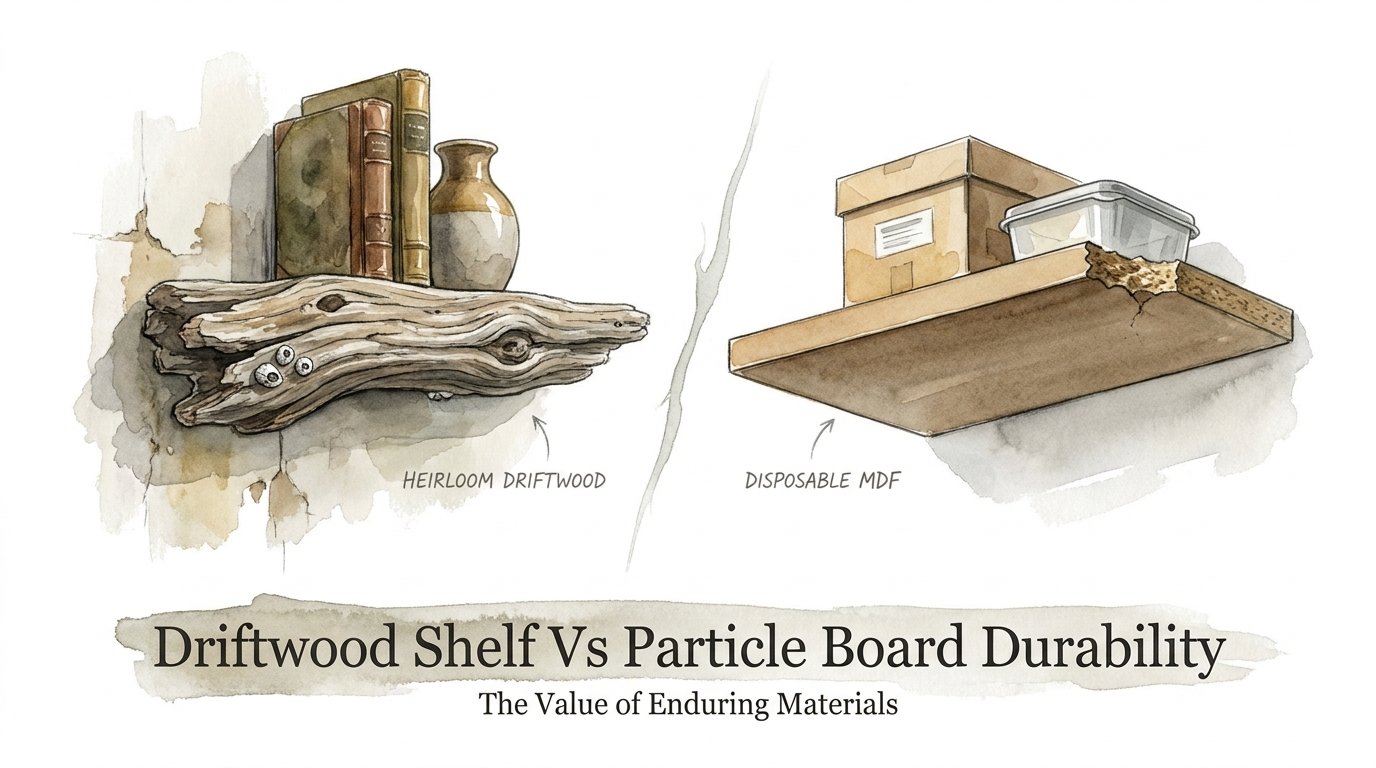
Particle board is essentially a structural sponge made of wood chips and synthetic resin. It exists because it is cheap to manufacture and easy to transport in thin, uniform sheets. In a controlled, bone-dry environment, it can hold a moderate amount of weight for a few years. However, the moment it encounters humidity or a spill, the resins begin to fail and the fibers swell. This lead to the “sagging shelf” syndrome that plagues many modern bookshelves.
Driftwood, or ocean-cured timber, sits at the opposite end of the durability spectrum. These pieces of wood have survived years of mechanical pounding by waves and chemical “pickling” by saltwater. Saltwater acts as a natural preservative, often killing wood-boring insects and slowing the rate of organic decay. The wood that survives this process is the heartwood—the densest, toughest part of the tree.
Comparing the two reveals a stark difference in internal architecture. Particle board relies on the strength of the glue between the chips. Driftwood relies on the continuous, long-chain cellulose fibers that grew over decades. While a particle board shelf might snap under a sudden load or crumble when moved, a solid piece of salvaged timber can support hundreds of pounds without flinching. It is the difference between a house built of sand and one built of stone.
How to Harvest and Prepare Ocean-Cured Timber
Finding the right piece of wood is the first step in this pioneer’s journey. Look for “gray-ghost” timber—wood that has been sun-bleached to a silver-gray and feels surprisingly light for its size. This indicates that the sap has been leached out and the wood is well-seasoned. Use the “knock test”: strike the wood with a hard object. A dull thud suggests internal rot, while a sharp, clear ring means the fibers are dense and healthy.
Preparation begins with a thorough cleaning to remove sand, salt, and hitchhikers. Use a stiff-bristled brush and fresh water to scrub the surface along the grain. Many builders choose to soak their finds in a large trough of fresh water for several days, changing the water daily. This process, known as desalination, removes the excess salt that can attract moisture from the air later on.
Once cleaned, the wood must be dried slowly to prevent cracking. Place it in a well-ventilated, shaded area—not in direct sunlight, which can cause the exterior to dry too fast and split. Depending on the thickness of the piece, this could take anywhere from a few weeks to several months. Professional practitioners often use a moisture meter to ensure the internal moisture content is below 12% before they begin the final build.
Benefits of Building with Salvaged Relics
Building with driftwood offers an environmental advantage that no store-bought furniture can match. You are effectively sequestering carbon that would otherwise rot or be burned on a beach. This process requires zero industrial energy for milling and zero chemical treatments for preservation. It is the purest form of recycling available to the home woodworker.
Health is another significant benefit. Many engineered wood products, including MDF and particle board, emit Volatile Organic Compounds (VOCs) like formaldehyde for years after they enter your home. These gasses can irritate the lungs and eyes. Driftwood is chemically inert; the only “off-gassing” you might experience is the faint, nostalgic scent of sea salt and aged cedar.
The aesthetic value of these pieces is irreplaceable. Every knot, groove, and silvered grain line tells a story of a journey through the elements. You cannot buy this patina in a hardware store. A driftwood shelf is a conversation piece that brings the raw power of the wilderness into the domestic space, grounding your home in the physical world rather than the digital one.
Challenges of Working with Sea-Aged Wood
Nature does not provide straight lines or 90-degree angles. This is the primary hurdle for the modern woodworker accustomed to square plywood. Mounting an irregular, heavy piece of timber to a flat wall requires patience and specialized techniques. You may need to “scribe” the back of the wood to match the contours of your wall or use heavy-duty floating shelf brackets that can be hidden deep within the timber.
The presence of salt is also a challenge for your tools. Residual salt crystals are incredibly abrasive and will dull saw blades and drill bits faster than kiln-dried lumber. It is wise to use “disposable” or older blades for the initial rough cuts and save your high-end chisels for the final fitting once the wood is clean.
Hidden pests are a rare but real concern. While saltwater kills many land-based bugs, some marine borers can leave intricate tunnels behind. If you are worried about bringing uninvited guests into your home, a soak in a diluted bleach solution (one part bleach to ten parts water) for 30 minutes can sanitize the piece. Alternatively, kiln-drying the wood at low temperatures can effectively sterilize it.
Limitations of Driftwood Shelving
Structural consistency is not guaranteed. Because every piece of driftwood has a different history, you cannot always predict its weight-bearing capacity based on a standard chart. A piece of cedar found on a beach will behave differently than a piece of oak found in a river. You must use your judgment and err on the side of caution when loading these shelves with heavy items.
Legalities and ethics also come into play. Many public beaches and national parks have strict rules against removing driftwood, as it provides a critical habitat for coastal ecosystems. Always check local regulations before you start your harvest. It is best to scavenge from private land with permission or from areas where the wood is considered debris that needs to be cleared.
Weight is the final constraint. Solid, water-aged timber is often significantly heavier than its engineered counterparts. A four-foot shelf made of salvaged fir can weigh 30 to 40 pounds before you even put a book on it. This requires securing the shelf directly into wall studs using long, heavy-gauge lag bolts. Drywall anchors will almost certainly fail under these loads.
Material Comparison: Engineered vs. Salvaged
| Feature | Particle Board (MDF) | Ocean-Cured Driftwood |
|---|---|---|
| Lifespan | 3-7 years (average) | 50-100+ years |
| Moisture Resistance | Poor (swells and rots) | Excellent (natural preservation) |
| Chemical Profile | Formaldehyde & VOCs | Inert/Natural |
| Cost | $20 – $50 per shelf | Free (requires labor) |
| Repairability | Impossible once broken | High (can be sanded/refinished) |
Practical Tips for a Successful Build
Begin with the right hardware. When mounting heavy salvaged timber, standard L-brackets often look out of place. Consider using industrial steel pipes for a rugged look or heavy-duty internal rods for a “floating” effect. Ensure that your mounting hardware is rated for at least double the intended load of the shelf.
Finishing the wood requires a light touch. The goal is to preserve the natural character, not cover it in plastic. Natural oils like Linseed or Tung oil are excellent choices. They penetrate deep into the fibers, nourishing the wood and highlighting the grain without adding an artificial shine. Applying a coat of beeswax can provide a soft, matte finish that feels great to the touch and offers a final layer of protection against dust.
Drilling into the wood should be done with care. Use high-quality Forstner bits for larger holes and always drill a pilot hole for any screws. This prevents the old, dry fibers from splitting. If you encounter a particularly hard knot, back the drill out frequently to clear the wood chips and prevent the bit from overheating and burning the timber.
Advanced Considerations: The Art of the Scribe
Serious practitioners often use a technique called “scribing” to ensure an irregular shelf fits perfectly against a wall. This involves holding the shelf against the wall and using a compass or a specialized scribe tool to trace the wall’s imperfections onto the back edge of the wood. You then use a jigsaw or an orbital sander to remove the excess material, creating a seamless fit that looks like the wood grew out of the drywall.
Another advanced technique is the use of “Dutchman” patches or bow-tie inlays. If your piece of driftwood has a large crack that threatens its structural integrity, you can carve out a butterfly-shaped recess across the crack and insert a piece of contrasting hardwood. This not only stops the crack from spreading but also adds a beautiful, artisan touch to the finished piece.
Think about the light. Driftwood reacts beautifully to directional lighting. If you are mounting these shelves in a dark room, consider installing a small LED strip along the back edge. The light will catch the ridges and textures of the sea-worn grain, turning a simple storage solution into a piece of sculpture.
Example Scenario: The 4-Foot Cedar Ledge
Imagine walking a rocky beach in the Pacific Northwest after a winter storm. You find a 5-foot section of a Western Red Cedar branch, about 4 inches thick and 8 inches wide. It has been stripped of its bark and bleached to a beautiful bone-white. This is the perfect candidate for a heavy-duty mantel-style shelf.
The process begins by cutting the ends square with a hand saw to reveal the tight, reddish-orange heartwood inside. After a week of soaking in a fresh-water bath and a month of drying in the workshop, you sand the top surface with 120-grit paper, leaving the “live” front edge untouched. You then drill two 3/4-inch holes into the back of the timber, spaced 32 inches apart to align with the studs in your living room wall.
Final installation involves driving two solid steel rods into the wall studs and sliding the cedar log onto them. The result is a shelf that can easily hold a collection of heavy cast-iron cookware or a library of encyclopedias. It is rock-solid, costs nothing in materials, and will still be there when the house is eventually passed down to the next generation.
Final Thoughts
We live in an age of fragility, but your home doesn’t have to be a part of it. Trading the flimsy convenience of particle board for the enduring grit of salvaged driftwood is more than a DIY project. It is a statement about what you value: longevity, health, and a tangible connection to the natural world.
The ocean provides the best pressure-treatment money can’t buy. Taking the time to find, clean, and mount these pieces of history ensures that your home is built on a foundation of strength. Experiment with different textures, learn the quirks of different wood species, and stop settling for furniture that is designed to fail.
Building a legacy starts with the materials you choose to keep close. Go to the shore, find a piece of the world that has survived the storm, and bring it home. Your walls will thank you for the company of something that actually knows how to last.
Sources
1 demeterdeco.com (https://www.demeterdeco.com/news/particle-board-vs-plywood-vs-mdf-vs-solid-wood-understanding-your-building-material-options/) | 2 lilyanncabinets.com (https://www.lilyanncabinets.com/cabinet-articles/wood-cabinets-vs-particle-board-cabinets/) | 3 hikariusa.com (https://hikariusa.com/wp/know-adding-driftwood-tank) | 4 stikwood.com (https://www.stikwood.com/blogs/workbench/mdf-vs-wood-the-ultimate-guide) | 5 wikihow.com (https://www.wikihow.com/Preserve-Driftwood) | 6 reddit.com (https://www.reddit.com/r/woodworking/comments/1qbwr4n/weight_capacity/) | 7 cabinetswarehouse.com (https://www.cabinetswarehouse.com/do-you-really-want-particle-boards/) | 8 thienducaquarium.com (https://thienducaquarium.com/curing-driftwood-for-aquariums) | 9 dksstores.com (https://dksstores.com/blog-post6)