Diy Driftwood Shelving Vs Store Bought Furniture
One comes with a manual and a hex key; the other comes with a soul and a hundred-mile story. There is a deep psychological shift that happens when you stop being a consumer and start being a producer. Instead of ordering a shelf from a warehouse, go find one that the Pacific Ocean carved for you over twenty years. Your home should tell a story, not just show a receipt.
[affiai]When you walk into a big-box store, you are surrounded by furniture that was born in a factory and designed to die in a landfill. It is the result of optimized supply chains and compressed sawdust. But when you look at a piece of driftwood, you are looking at a survivor. You are looking at wood that has been stripped of its softest parts by the relentless pounding of salt and tide, leaving behind only the heartwood—the grit that remains after the storm.
Crafting your own driftwood shelving is not just a weekend project; it is a claim of ownership over your environment. It requires you to learn the language of the shoreline, the weight of the tide, and the physics of the wall. This guide will walk you through the transition from being a buyer of things to a maker of legacy.
Diy Driftwood Shelving Vs Store Bought Furniture
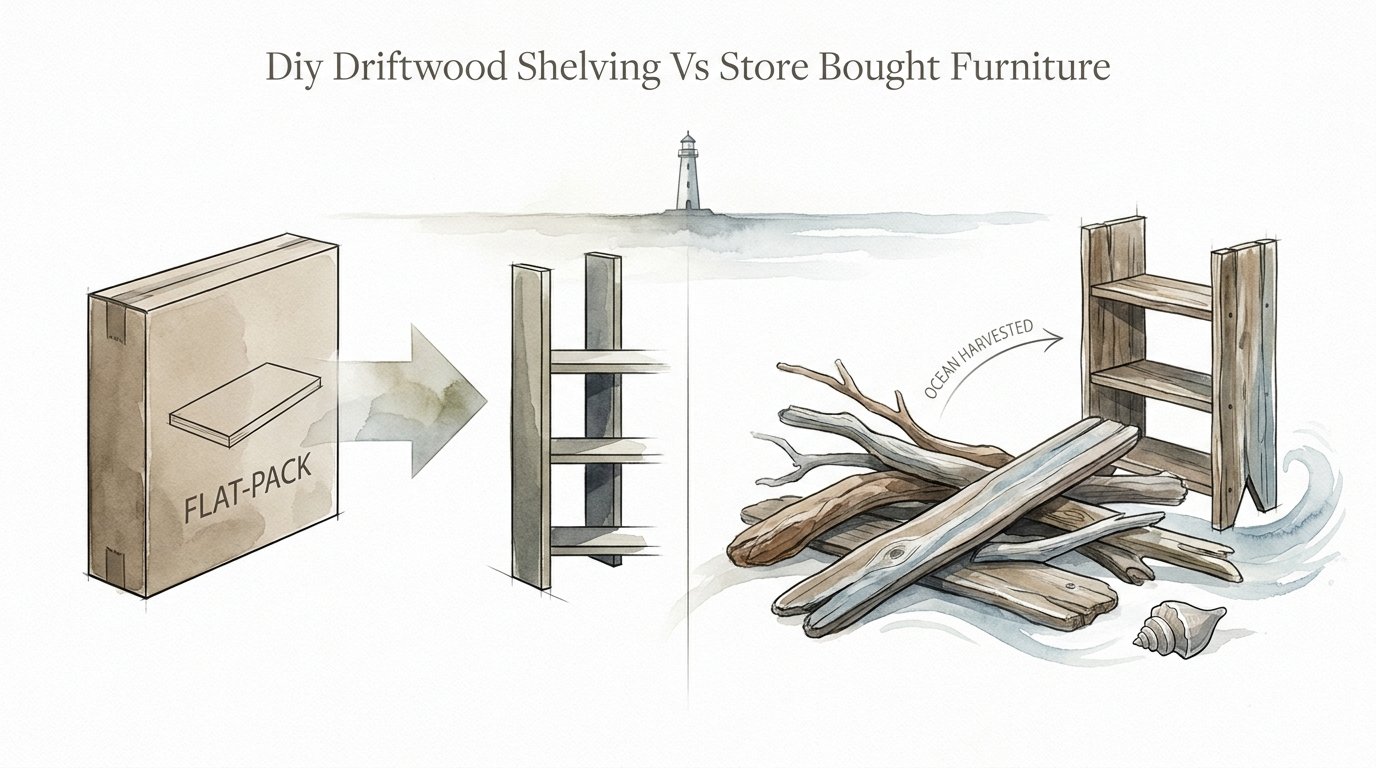
Diy driftwood shelving represents a total departure from the “flat-pack” culture of modern retail. Store-bought furniture exists to fill a void in a room; driftwood shelving exists to fill a void in the spirit. In practical terms, store-bought furniture is defined by its uniformity and its predictable failure points. It is made from Medium Density Fiberboard (MDF) or particleboard, which is essentially sawdust held together by hope and industrial glue. These materials are prone to “creep,” a slow, permanent deformation under constant weight that causes shelves to sag and eventually snap.
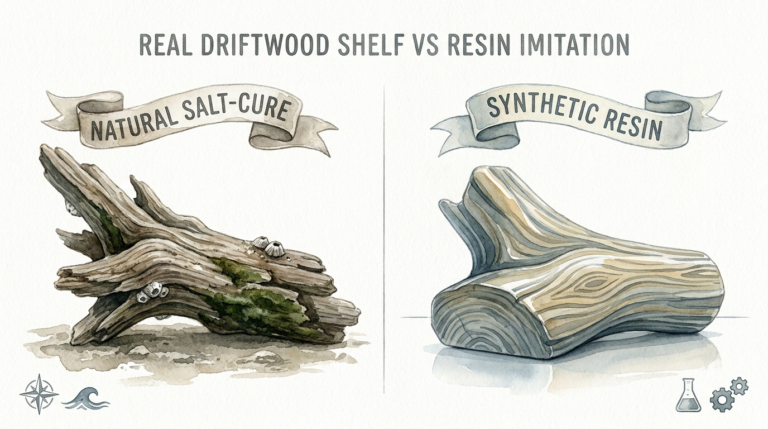
Driftwood, by contrast, is nature’s most rigorous stress test. To become driftwood, a tree must fall, enter the water, and endure years of abrasive contact with rocks and sand. This process leaches out the sugars and resins that attract rot and pests, leaving behind a salt-hardened, sun-bleached skeleton. When you bring this into your home, you are bringing in a material that has already survived the worst the earth has to offer.
While store-bought units are designed to be “invisible” and utilitarian, driftwood shelving is a focal point. It serves the same real-world purpose—holding your books, your tools, or your memories—but it does so with a textured, organic presence that cannot be faked. It is used in spaces where the owner values authenticity over convenience, and where the goal is to create a home that feels like an extension of the natural world rather than a showroom for a corporation.
The Harvest: Finding Wood with Character
The process begins long before you pick up a drill. It begins on the shoreline, where you must learn to distinguish between a rotting log and a piece of ocean-cured treasure. Not all wood found on a beach is suitable for shelving. You are looking for pieces that are “sound”—meaning they are dense, heavy for their size, and free from deep-seated soft rot.
Hardwoods like oak, walnut, or even salt-hardened cedar make the best candidates. When you find a piece, perform the “thump test.” Strike the wood with a stone or another piece of wood. A dull, muffled sound suggests internal decay, while a sharp “clack” indicates the wood is dry and structurally intact.
Environmental ethics play a massive role here. In many regions, driftwood serves as a critical habitat for coastal organisms and acts as a natural buffer against beach erosion. You must act as a steward, not a scavenger. This means understanding the local laws. For instance, in Oregon, visitors are generally allowed to take small amounts of driftwood for personal use, provided it can be carried by hand. In California, state parks often limit collection to 50 pounds or one piece per person per day. Conversely, states like Michigan have strict prohibitions against removing any natural resources from state lands to protect the delicate ecosystem.
How to Prepare Driftwood for the Home
You cannot simply pull a piece of wood from the surf and screw it to your wall. It is currently a sponge for salt, sand, and potentially microscopic hitchhikers. The preparation phase is where the “pioneer-grit” comes in. It is labor-intensive, but it is the difference between a beautiful shelf and a bug infestation in your living room.
The first step is a deep cleaning. You need to remove the surface grime and the deep-seated salt. A pressure washer is effective but must be used with a wide-fan nozzle to avoid “fuzzing” the delicate grain that the ocean worked so hard to reveal. Following the initial wash, the wood must be disinfected. A solution of one part bleach to ten parts water is the standard. Submerge the wood for 12 to 24 hours. This soak kills fungal spores and kills any sand gnats or wood-boring insects that might be nesting in the crevices.
Once the wood is clean, it must be dried. This is the most overlooked step. Wood found on a beach can have a moisture content of 40% or higher. If you mount it while it is wet, it will warp, crack, and potentially pull your anchors right out of the drywall as it shrinks. You can air-dry it in a garage or shed, but this can take months. For the serious practitioner, a homemade kiln—often just a small box with a dehumidifier or a heat lamp—can bring the moisture content down to an acceptable 10% to 12% in a few weeks.
Engineering the Irregular: Mounting Techniques
The greatest challenge of driftwood is its lack of straight lines. A store-bought shelf has a flat back and 90-degree corners; a piece of driftwood is a collection of curves and tapers. To make it functional, you must engineer a way to mount it level and secure.
One of the most effective methods for heavy driftwood is the use of industrial pipe brackets. By mounting 1/2-inch black iron pipe flanges to your wall studs and extending a short length of pipe, you create a “floating” support system. You then drill oversized holes into the back of your driftwood and slide the wood onto the pipes. This allows the wood to rest securely while hiding the hardware.
For lighter, flatter pieces, a French cleat system is the gold standard. You plane a small section of the back of the driftwood flat and attach a beveled strip of wood. This interlocks with a matching strip on the wall. It distributes the weight evenly across the entire length of the shelf and allows for easy removal if you ever need to clean or refinish the wood. Always remember the physics of leverage: the further a shelf extends from the wall, the more “torque” it applies to your fasteners. A shelf mounted into drywall anchors alone is a disaster waiting to happen; you must find the studs.
Benefits of the Hand-Forged Approach
Choosing to build with driftwood offers practical and aesthetic advantages that no retail store can match. The most immediate benefit is the structural integrity of solid wood. While MDF shelves sag under the weight of a dozen hardcover books, a salt-hardened piece of oak or cedar remains rigid for decades. It does not “creep” because its fiber structure is intact and reinforced by years of mineral absorption.
Sustainability is another major factor. Every piece of driftwood you harvest is a piece of furniture that didn’t require a tree to be cut down, processed in a mill, or shipped across an ocean in a container ship. You are essentially recycling the debris of the earth into something functional. This is the ultimate form of low-impact living.
There is also the matter of customization. When you make your own shelving, the furniture fits the room, not the other way around. You can choose a piece that snakes around a corner or fits perfectly into a narrow alcove. The result is a home that feels “built-in” and intentional, reflecting your specific needs and the unique geography of your life.
Challenges and Common Pitfalls
The path of the producer is paved with mistakes. One of the most common errors is underestimating the weight of the wood. A water-logged piece of driftwood can lose half its weight during the drying process, but even when dry, a thick slab of hardwood is heavy. Beginners often use undersized screws or fail to hit the center of the wall stud, leading to a shelf that sags or pulls away from the wall.
Another pitfall is “over-finishing.” It is tempting to sand the driftwood until it is as smooth as a piece of plastic and then coat it in high-gloss polyurethane. This is a mistake. The beauty of driftwood lies in its texture—the silvered patina and the deep grooves carved by the tide. Over-sanding destroys the very “soul” you were trying to capture.
Finally, do not ignore the legalities. Taking wood from protected marine sanctuaries or private property can result in significant fines. Always check the Department of Natural Resources (DNR) or Bureau of Land Management (BLM) guidelines for the specific stretch of beach you are visiting. Respecting the land is part of the craft.
Limitations: When to Buy Instead
While driftwood shelving is superior in character, it is not the right choice for every situation. If you need 50 linear feet of identical shelving for a home library, driftwood is impractical. It is impossible to find fifty pieces of wood with the same dimensions, and the labor required to prepare them would be immense.
Furthermore, driftwood is not ideal for high-hygiene environments like a kitchen pantry where food is stored directly on the surface. Despite deep cleaning, the porous nature of old wood can harbor dust and is difficult to sanitize compared to a sealed, factory-finished surface.
Lastly, there are weight limitations to consider with floating mounts. If you plan to store an entire collection of vinyl records or cast-iron cookware, a single piece of driftwood held by two hidden brackets may not provide the necessary safety margin. In these cases, industrial steel shelving or heavy-duty reinforced cabinetry is a more responsible choice.
Comparison: Flat-Pack vs. Ocean Harvested
To understand the true cost and value, we must look at the data. The following table compares a standard “premium” store-bought floating shelf with a DIY driftwood shelf of similar size.
| Feature | Flat-Pack (Store-Bought) | Ocean Harvested (DIY) |
|---|---|---|
| Material | MDF / Particleboard | Salt-Cured Hardwood |
| Longevity | 3–7 Years (prone to sagging) | 50+ Years (structurally stable) |
| Assembly Time | 15 Minutes | 20–40 Hours (cleaning/drying) |
| Initial Cost | $40 – $120 | $0 (excluding hardware/tools) |
| Resale Value | Near Zero | High (Artisanal Appeal) |
| Ecological Impact | High (Manufacturing/Shipping) | Negligible (Salvaged) |
Practical Tips and Best Practices
If you are ready to begin your first project, start small. Find a piece of wood no longer than two feet to learn the cleaning and mounting process. Use a stainless steel wire brush to remove sand from the cracks; nylon brushes often aren’t enough, and regular steel brushes can leave behind tiny fragments that will rust and stain the wood.
When it comes to the finish, less is more. A simple coat of boiled linseed oil or a beeswax-orange oil blend will darken the wood slightly and bring out the depth of the grain without creating a plastic-like film. This allows the wood to breathe and age naturally. If you must use a sealant in a high-moisture area like a bathroom, opt for a matte-finish water-based poly that won’t yellow over time.
Always use a level during every stage of the installation. Because the wood itself is irregular, you cannot rely on your eyes. Level the mounting hardware on the wall first, then ensure the “seating” area of the wood is trimmed or shimmed so that the top surface remains flat. A shelf that looks level but isn’t will eventually lead to items sliding off or unnecessary stress on the brackets.
Advanced Considerations for the Serious Builder
For those who have mastered the basic shelf, the next step is integrating the wood into the architecture of the room. This might involve hidden LED lighting. By routing a small channel into the underside of the driftwood, you can install a low-profile LED strip that washes the wall in light, highlighting the texture of the wood and the stone of the wall.
Advanced joinery can also be used to combine multiple pieces of driftwood into larger structures. A mortise and tenon joint can connect a vertical “support” branch to a horizontal “shelf” slab, creating a free-standing unit that looks like it grew directly out of the floor. Because driftwood is often brittle, these joints must be cut with extreme precision and reinforced with high-quality waterproof wood glue.
Consider also the use of epoxy resin. If you find a piece of wood with a beautiful shape but a large structural void, you can “cast” the void in clear or tinted resin. This preserves the organic outline of the driftwood while creating a flat, stable surface for smaller objects that might otherwise fall through the cracks.
A Scenario in Practice: The Coastal Study
Imagine a small home office overlooking a bay. The owner wanted shelving that felt like it belonged to the sea. Instead of buying a metal rack, they spent three weekends searching the local coastline after a winter storm. They found three slabs of salt-bleached Douglas fir, each about four feet long and three inches thick.
The slabs were soaked in a trough of bleach-water, then dried in a garage for two months. To mount them, the owner used 10-inch lag bolts with the heads cut off, driven directly into the wall studs. They drilled matching holes into the back of the fir slabs and slid them on. The result was three massive, floating tiers that appeared to be growing out of the drywall. The total cost was less than $30 for the bolts and cleaning supplies, but the value added to the room was immeasurable. The shelves don’t just hold books; they hold the memory of the storm that brought them to shore.
Final Thoughts
Building with driftwood is an exercise in patience and a tribute to the power of the natural world. It forces you to slow down—to wait for the wood to dry, to scrub away the grit, and to solve the puzzles that irregular shapes present. In doing so, you move away from the “disposable” mindset that defines so much of modern life and move toward a philosophy of stewardship and craftsmanship.
The result is more than just a place to put your keys. It is a physical manifestation of your ability to see value where others see debris. It is a reminder that the most beautiful things are often the ones that have been weathered, beaten, and shaped by forces larger than ourselves.
Go to the water. Find your story. Bring it home and give it a place on your wall. You will find that the work of your own hands provides a satisfaction that no store-bought receipt can ever offer. Experiment with different woods, refine your mounting techniques, and let the ocean be your primary supplier. Your home—and your soul—will be better for it.
Sources
1 ashdeco.com (https://ashdeco.com/blogs/buying-guides/floating-shelf-weight-limit-guide) | 2 99wfmk.com (https://99wfmk.com/michigan-driftwood-collection-rules/) | 3 dksstores.com (https://dksstores.com/blog-post67) | 4 wikihow.com (https://www.wikihow.com/Clean-Driftwood) | 5 parklanejewelry.com (https://www2.parklanejewelry.com/how-to-clean-driftwood/) | 6 aprettyfix.com (https://aprettyfix.com/disinfect-driftwood/) | 7 youtube.com (https://www.youtube.com/watch?v=qACOt05YMAo) | 8 revitbuildersworkshop.com (https://revitbuildersworkshop.com/blogs/diy/is-it-cheaper-to-build-your-own-shelving-units-heres-what-you-need-to-know) | 9 spryinterior.com (https://www.spryinterior.com/blogs/news/which-of-the-shelves-will-support-the-greatest-weight)