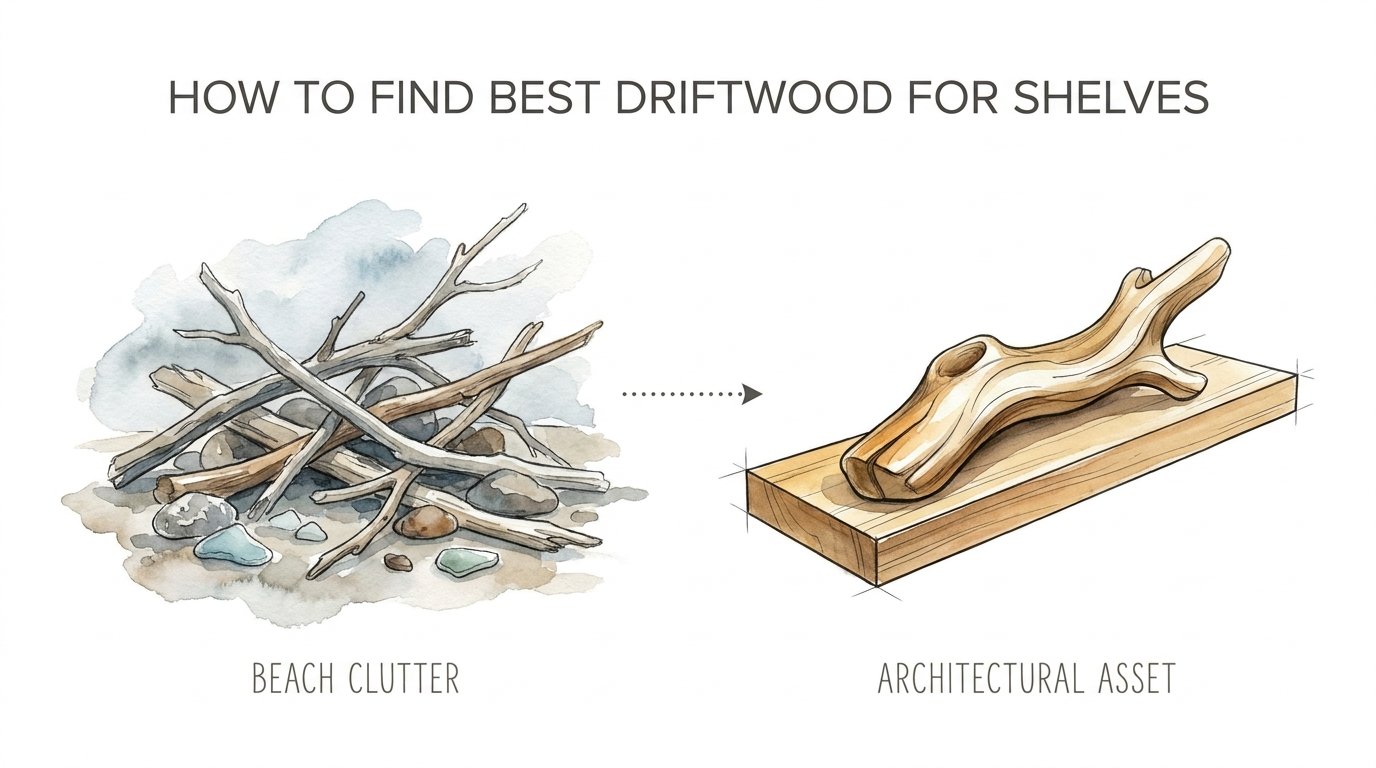
How To Find Best Driftwood For Shelves
Most beachgoers see a tripping hazard, but the craftsman sees a $400 architectural anchor waiting to be claimed. What if the ‘junk’ you trip over during your morning walk is actually the high-end timber your home is missing? Learn to spot the density and structural integrity hidden under that weathered exterior. Turning shoreline nuisance into a living room asset is the ultimate DIY win.
[affiai]The transformation from salt-crusted debris to a high-end interior element requires more than a keen eye; it demands a fundamental understanding of wood anatomy and the transformative power of environmental curing. While the average person overlooks the grey, gnarled limbs littering the tideline, a serious practitioner understands that these pieces have survived a brutal natural selection process. Only the densest, most resilient fibers remain after months or years of oceanic battering.
Bringing these elements into your home connects your living space to the raw power of the sea. It is a pursuit that blends the patience of a beachcomber with the precision of a master carpenter. Whether you are looking to create a single focal-point mantle or a series of rugged, floating book repositories, the journey begins with knowing exactly what to look for before you even pick up a piece of timber.
How To Find Best Driftwood For Shelves
Finding the right material for a structural shelf requires looking past the surface aesthetics to evaluate the mechanical properties of the wood. Not every piece of wood on the beach is a candidate for furniture. You are looking for specimens that have been “salt-cured” and sun-bleached, but which still retain their core density.
To identify the best candidates, you must first understand the species common to your coastline. On the West Coast of North America, you will frequently encounter Western Red Cedar, Sitka Spruce, and Douglas Fir. These are prized for their natural rot resistance and high strength-to-weight ratios. On the Atlantic coast, you might find weathered Oak, Pine, or even exotic “drift lumber” like Mahogany or Teak that has fallen off cargo ships.
Density is your primary metric for success. A simple way to test this in the field is the “Thud vs. Clink” test. Strike the wood with a small stone or another piece of hardwood. A hollow “thud” indicates internal rot or a soft species like Pine that has become waterlogged and spongy. A sharp, resonant “clink” suggests a dense, tight-grained hardwood or a highly compressed softwood that has retained its integrity.
Visual cues also provide vital information. Look for wood where the soft sapwood has already been eroded away by the sand and surf, leaving only the rugged, dark heartwood exposed. Heartwood is the dead inner core of the tree that contains high concentrations of extractives—natural chemicals that protect the wood from decay. If a piece of driftwood has maintained its shape despite years in the surf, it is likely heartwood-dominant and perfect for a shelf that needs to bear weight.
The Restoration Pipeline: From Shore to Shelf
Once you have secured a piece of high-potential timber, the real work begins. You cannot simply bolt a piece of raw beach wood to your wall without a rigorous treatment process. The wood is currently a host for three things you do not want in your home: salt, pests, and moisture.
Desalting is the most critical and often overlooked step. Wood is naturally hygroscopic, meaning it absorbs moisture from the air. Salt trapped within the wood fibers accelerates this process, causing the wood to “sweat” in humid conditions. This moisture can ruin your wall paint and corrode any metal mounting hardware. To desalt the wood, submerge it in a large trough of fresh water. Change the water every 24 to 48 hours for at least a week. This “leaching” process draws the salt out of the cellular structure.
Sanitization follows the desalting phase. Create a solution of one part household bleach to ten parts water and soak the wood for another 24 hours. This kills mold spores, bacteria, and hidden insects like shipworms or sand gnats. For smaller pieces, some craftsmen prefer boiling the wood for several hours, which effectively sterilizes the core.
Drying requires the most patience. After the soaking cycles, the wood must reach an internal moisture content of 6% to 8% before it can be finished. This can take months in a climate-controlled shop or several weeks in a DIY kiln. Rushing this step leads to warping and cracking once the shelf is mounted. Use a pin-style moisture meter to verify that the core is truly dry before proceeding to the sanding and finishing stages.
Benefits of Using Sea-Cured Architectural Assets
Choosing driftwood over kiln-dried lumber from a big-box store offers several distinct advantages that appeal to both the aesthetic-minded homeowner and the sustainability-conscious builder.
First and foremost is the “Pre-Stressed” nature of the material. Driftwood has already survived the most extreme conditions nature can throw at it—extreme UV exposure, mechanical abrasion from sand, and chemical saturation from salt. This means the wood is incredibly stable. Unlike “green” lumber, which may twist or bow as it dries in your home, a properly treated piece of driftwood has already done all the moving it is ever going to do.
Another significant benefit is the unique surface texture, often referred to as “silvering.” This grey patina is the result of sunlight breaking down the lignin in the wood’s surface cells. It is a look that is nearly impossible to replicate perfectly with stains or chemical aging treatments. When you use driftwood, you are utilizing a finish that took years of natural processing to achieve.
From a practical standpoint, driftwood shelves are a form of radical upcycling. You are taking a material that municipalities often pay to remove from beaches and turning it into a high-value asset. This reduces the demand for newly harvested timber and keeps functional carbon locked away in your home’s architecture rather than allowing it to rot and release CO2 on a beach.
Challenges and Common Pitfalls
The most common mistake beginners make is falling in love with a piece of wood that is “punky.” Punky wood is timber that has begun to rot at a cellular level, often due to fungal growth. It may look beautiful and gnarled, but it has the structural integrity of a cracker. If you can press your thumbnail into the wood and leave a deep indentation, or if pieces of the grain flake off with minimal pressure, the wood is not fit for a shelf.
Hidden hardware is another frequent challenge. “Drift lumber”—pieces of wood that were once part of ships, docks, or pallets—often contains deeply embedded, rusted nails or screws. These can destroy an expensive saw blade or planer knife in a split second. Always scan your finds with a high-sensitivity metal detector before you begin any mechanical surfacing or cutting.
Sand infiltration is a subtle but persistent enemy. Waves drive fine silica sand deep into the cracks and pores of the wood. This sand acts as a high-grit abrasive that dulls chisels and sandpaper almost instantly. A thorough pressure washing while the wood is still wet from the desalting soak is necessary to dislodge as much of this grit as possible.
Limitations and Environmental Constraints
While driftwood is a versatile material, it is not a universal solution for every shelving need. One major limitation is weight capacity relative to thickness. Because driftwood is often irregular in shape, calculating the load-bearing capacity is more difficult than with a standard 2×10 plank. You must always over-engineer your mounting solution to account for potential hidden weaknesses in the grain.
Environmental factors also play a role in the legality of your harvest. Many coastal regions, particularly National Parks and Marine Sanctuaries, have strict laws against the removal of any natural material. Driftwood plays a vital role in coastal ecosystems by providing habitat for birds and stabilizing sand dunes. Always check local regulations before you begin your hunt. In many jurisdictions, you are limited to a certain poundage per day or require a personal-use permit.
Additionally, the “salt-cured” nature of the wood means it may never be suitable for direct contact with sensitive items. Even after a thorough desalting, trace amounts of minerals may remain. It is generally not recommended to use driftwood for food-prep surfaces or to store high-value, unsealed paper archives directly on the wood without a protective barrier or a very thick, non-porous finish like epoxy.
Optional Comparison: Driftwood vs. Reclaimed Barn Wood
When deciding on a rustic aesthetic for your shelving, it is helpful to compare the two heavyweights of the “found wood” world: Driftwood and Reclaimed Barn Wood.
| Feature | Driftwood | Reclaimed Barn Wood |
|---|---|---|
| Primary Texture | Smooth, rounded, silver-grey patina. | Rough-sawn, dark brown or red, often with nail holes. |
| Internal Stress | Low (pre-stressed by ocean). | Moderate (prone to hidden cracks/checks). |
| Preparation Difficulty | High (requires desalting and long drying). | Medium (requires de-nailing and kiln treatment). |
| Structural Predictability | Low (irregular shapes). | High (usually standard dimensions). |
Practical Tips for a Flawless Installation
Mounting an irregular piece of driftwood requires a departure from standard shelf brackets. To achieve the “floating” look that best showcases the wood’s natural form, use heavy-duty steel rebar or specialized blind shelf supports.
Start by creating a “flat” on the back of the wood where it will meet the wall. Use a drawknife or a power planer to remove just enough material to create a stable, vertical surface. This ensures the shelf doesn’t rock or lean once mounted. If the wall is uneven, you may need to “scribe” the back of the wood to match the specific contours of your drywall.
When drilling the holes for your supports, use a drill guide. Because driftwood is rarely a perfect rectangle, it is easy to drill your holes at a slight angle, which will cause the shelf to sit crooked. A laser level is your best friend during this stage. Mark your stud locations precisely; for a heavy driftwood slab, you must hit at least two studs to ensure the shelf doesn’t pull out of the wall under load.
For finishing, less is usually more. A high-quality matte polyurethane or a natural tung oil will protect the wood without hiding the silver-grey patina you worked so hard to preserve. If you want to deepen the color, a “Danish Oil” can bring out the rich ambers and browns hidden beneath the sun-bleached surface.
Advanced Considerations: Structural Stabilization
For pieces that are aesthetically perfect but structurally questionable, advanced stabilization techniques are required. Pentacryl, a wood stabilizer, can be used to displace water in green or waterlogged wood, preventing it from cracking as it dries. This is particularly useful for large “root wad” sections that have complex, multidirectional grain.
If you encounter a piece with beautiful “voids” or deep cracks that threaten its integrity, consider an epoxy resin fill. Clear resin allows you to see the internal details of the wood while providing a rock-hard structural bond. This technique turns a fragile piece of “junk” into a composite material that is often stronger than the original wood.
Vacuum chamber stabilization is another option for the serious practitioner. By placing the wood in a vacuum with a specialized stabilizing resin, you can force the resin into the very center of the wood’s cellular structure. Once cured, the wood becomes virtually waterproof and significantly more dense, making even softer species like Pine suitable for heavy-duty shelving.
Examples and Scenarios
Consider the “Atlantic Oak Mantle” scenario. A craftsman finds a four-foot section of a shipwrecked oak piling. The exterior is gnarled and covered in old bolt holes, but the core is solid. By desalting the piece for two weeks and then power-washing the grit from the bolt holes, they reveal a piece of history. Instead of hiding the holes, they leave them as “character marks,” using them as the entry points for the floating shelf hardware. The result is a 100-pound mantle that looks like it grew out of the wall.
In another scenario, a DIYer finds several thin planks of Western Red Cedar. These are too thin for a heavy mantle but perfect for a series of “spice shelves” in a coastal-themed kitchen. By using a light bleach soak to turn the wood a uniform bone-white, they create a minimalist, modern look. Because the cedar is naturally oily and moisture-resistant, it thrives in the humid environment of the kitchen without warping.
These examples illustrate the versatility of the material. Whether you are dealing with a massive timber or a collection of small branches, the key is matching the project to the wood’s inherent strengths.
Final Thoughts
Mastering the art of finding and treating driftwood for architectural use is a rewarding blend of environmental stewardship and high-level craftsmanship. It forces you to slow down, to walk the shore with intent, and to see the potential in what others have discarded. By following a rigorous process of desalting, sanitizing, and drying, you transform a coastal nuisance into a permanent part of your home’s story.
The result is more than just a place to store books or display photos. A driftwood shelf is a physical anchor to the natural world. It carries the weight of the ocean and the heat of the sun into your living room, providing a textural depth that no factory-made furniture can match.
As you begin your journey into the world of shoreline scavenging, remember to respect the ecosystem and the laws that protect it. Take only what you need, treat it with the respect that aged timber deserves, and do not be afraid to experiment. Each piece of wood has spent years waiting for the right craftsman to see its true value. It is time to go out and find your next architectural anchor.
Sources
1 youtube.com (https://www.youtube.com/watch?v=aFWLyAPowMA) | 2 kuer.org (https://www.kuer.org/podcast/treenote/2025-09-11/how-driftwood-connects-the-forests-to-the-seas) | 3 kuksa.shop (https://www.kuksa.shop/en/blog/driftwood/) | 4 hawk-hill.com (https://www.hawk-hill.com/diy-floating-driftwood-shelf/) | 5 noaa.gov (https://repository.library.noaa.gov/view/noaa/41462/noaa_41462_DS1.pdf)