Driftwood Shelf Wall Layout Ideas
A pile of wood is a mess, but a pattern of wood is a system. Don’t let your beachcombing treasures sit in a corner collecting dust. Applying the logic of vertical spacing and geometric patterns helps you turn a chaotic pile of ‘sticks’ into an intentional, high-performance storage gallery that breathes life into your home. This transition from raw debris to a functional display requires a steady hand and a clear vision.
[affiai]You have likely spent hours walking the shoreline, picking up pieces that felt right in your palm. These fragments of history, weathered by salt and tide, deserve more than a dark box in the garage. Transforming them into wall shelving is an act of preservation that honors the journey of the wood while serving your modern needs.
Understanding how to arrange these natural forms is the difference between a cluttered wall and a curated masterpiece. We will explore the mechanics of layout, the grit of installation, and the wisdom of choosing the right piece for the right purpose. Every knot and curve has a role to play if you know where to place it.
Driftwood Shelf Wall Layout Ideas
A driftwood shelf wall is a curated arrangement of reclaimed marine timber mounted to a vertical surface for the purpose of display or storage. Unlike standard lumber, driftwood brings irregular edges and unique textures that challenge traditional shelving norms. These systems exist to bridge the gap between the rugged outdoors and the structured interior of a home.
In real-world applications, these layouts serve as focal points in living rooms, functional organizers in entryways, or serene accents in bathrooms. Think of a well-planned driftwood gallery as a shoreline frozen in time. Instead of random placement, we use specific geometric strategies to guide the eye and balance the weight of the room.
The Anchored Asymmetry
This layout uses one heavy, “anchor” piece of wood placed off-center. Smaller, more delicate pieces then orbit this central mass at varying heights. It mimics the natural way debris settles against a rock on the coast. This style works best for art displays where the wood itself is the primary attraction.
The Symmetrical Grid
Using driftwood for a grid requires selecting pieces with relatively straight “shelving” surfaces. You align these in parallel rows, often staggering the ends to maintain an organic feel while following a strict vertical spacing logic. It provides a sense of order and is ideal for book collections or uniform glass jars.
The Spiral Staircase
Mounting short, thick segments of driftwood in a rising diagonal creates a “staircase” effect. This draws the eye upward and is a classic technique for narrow walls or corners. Each “step” offers a small platform for a single meaningful object, like a piece of sea glass or a small succulent.
How to Prepare and Mount Your Gallery
Success in this project starts long before you reach for the drill. You must respect the material and understand that wood pulled from the water carries moisture, salt, and sometimes unwanted hitchhikers. Following a rigorous preparation process ensures your shelves last for generations without warping or rotting.
Step 1: Sanitization and Cleaning
Scrub the wood vigorously with a stiff-bristled brush to remove sand, loose bark, and dried salt. After the initial scrub, submerge the pieces in a solution of one part bleach to nine parts water. Let them soak for at least 24 hours to neutralize bacteria and insects hiding in the grain.
Step 2: Controlled Drying
Place the wood in a well-ventilated area out of direct sunlight. Drying driftwood too quickly in high heat can cause deep cracks or “checking.” Allow the wood to season for at least one to two weeks until it feels light and rings hollow when tapped.
Step 3: Surface Refinement
Use medium-grit sandpaper to smooth out any “splinter-prone” areas without erasing the character of the wood. Applying a coat of linseed oil or beeswax will nourish the fibers and bring out the deep greys and ambers hidden by the salt crust.
Step 4: Choosing the Mounting Hardware
Heavy pieces require sturdy intervention. Floating shelf brackets made of black steel pipe or internal rod systems are preferred for a “clean” look. For lighter decorative sticks, simple eye-hooks and high-tensile twine can create a suspended, nautical aesthetic.
Benefits of a Systematic Wall Gallery
Choosing a systematic layout over a random jumble offers measurable improvements to both the home’s atmosphere and the longevity of the wood. A planned system distributes weight across wall studs effectively, preventing drywall damage and shelf failure.
Structural integrity is the primary advantage. When you apply the logic of vertical spacing, you ensure that every piece is anchored into a stud or a high-capacity toggle bolt. This allows the shelf to hold actual weight—books, lamps, or ironware—rather than just acting as a fragile ornament.
Visual clarity is another major benefit. A chaotic pile of wood absorbs light and creates visual noise. An intentional gallery uses “white space” between the pieces to let the unique silhouette of each driftwood branch stand out. This turns the wall into a conversation piece rather than a cluttered corner.
Challenges and Common Mistakes
The most frequent error is failing to account for the “eccentric loading” of irregular wood. Standard shelves have flat backs; driftwood does not. If the back of the wood is rounded, it will want to rotate downward when you place an object on it. You must “scribe” or flatten the back of the wood where it meets the wall to ensure a flush, stable fit.
Another pitfall is ignoring the weight-to-density ratio of different woods. A piece of Mopani driftwood is significantly heavier than a piece of Pine driftwood of the same size. Attempting to hang dense African hardwoods with simple adhesive strips or small nails is a recipe for a broken floor and shattered treasures.
Neglecting the “critter check” is a mistake that haunts many beginners. Driftwood can harbor wood-boring beetles that remain dormant for months. Skipping the bleach soak or the heat-treating process can introduce these pests into your home’s structural framing.
Limitations of Driftwood Shelving
Driftwood is not a universal solution for every storage need. Because it is weathered, the internal structure may be compromised by years of saturation. It should not be used as a primary support for heavy items like televisions or large kitchen mixers unless the wood is exceptionally thick and confirmed to be rot-free.
Environmental constraints also play a role. In high-humidity areas like bathrooms, untreated driftwood can absorb moisture and develop mold. This requires a much more robust sealing process, such as multiple coats of marine-grade polyurethane, which may alter the “natural” matte look of the wood.
Wall type is the final limitation. Plaster-and-lath walls in older homes are brittle and may crack under the focused pressure of heavy driftwood brackets. In these cases, a “ledger board” system—where the driftwood is mounted to a secondary piece of flat timber which is then secured to the wall—is often necessary.
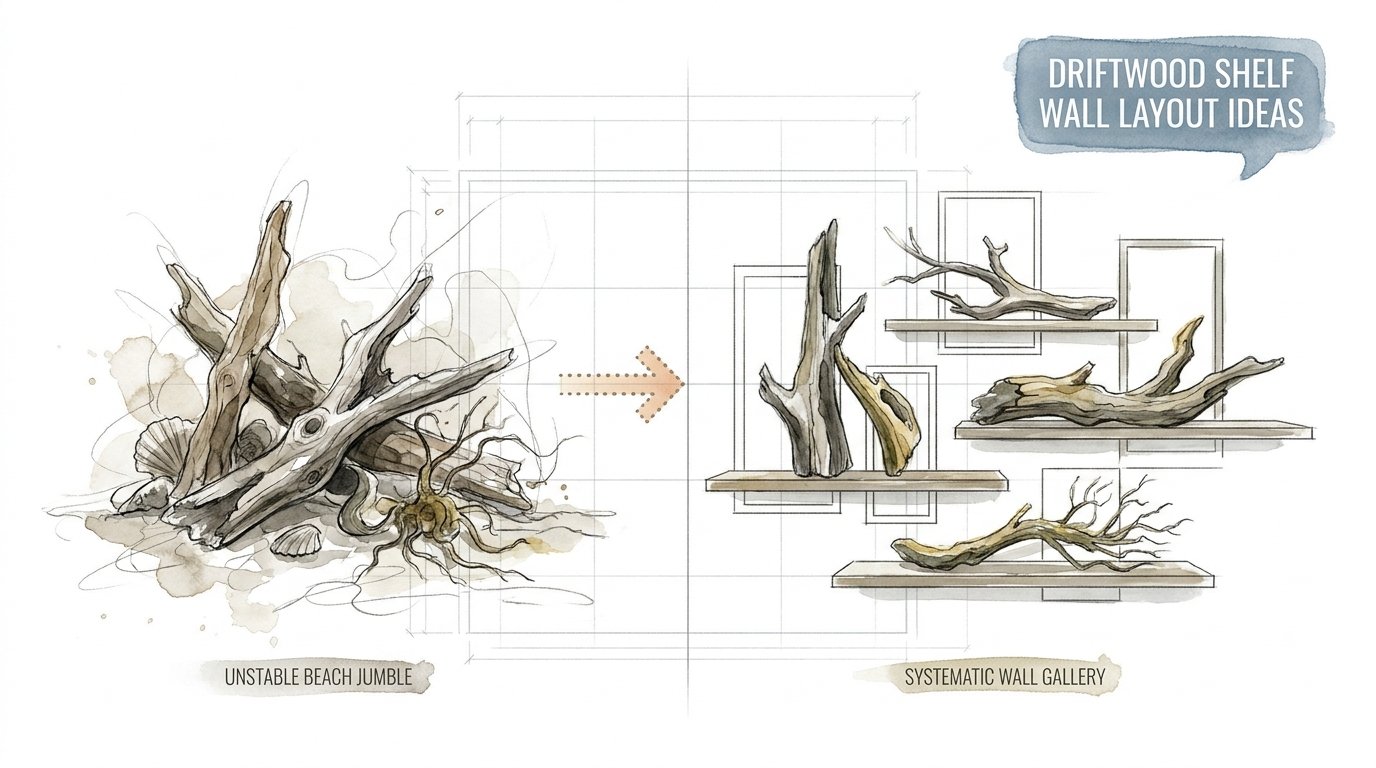
Comparison: UNSTABLE BEACH JUMBLE vs SYSTEMATIC WALL GALLERY
| Factor | Unstable Beach Jumble | Systematic Wall Gallery |
|---|---|---|
| Safety | High risk of falling or shifting. | Securely anchored to wall studs. |
| Function | Purely decorative/clutter. | Usable storage for various items. |
| Maintenance | Difficult to dust or clean around. | Easy access for cleaning and care. |
| Visual Impact | Chaotic, messy, and distracting. | Sophisticated, intentional, and artistic. |
Practical Tips for a Better Layout
Start by laying your entire collection out on the floor. This “mock-up” allows you to move pieces around without putting unnecessary holes in your drywall. Use a measuring tape to define the boundaries of your wall space on the floor so you know exactly how the pieces will fit together.
Keep a level and a stud finder close at hand. Natural wood is rarely straight, which can trick your eyes into thinking a shelf is level when it is actually slanted. Rely on the bubble in your level rather than your perspective to ensure your items don’t slide off the wood.
Vary the orientations of your pieces to keep the eye moving. Mixing horizontal planks with vertical “sentinel” pieces creates a dynamic energy. Using a combination of thick, blocky wood and thin, spindly branches adds a sense of depth that makes the gallery feel three-dimensional.
Advanced Considerations for Serious Builders
Serious practitioners often integrate lighting into their driftwood systems. Small LED puck lights or recessed strips can be hidden behind the irregular edges of the wood. This creates a “glow” effect that highlights the texture of the grain and turns the shelving into a night-time art piece.
Consider the species of wood you are using. Mopani and Malaysian driftwood are dense and often sink in water; they are excellent for heavy-duty shelving. Manzanita or Spiderwood are more “branchy” and better suited for lightweight air plants or jewelry organization.
Think about modularity. Using “french cleats” to mount your driftwood allows you to swap pieces in and out as your collection grows. This professional-grade mounting technique provides extreme strength while allowing the entire layout to evolve without re-drilling the wall.
Examples of Driftwood Systems in Practice
In a coastal entryway, a single long piece of sun-bleached cedar can be fitted with forged iron hooks. This serves as a heavy-duty coat rack while a flat “ledger” piece above it holds keys and outgoing mail. The system is rugged enough for wet jackets but refined enough for a modern home.
A bathroom gallery might use three staggered pieces of Mopani wood to hold rolled towels and small glass jars of sea salts. The moisture-resistant nature of these dense woods, when sealed with wax, makes them perfect for the humid environment.
In a minimalist living room, a “floating triptych” of three identical-length driftwood planks provides a place for a book collection. The silver-grey patina of the wood contrasts sharply against a dark charcoal wall, creating a high-end look using materials found for free on a morning walk.
Final Thoughts
Building a driftwood shelf wall is more than a weekend craft project. It is a way to bring the raw, unyielding spirit of the wilderness into your living space through careful organization. Taking the time to clean, season, and mount your wood properly ensures that your gallery remains a source of pride rather than a source of dust.
Experimenting with different layouts on the floor before you commit to the wall is the best way to find a balance that works for your specific home. Whether you choose a rigid grid or a flowing asymmetrical cluster, remember that the wood’s history is part of the charm. Let the knots, holes, and scars tell their story.
The journey from the beach to the bedroom is long, but the results are worth the effort. By treating your treasures with the respect of a system, you create a home that feels grounded, intentional, and deeply connected to the natural world. Pick up your tools and begin the transformation today.
Sources
1 hawk-hill.com (https://www.hawk-hill.com/how-to-clean-driftwood/) | 2 threepsandq.com (https://threepsandq.com/2018/08/07/projects-driftwood-part-i-sorting-and-cleaning/) | 3 wikihow.com (https://www.wikihow.com/Preserve-Driftwood) | 4 lakewedoweelife.com (https://www.lakewedoweelife.com/lake-life/driftwood-art-and-treasures-by-tammy-lovvorn) | 5 specialeditionart.com (https://specialeditionart.com/blogs/theoracle/how-to-hang-driftwood-on-your-wall-a-comprehensive-guide) | 6 hawk-hill.com (https://www.hawk-hill.com/diy-floating-driftwood-shelf/) | 7 ourfifthhouse.com (https://ourfifthhouse.com/2018/03/simple-guide-getting-gallery-wall-right/) | 8 youtube.com (https://www.youtube.com/watch?v=o8n0DzWf4cY) | 9 bunnycart.com (https://www.bunnycart.com/blog/driftwood-everything-you-need-to-know/) | 10 stackexchange.com (https://diy.stackexchange.com/questions/155521/load-bearing-wall-shelving-suggestions) | 11 hygger-online.com (https://www.hygger-online.com/choose-the-best-driftwood-before-building-aquariums/)