Diy Kinetic Driftwood Garland
The ocean gave this wood life through movement; why are you nailing it down? Stop treating your beach finds like dead museum specimens. Using the ‘Free-Axis’ lashing technique, you can turn a basic garland into a kinetic sculpture that responds to the air currents in your home. Watch your decor come to life with the rhythm of the sea.
[affiai]Coastal living is more than just a color palette of blues and sandy beiges. It is a relationship with the elements. When you find a piece of driftwood, you are holding the physical record of a thousand storms and miles of tide. Standard DIY projects tell you to glue these pieces to a frame or stack them into a rigid tower. This approach kills the very spirit of the wood. A kinetic driftwood garland honors the journey the wood took to reach your hands by allowing it to keep moving.
Movement in the home softens the edges of a room. Natural sculptures that twist and sway provide a focal point that is never the same twice. This guide will walk you through the mechanics of the Free-Axis lashing, the physics of balance, and the grit required to build something that lasts.
Diy Kinetic Driftwood Garland
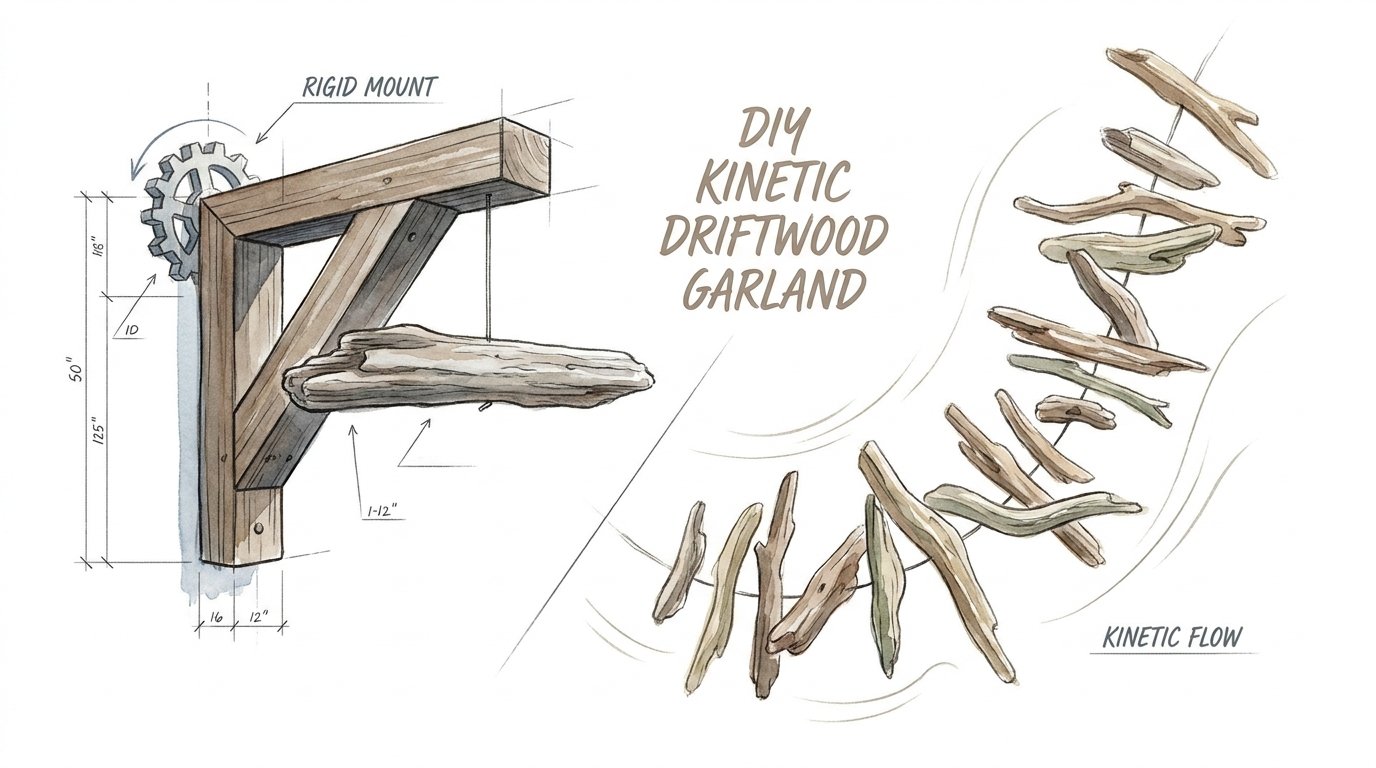
A DIY kinetic driftwood garland is a vertical or horizontal assembly of weathered wood pieces linked by a specialized lashing that allows for independent rotation. Unlike a standard beaded garland where pieces are restricted by the cord passing through them, a kinetic version treats every piece of wood as a separate rotor. This setup captures even the slightest internal drafts, turning a simple wall hanging into a living installation.
These sculptures exist at the intersection of maritime history and modern kinetic art. In the real world, sailors used similar lashing techniques to secure spars while allowing for the flex of the ship. In your home, this translates to a piece of decor that does not just sit there—it performs. You might see these in high-end coastal galleries or hanging from the porches of weather-beaten beach shacks. They serve as visual barometers for the air movement in a space, providing a tactile connection to the outdoors.
Visualizing this is simple. Think of a wind chime that makes no noise but tells a story through shadow and light. Every piece of wood is a pivot point. The Free-Axis technique ensures that no single piece of wood is “locked” in place, allowing the entire structure to ripple like a kelp forest in a current.
How the Free-Axis Lashing Works
The core of this project is the lashing. Standard knots like the square knot or the overhand knot create friction that stops movement. The Free-Axis lashing is a variation of the shear lashing, designed specifically to provide a pivot point rather than a rigid bond. It functions as a flexible joint, similar to a universal joint in a vehicle.
Select a cordage that offers high tensile strength but low surface friction. Waxed linen or high-test hemp cord is ideal. The lashing involves creating a series of loose wraps around the wood that are then “frapped”—tightened around the cord itself—to create a captive loop. This loop acts as a bearing. The wood can spin 360 degrees within the loop without the cord twisting or tangling.
Balancing these pieces requires an understanding of the center of gravity. Each piece of driftwood is unique in density and shape. To achieve a fluid flow, you must find the natural balance point of every individual stick before lashing. Drilling a hole exactly through the center of mass ensures that the wood hangs level. If you miss the mark, the piece will dip, creating a “heavy” look that disrupts the kinetic rhythm of the garland.
Benefits of Kinetic Flow
Kinetic decor offers a psychological benefit that static art cannot match. Humans are hardwired to notice movement; it is a primal survival instinct. When that movement is slow, predictable, and natural, it induces a state of “soft fascination.” This state is known to reduce stress and improve mental clarity. A kinetic driftwood garland brings the pacing of the ocean into the frantic environment of a modern home.
Durability is another major advantage. Rigidly mounted wood is susceptible to cracking as humidity levels change. Driftwood is particularly porous and expands or contracts with the seasons. A lashed kinetic sculpture allows the wood to “breathe” and move. Because it is not pinned down, the stress of wood movement is absorbed by the cordage rather than the wood grain itself, preventing splits.
Spatial versatility makes these garlands fit where other art won’t. You can hang a vertical garland in a narrow corner, a stairwell, or a window frame. The vertical orientation utilizes unused air space, drawing the eye upward and making small rooms feel taller. Because they respond to air, they are perfect for placement near HVAC vents or open windows, where they can act as a silent visual fan.
Challenges and Common Mistakes
The most frequent error is failing to cure the wood properly. Freshly found driftwood is often saturated with salt, sand, and microscopic organisms. If you lash “raw” wood, the salt will eventually draw moisture from the air, rotting your cordage and leaving white crusty deposits on your floors. Proper preparation takes time but is non-negotiable for a professional result.
Weight distribution is the second hurdle. Beginners often try to put the largest, heaviest pieces at the top. This creates a high center of gravity for the entire garland, making it prone to swinging wildly rather than rotating gracefully. A stable kinetic sculpture follows a “pyramid” weight distribution. Put your heaviest, most stable pieces at the bottom to act as a keel, providing tension that keeps the upper rotors aligned.
Tangling is a reality for any multi-part sculpture. If the gap between your wood pieces is too small, they will bump into each other and lock up. You need “air” between the rotors. A good rule of thumb is to leave a gap equal to 1.5 times the width of the widest piece of wood in that section. This ensures that even during a gust, the pieces can pass each other without catching.
Limitations of the Medium
Kinetic driftwood sculptures are not suited for high-traffic outdoor areas without significant maintenance. Constant wind will eventually fray even the best hemp cord. If you plan to hang your garland on a porch, you must use UV-resistant marine-grade twine or stainless steel wire. Natural fibers will bleach and snap within a single season under direct sun and salt spray.
Weight is a structural constraint. Driftwood may look light and airy, but a five-foot garland can easily weigh ten to fifteen pounds depending on the wood species. You cannot simply hang this from a plastic adhesive hook. It requires a secure ceiling anchor or a heavy-duty wall bracket. Always check the load-bearing capacity of your hardware before installation.
Environmental sensitivity is also a factor. In very dry climates, driftwood can become brittle. Without the occasional humidity of the coast, the wood may begin to flake or “dust.” If you live in an arid region, you might need to treat the wood with a light coat of beeswax or linseed oil to keep the fibers bound together. This adds weight, which will change the kinetic response of the piece.
Rigid Mount vs. Kinetic Flow
Deciding between a fixed display and a moving one depends on your space and your intent. A rigid mount is a statement of permanence, while a kinetic flow is a statement of transition.
| Feature | Rigid Mount | Kinetic Flow |
|---|---|---|
| Movement | None; Static | High; 360-degree rotation |
| Installation Complexity | Low (Glue/Nails) | High (Lashing/Balancing) |
| Visual Interest | Consistent | Dynamic / Ever-changing |
| Stress Resistance | Low (Prone to cracking) | High (Flexes with wood) |
| Skill Level | Beginner | Intermediate |
Practical Tips for Success
Start your project at the beach. When gathering wood, look for “bored” wood—pieces that have been naturally tunneled by shipworms. These pieces have built-in textures and often have lower density, making them incredibly responsive to light breezes. Collect more than you think you need. You will want a variety of lengths and thicknesses to play with the visual weight of the sculpture.
Cleaning is the most important step for indoor longevity. Soak your finds in a tub of fresh water for 48 hours to leach out the salt. Change the water twice. Following the soak, use a stiff nylon brush to scrub away any loose bark or hitchhiking organisms. Dry the wood in a sunny, well-ventilated spot for at least two weeks. Wood that feels dry to the touch can still be damp in the core.
When drilling your pilot holes, use a drill press if possible to ensure the hole is perfectly vertical. If you are using a hand drill, clamp the wood and use a bubble level. A crooked hole will cause the wood to wobble on its axis, which creates friction and kills the kinetic movement. Sand the edges of the holes with a small bit of rolled-up sandpaper to prevent the wood from cutting into your cordage over time.
Advanced Considerations
Serious practitioners often incorporate “found metal” into their kinetic garlands. Adding a rusted washer or a bit of sea-worn copper between wood segments can act as a secondary pivot or a weight. This changes the rotational speed of the pieces. Metal is denser than wood; placing a metal weight at the very bottom of the garland increases the “swing” period, making the movement more majestic and less twitchy.
Experiment with asymmetrical balance. Not every piece of wood needs to be drilled in the center. By drilling closer to one end, you create a “lever arm.” An asymmetrical rotor will catch more wind on the long end, causing it to spin more aggressively. If you alternate symmetrical and asymmetrical pieces, you create a complex visual counterpoint where different parts of the garland move at different speeds.
Cordage choice can be upgraded for performance. Braided fishing line (80lb test or higher) is nearly invisible and has almost zero friction. However, it lacks the “pioneer” aesthetic of hemp or jute. A professional trick is to use a core of high-strength synthetic line for the structural load and “wrap” it with natural fibers for the look. This gives you the beauty of the old world with the reliability of the new.
Example Scenario: The Entryway Installation
Consider an entryway with a ten-foot ceiling. A standard piece of art would get lost on such a large wall. Instead, you build a vertical kinetic garland using twenty-five pieces of weathered cedar driftwood, ranging from twelve inches at the bottom to four inches at the top.
You find the balance point of each piece by resting it on a finger and marking the spot where it sits level. You drill a 1/8th inch hole at each mark. Using the Free-Axis lashing, you space the pieces four inches apart. At the bottom, you add a single smooth river stone with a natural hole to act as a stabilizing weight.
The result is a sculpture that reacts every time the front door opens. The rush of air sends the cedar rotors into a slow, cascading spin. The “keel” stone at the bottom keeps the garland from swinging into the wall, while the individual pieces rotate independently. It serves as a silent greeting that reminds everyone who enters of the wind and the waves.
Final Thoughts
Building a kinetic driftwood garland is an exercise in patience and a lesson in physics. It forces you to look at natural materials not as dead objects to be manipulated, but as dynamic parts of an ongoing story. The Free-Axis lashing is the key that unlocks this potential, moving your decor from the realm of static “stuff” into the category of living art.
This project rewards the maker who is willing to spend time on the details. Finding the center of gravity, curing the wood, and perfecting the tension of a frap wrap are skills that carry over into all forms of craft. There is a deep satisfaction in watching a piece of wood you found on a cold morning move gracefully in the warmth of your living room.
Experiment with your designs. No two pieces of wood are the same, and therefore no two garlands will ever move in the same way. The sea never repeats itself, and neither should your home. Grab your drill, find your cordage, and let the wood dance.
Sources
1 artsandrec-op.org (http://artsandrec-op.org/wp-content/uploads/2018/06/Lesson-Plan-Merged.pdf) | 2 youtube.com (https://www.youtube.com/watch?v=4e2nfZ6CPuM) | 3 curbly.com (https://www.curbly.com/17809-how-to-diy-hanging-mobile-with-driftwood) | 4 kojo-designs.com (https://www.kojo-designs.com/2011/11/kojotutorial-driftwood-mobile/) | 5 youtube.com (https://www.youtube.com/watch?v=JUhYTB8KvtQ) | 6 fyilight.com (https://www.fyilight.com/blog/kinetic-light-vs-moving-heads-stage-budget-2026/) | 7 youtube.com (https://www.youtube.com/watch?v=uZARheDlf_c) | 8 makezine.com (https://makezine.com/projects/the-lost-art-of-lashing/) | 9 fi.edu (https://fi.edu/en/science-and-education/science-recipes/kinetic-sculptures) | 10 youtube.com (https://www.youtube.com/watch?v=_6dx-lGjceQ) | 11 wordpress.com (https://domesticingenuity.wordpress.com/2012/09/18/diy-driftwood-mobile/) | 12 reddit.com (https://www.reddit.com/r/Dyna/comments/1skkz0h/anyone_using_the_kinetic_structures_front_rear/)