kids daily routine chart ideas
You don’t need a tech budget to teach responsibility. Tactile systems beat digital ones every time for kids. They need to feel the progress. Use what you have around the house to build a daily routine that sticks.
[affiai]Mornings don’t have to be a race against the clock. When you give a child a physical tool, you give them autonomy. They stop asking “what’s next?” and start looking at their own progress. This shift from nagging to leading is where the magic happens.
Most parents think they need a fancy app to organize their family. In reality, the best systems are the ones kids can touch, flip, and move. A physical chart provides a constant visual anchor in a world of disappearing digital notifications. It turns abstract concepts like “time management” into concrete actions.
If you are tired of being a human alarm clock, it is time to build a system. You can create a high-functioning routine using nothing but recycled cardboard and some old clothespins. This isn’t just about chores; it’s about building the executive function skills that last a lifetime.
kids daily routine chart ideas
A kids daily routine chart is a visual map of a child’s day. It breaks down complex blocks of time into small, manageable steps. Instead of a long list of verbal commands, the chart provides a predictable sequence of events. This reduces the mental load for the child and the parent.
Visual schedules are essential because children often struggle with working memory. When you tell a five-year-old to “get ready,” that instruction is too vague. A chart breaks that down into “brush teeth,” “put on socks,” and “grab backpack.” The child can see exactly where they are in the process at any given moment.
Think of it like a GPS for their morning. Without it, they are wandering through a fog of distractions. With it, they have a clear path from their bed to the front door. These charts are used in classrooms and occupational therapy offices because they provide the structure kids crave to feel safe and competent.
Common examples include magnetic boards on the fridge or “flip” charts made from file folders. The goal is to move a task from the “To-Do” side to the “Done” side. That physical movement provides a dopamine hit that no digital checkbox can replicate. It makes the accomplishment feel real.
How to Build a Routine Chart That Actually Works
Start with a brain dump of your current pain points. Identify the three times of day that feel the most chaotic. Usually, this is the morning rush, the after-school transition, and the bedtime wind-down. You don’t need to chart every single minute of the day.
Gather your materials from around the house. You can use an old cookie sheet and magnets, or a piece of cardboard and some velcro dots. The key is durability. A chart that falls apart on Tuesday will be ignored by Wednesday. Make it sturdy enough to survive a toddler’s enthusiasm.
Use images more than words. For younger children, a picture of a toothbrush is far more effective than the word “brushing.” You can take photos of your child actually doing the tasks to make it even more personal. This creates a powerful connection between the image and the action.
Create a “Done” zone. This is the most important part of the design. Whether it’s flipping a tab up, moving a magnet across a line, or dropping a clothespin into a jar, the physical transition is what reinforces the habit. The tactile feedback tells the brain that the mission is accomplished.
Involve your child in the building process. Let them pick the colors or choose which stickers go on which tasks. When a child helps build the system, they feel a sense of ownership. It is no longer “Mom’s chart”; it is “My schedule.” This buy-in is the secret to long-term success.
Benefits of a Tactile Routine System
Physical charts end the “broken record” syndrome. Instead of repeating yourself ten times, you can simply ask, “What does your chart say?” This removes you as the source of friction. The chart becomes the authority, which reduces power struggles and household tension.
These systems build executive function skills. Kids learn to sequence events, manage their time, and prioritize tasks. These are the same skills they will need to manage a college course load or a professional career. You are training their brain to think in systems while they are still in pajamas.
Tactile charts provide immediate positive reinforcement. The act of moving a clip or a magnet is a small victory. This builds confidence and self-esteem. A child who can navigate their own morning feels capable and independent, which spills over into other areas of their life.
Physical systems are also immune to “digital distractions.” There are no notifications to pull them away, no batteries to die, and no blue light to interfere with sleep. It is a focused, analog tool that serves one purpose. This simplicity is its greatest strength in our high-tech world.
Challenges and Common Mistakes
The biggest mistake parents make is over-complicating the chart. If you include twenty steps for a four-year-old, they will shut down. Keep it simple. Focus on 4-6 essential tasks per routine. You can always add more complexity as they master the basics.
Inconsistency is the second major pitfall. If you use the chart on Monday but ignore it on Tuesday, the system fails. You have to be the guardian of the routine for the first few weeks. It takes time for the neural pathways to form, so don’t give up if the first few days are rocky.
Avoid making the chart feel like a punishment. If the routine becomes a source of stress or yelling, the child will associate it with negative emotions. Keep the tone light and celebratory. Use “when/then” language: “When you finish your chart, then we can have five minutes of play before we leave.”
Many parents also fail to update the chart as the child grows. A routine that worked for a toddler will be insulting to a ten-year-old. Review the tasks every few months. If a task has become a permanent habit that they do without thinking, remove it and replace it with a new challenge.
Limitations of Physical Routine Charts
Physical charts are not portable. If you spend a lot of time on the go, a chart fixed to the refrigerator won’t help you at a hotel or a grandparent’s house. You may need to create a “travel version” or a simplified checklist for those situations.
They also require physical space. In a small home, finding a central, visible spot for multiple charts can be difficult. You have to balance visibility with household aesthetics. A cluttered chart in a cluttered room often becomes part of the “visual noise” and gets ignored.
Physical charts don’t send you alerts. If you aren’t in the same room as the child, you won’t know if they are actually moving their magnets. It requires a certain level of parental proximity, especially in the beginning. It is a tool for engagement, not a remote-control parenting device.
Finally, they aren’t great for tracking long-term data. If you want to see a graph of completion rates over six months, a paper chart won’t give you that. However, for most families, the goal is daily habit formation, not data analytics. Choose the tool that fits your primary objective.
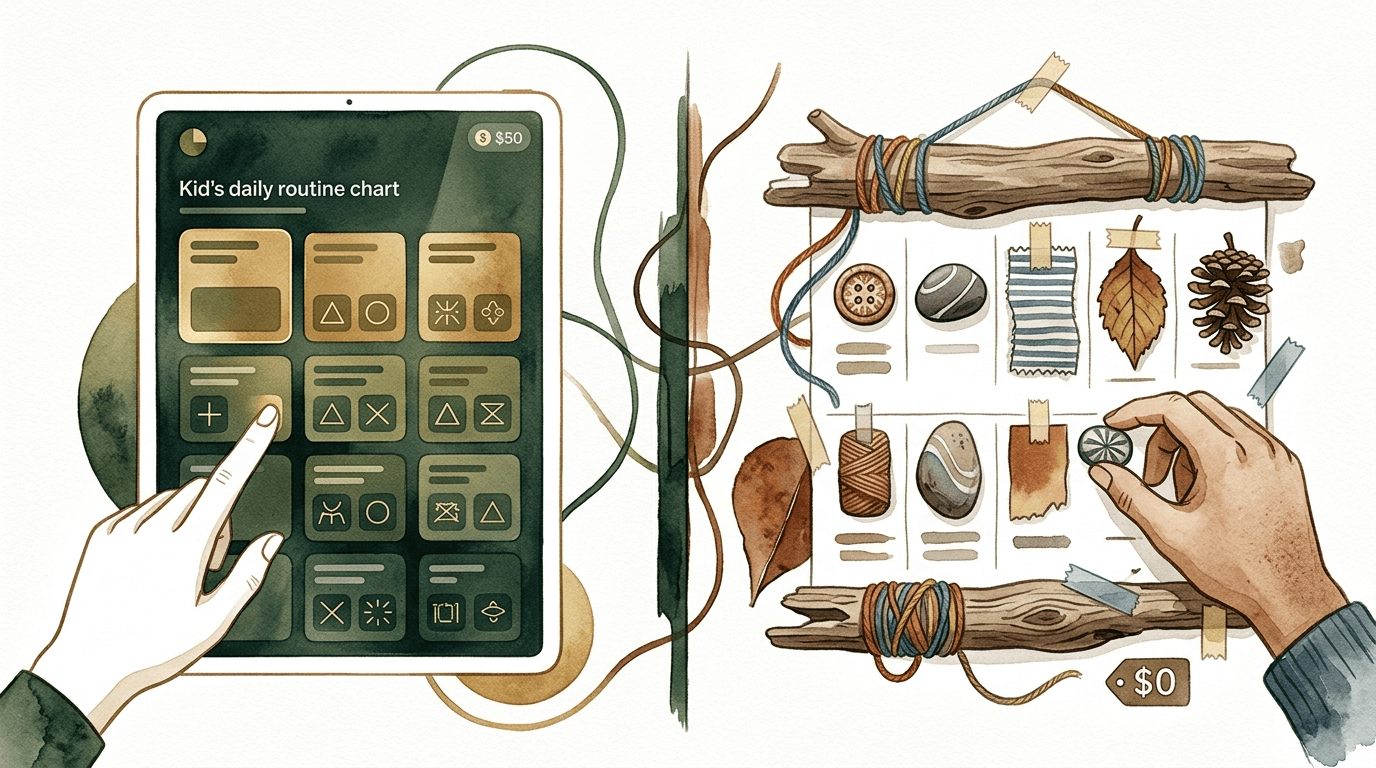
The $50 Subscription App vs The $0 Found-Object Chart
Many parents are tempted by high-end apps that promise to gamify chores. While these can work for older teens, they often fall short for younger children who need tactile feedback. Below is a comparison of how a “found-object” system stacks up against a digital subscription.
| Feature | $50/Year Subscription App | $0 Found-Object Chart |
|---|---|---|
| Cost | High recurring fee | Free (Recycled materials) |
| Setup Time | Digital configuration required | 30-minute DIY project |
| Sensory Input | Screen taps only | Tactile (Clips, velcro, magnets) |
| Visibility | Hidden behind a lock screen | Constant (Wall or fridge) |
| Engagement | Risk of “app fatigue” | High (Physical interaction) |
The found-object chart wins on visibility and sensory engagement. Because it is always “on” and always visible, it acts as a passive reminder. You don’t have to unlock a phone or worry about screen time limits just to check if the dog has been fed.
Practical Tips and Best Practices
Place your chart at the child’s eye level. It sounds simple, but if they have to look up or ask for help to reach it, the independence is lost. Mount it on the back of their bedroom door or on a low spot on the kitchen wall.
Use the “Check-In” method. Instead of hovering, set a timer for five minutes. Tell the child, “I’m going to check the chart in five minutes to see how many clips you’ve moved.” This gives them a sense of urgency without the feeling of being micromanaged.
Include a “Reward Menu” at the bottom of the chart. These shouldn’t be expensive toys. Think of “Experience Rewards”: picking the music in the car, staying up ten minutes late for a story, or choosing what’s for dinner on Friday. This keeps the motivation high and the budget low.
Batch your tasks logically. Group all “bathroom” tasks together so the child isn’t running back and forth across the house. A logical flow makes the routine faster and more intuitive. Efficiency is the best way to prevent the child from getting bored with the system.
- Use high-contrast colors for better visual processing.
- Laminate paper charts to allow for dry-erase checkmarks.
- Use “First/Then” boards for kids who get overwhelmed by long lists.
- Keep a stash of extra magnets or clips for when the originals inevitably vanish.
Advanced Considerations for Routine Scaling
As your children enter the “tween” years, you can transition from a task-based chart to a time-blocked chart. Instead of individual steps, give them chunks of time to manage. This teaches them how to handle larger projects and more complex schedules.
Consider a “Family Command Center” where everyone’s charts are stored in one place. This models the behavior for the kids. If they see that Mom and Dad also have a routine and a system, they are much more likely to respect their own. Consistency across the household is a powerful teaching tool.
For neurodiverse children, particularly those with ADHD or Autism, physical charts are often a medical necessity rather than a parenting preference. These children often experience “time blindness.” A physical countdown—like a jar of pebbles or a visual timer—can help them “feel” the passage of time in a way that words cannot.
Don’t be afraid to pivot. If a system isn’t working after two weeks of consistent effort, change the format. Maybe your child hates velcro but loves magnets. Or maybe they prefer a “check-off” list over a “flip” chart. Treat your household routines like a laboratory and keep experimenting until you find the formula that sticks.
Example Scenarios: From Chaos to Calm
Imagine a typical Tuesday morning. Before the chart, “Leo” (age 6) spent twenty minutes playing with LEGOs while his shoes remained lost under the couch. His mom shouted from the kitchen every three minutes. The morning ended in tears and a late slip at school.
After implementing a “Clothespin Chart,” the dynamic changed. Leo wakes up and sees his chart hanging on his bedpost. He moves the “Make Bed” clip to the “Done” jar. He sees the “Put on Shoes” picture and remembers to go to the mudroom. He moves all five clips before his mom even finishes her coffee.
In another scenario, “Sarah” (age 10) struggled with the after-school slump. She would get home, drop her bag in the hallway, and disappear into her tablet. By dinner time, her homework was untouched. Her parents created a “File Folder Flip Chart” for her desk.
Now, Sarah has a clear sequence: 1. Hang up bag, 2. Eat snack, 3. 30 minutes of homework, 4. Pack bag for tomorrow. Once the tabs are all flipped, she earns her screen time. The “cost” of her fun is clearly defined by the chart, which eliminates the nightly argument about when it’s time to work.
Final Thoughts
Building a daily routine doesn’t require a degree in child psychology or a massive bank account. It requires a shift in perspective. When we move from being the “boss” to being the “architect,” we give our children the space they need to grow. A tactile chart is the blueprint for that growth.
Success isn’t about a perfect streak of completed charts. It’s about the resilience to keep showing up and the structure to make the “right” choice the “easy” choice. Start small, use what you have, and watch as your home transforms from a place of chaos into a place of cooperation.
Every clip moved and every magnet shifted is a brick in the foundation of your child’s future. You aren’t just getting them to brush their teeth; you are teaching them how to master their own life. Put down the phone, grab some cardboard, and start building today.
Sources
1 family-checklist.com (https://family-checklist.com/blog/app-vs-printable-chore-chart.html) | 2 apolosign.com (https://www.apolosign.com/blogs/discover/visual-chore-charts-wall-screens) | 3 snipits.com (https://snipits.com/diy-daily-routine-charts-kids/) | 4 snipits.com (https://snipits.com/diy-daily-routine-charts-kids/) | 5 sensorypoodle.com.au (https://sensorypoodle.com.au/blogs/sensory-toys-australia/kids-routine-chart) | 6 diy.org (https://www.diy.org/blogs/kids-morning-routine-chart) | 7 rayzkidz.com (https://rayzkidz.com/how-to-implement-a-routine-chart-with-kids/) | 8 cassiescroggins.com (https://www.cassiescroggins.com/flip-up-routine-chart-for-kids/) | 9 webmd.com (https://www.webmd.com/parenting/features/chores-for-children) | 10 patpat.com (https://www.patpat.com/blogs/dress-guide/getting-ready-chart-kids-guide) | 11 myskylight.com (https://myskylight.com/chores-for-kids-by-age/) | 12 socialworkerstoolbox.com (https://www.socialworkerstoolbox.com/printable-visual-schedules-and-daily-routine-charts-for-children/) | 13 mychoreboard.com (https://www.mychoreboard.com/blog/printable-vs-digital-chore-charts/) | 14 napacenter.org (https://napacenter.org/visual-schedule/) | 15 wonderfullifefarm.com (https://www.wonderfullifefarm.com/blog/2023/4/age-appropriate-chores-for-kids) | 16 kokoroapp.online (https://kokoroapp.online/blog/digital-vs-physical-chore-tracking) | 17 7daysofplay.com (https://7daysofplay.com/morning-routine-chart/) | 18 vermont.gov (https://humanresources.vermont.gov/sites/humanresources/files/Age%20Appropriate%20Chores.pdf)