Driftwood Garland Material Comparison Guide
Your home can either be a plastic museum or a living sanctuary for the ocean’s history. Factories can mimic the look, but they can’t mimic the soul. A plastic garland off-gasses in your home, while a real driftwood garland brings twenty years of Atlantic history and the scent of the sea into your space.
[affiai]When you hang a piece of the coast on your wall, you aren’t just decorating; you are reclaiming a piece of a world that refuses to be tamed. Every knot and salt-bleached fiber tells a story of survival against the tide. This guide is for those who value the grit of the real over the polish of the fake.
We are going to look at what makes a driftwood garland more than just a string of wood. You will learn how to source it, how to clean it without stripping its character, and why the “ocean bones” in your living room are a better investment than anything made in a mold.
Driftwood Garland Material Comparison Guide
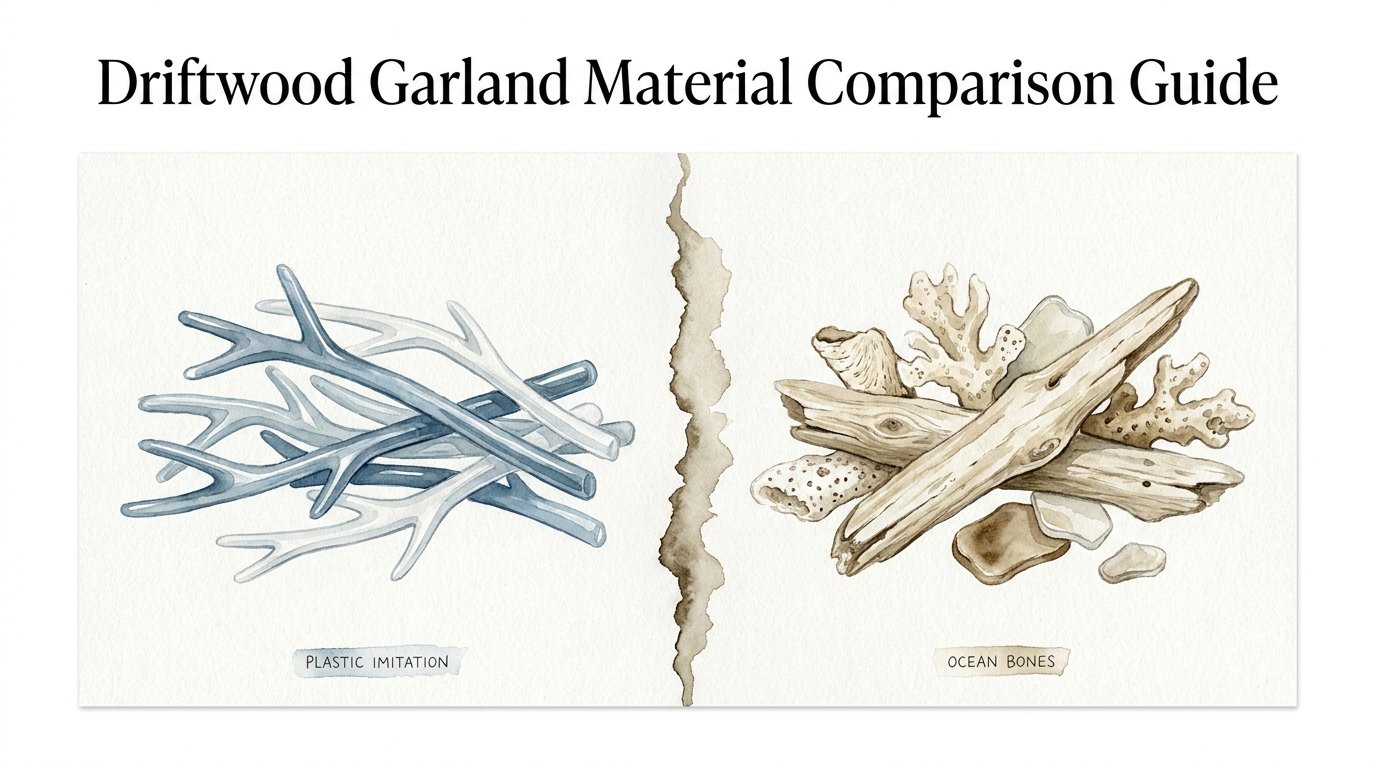
Understanding the difference between genuine driftwood and factory-made imitations is the first step in honest decorating. Real driftwood is wood that has been washed onto a shore by the action of winds, tides, or waves. It is a product of long-term exposure to salt, sun, and water, which naturally strips the bark and smooths the edges until only the densest, most resilient parts of the tree remain.
Factories attempt to replicate this process using chemical washes, sandblasting, and resin molds. While these look-alikes might offer a uniform appearance, they lack the structural integrity and history of the real thing. Genuine ocean-worn wood is often heavier than it looks if it hasn’t fully dried, or remarkably light if it has been sun-bleached for years. It possesses a “soul” that comes from its journey from forest to sea.
In the real world, driftwood garlands are used to bring organic texture into interior spaces. They act as a bridge between the wild outdoors and the structured indoors. Whether it is a vertical string in a nursery or a horizontal draped piece over a mantle, the material determines how the light hits the room and how the space feels to the touch.
The Life Cycle of an Ocean Bone: From Forest to Shore
The journey of a piece of driftwood begins in a storm. Trees fall into rivers due to erosion or high winds, beginning a transit that can take years. Once they reach the ocean, the real transformation begins. The salt water acts as a natural preservative, while the abrasive action of sand and waves grinds away the soft outer layers.
This “curing” process is what gives driftwood its signature silver-grey patina. It is not just a color; it is a scar. The sun then bleaches the wood, drying it out and killing many of the organisms that would otherwise rot it. What you find on the beach is the hardened core of a tree that has survived a gauntlet of natural forces.
This historical weight is why practitioners of “pioneer-grit” decor choose natural wood. You are hanging a piece of a tree that might have started its life fifty years ago in a mountain forest before spending a decade in the Atlantic. A plastic garland, by comparison, started its life in an oil refinery six months ago.
Sourcing and Legality: The Forager’s Code
Collecting driftwood is one of the oldest hobbies of our time, but it is not a free-for-all. In the United States, for example, California allows for the collection of up to 50 pounds of driftwood per day for personal use, provided you aren’t using power tools. However, in states like Georgia or Michigan, removing driftwood from certain public lands is strictly prohibited to protect the local ecosystem.
Always check local regulations before you start filling your bag. Public beaches often have different rules than state parks. Private property is off-limits unless you have written consent from the owner. This respect for the land is part of the “grit” mentioned earlier—we take only what the sea offers and only where we are permitted to do so.
If you cannot get to a beach, sourcing from reputable suppliers who prioritize sustainable harvesting is key. Look for those who collect “ocean-cured” wood rather than those who sandblast kiln-dried timber. The authenticity of your garland depends entirely on the honesty of your source.
How to Clean and Prepare the Sea’s Gift
You cannot simply bring a piece of the beach into your home without a proper cleaning. Natural wood carries sand, salt, and sometimes unwanted “guests” like sand gnats or bacteria. The cleaning process requires patience and a few simple tools.
Start by removing loose debris with a stiff brush. A wire brush can be used on rugged pieces, but a nylon brush is better for smooth, sun-bleached wood that you don’t want to scratch. Once the surface is clear, a deep soak is necessary to sanitize the wood.
A solution of one cup of household bleach to one gallon of water is standard for killing organisms. Submerge the wood for 24 to 48 hours. If the wood floats, use a heavy stone to keep it down. This soak not only cleans but can also lighten the wood to a more uniform “coastal” white.
After the bleach soak, rinse the pieces thoroughly in fresh water and let them dry in the sun for several days. Sun drying uses UV rays as a final sanitization step and ensures no moisture is trapped inside that could lead to mold. For a finished look, a light coat of linseed oil or beeswax can be applied, though many prefer the raw, matte finish of untreated wood.
Step-by-Step Assembly: Constructing the Garland
Once your wood is clean and dry, the assembly of a driftwood garland is a meditative process. You will need a drill with a small wood bit, high-quality twine, and your collection of “bones.”
1. Sorting by Weight and Shape: Lay your pieces out on the floor. If you are making a horizontal garland, place larger, heavier pieces in the center and taper out to smaller pieces at the ends. For a vertical garland, weight should be at the bottom to keep the string taut.
2. Drilling the Pilot Holes: Use a drill bit slightly larger than your twine. Find the balance point of each piece. If you drill too close to the end, the wood may split. Aim for the center mass of each fragment.
3. Selecting the Twine: Jute or hemp twine is the preferred choice for this style. It matches the organic aesthetic of the wood and is strong enough to hold the weight. Avoid synthetic ropes that look too shiny or plastic.
4. Threading and Knotting: To prevent the wood from sliding and clumping together, tie a knot before and after each piece of wood. This creates a “beaded” look and ensures the garland maintains its shape even when draped.
5. Adding Accents: If you want to break up the texture, consider adding sea glass, ceramic beads, or shells. These should be spaced intentionally to ensure they don’t distract from the raw beauty of the wood.
Benefits of Choosing Real Over Imitation
The practical benefits of authentic driftwood go beyond aesthetics. Natural materials are biodegradable and renewable. When you choose a wood garland, you are reducing the demand for petrochemical-based plastics that will sit in a landfill for a thousand years.
From a design perspective, the primary advantage is “biophilic” value. Humans have an innate connection to natural textures and shapes. Research suggests that incorporating organic elements into living spaces can reduce stress and increase feelings of tranquility. A real driftwood garland, with its unique whorls and grains, provides a tactile experience that plastic cannot replicate.
Furthermore, authentic driftwood is a conversation piece. Every piece is unique. You will never find two identical driftwood garlands in the world. This level of exclusivity is usually reserved for high-end art, but with driftwood, it is accessible to anyone willing to walk a beach or drill a hole.
Challenges and Common Mistakes
Working with “wild” wood isn’t always easy. One of the most common mistakes is failing to dry the wood completely before stringing it. If the core of the wood is still damp, it can harbor mold that will eventually rot the twine and ruin the piece. Patience during the drying phase is mandatory.
Another challenge is the fragility of certain pieces. Wood that has been in the water for a long time can sometimes become “cork-like” or “punky.” If you can press your thumbnail deep into the wood with ease, it is likely too rotten to hold a drill hole. These pieces should be discarded or used for purely decorative, non-structural purposes.
Finally, be wary of “creosote” wood. Sometimes old pier pilings wash up on shore. These are treated with chemicals that are toxic and smell strongly of oil or tar. Never use wood that feels sticky or has a chemical odor for indoor decor. It is meant for the sea, not your living room.
Limitations: When the Sea Should Stay Outside
Real driftwood has constraints. It is heavy, especially in larger installations. Hanging a six-foot driftwood garland requires proper wall anchors; you cannot simply tape it to the wall. If you are decorating a rental where you cannot drill into the walls, a heavy natural garland may not be the best choice.
Environmental limitations also exist. In extremely humid environments, untreated driftwood can absorb moisture from the air, which may lead to a “musty” smell over time. In these cases, sealing the wood with a clear matte varnish is a necessary trade-off to preserve the piece.
Additionally, driftwood is a fire hazard. Never drape a garland over a wood-burning stove or near open candles. The wood is extremely dry and often porous, meaning it will catch fire much faster than standard lumber.
Comparison Table: Real Driftwood vs. Faux Imitation
| Feature | Authentic Driftwood | Plastic/Resin Imitation |
|---|---|---|
| Source | Oceans, rivers, lakes | Factories, petrochemicals |
| Texture | Unique grains, salt-worn crevices | Uniform, repeated patterns |
| Aroma | Faint salt and wood scent | Chemical or neutral scent |
| Maintenance | Initial cleaning required | Ready to use out of the box |
| Sustainability | High (Biodegradable/Renewable) | Low (Non-biodegradable) |
| Visual Aging | Ages gracefully into silver/white | May fade or peel over time |
Practical Tips and Best Practices
If you want your garland to last a lifetime, follow these optimization techniques. First, use a high-speed drill bit to prevent splintering the wood. Driftwood is often much harder or much softer than expected; a sharp bit ensures a clean hole.
When stringing the garland, use “double-knotting.” Tie a knot, thread the wood, then tie another knot immediately after. This locks the wood in place and prevents it from shifting if the garland is bumped.
For those who want a more “curated” look, you can “sun-bleach” your wood at home. After the bleach soak, leave the pieces in direct, intense sunlight for at least a week. Rotate them daily. This will turn the wood a stark, beautiful white that rivals any high-end boutique piece.
Advanced Considerations for Serious Practitioners
Serious decorators often look at the “flow” of the wood. This involves matching the “curves” of separate driftwood pieces so that the garland appears to have a natural, snake-like movement when hung. This takes a significant amount of time to sort through hundreds of pieces, but the result is a sculptural masterpiece rather than just a string of sticks.
Consider the “tannin” factor. If you plan on using driftwood in a way that it touches white fabric (like hanging over white curtains), be aware that some wood types can still “bleed” tannins if they get damp. Test your wood by soaking a small piece in hot water; if the water turns yellow or brown, the wood needs further soaking or a sealant to prevent staining your textiles.
Scaling considerations are also important. For large-scale installations, such as a driftwood headboard or a room-length garland, use aircraft cable or heavy-duty nautical rope instead of jute twine. The weight of fifty pieces of dense oak driftwood can easily snap standard gardening string.
Examples and Scenarios
Imagine a modern minimalist living room with white walls and grey furniture. A single, three-foot vertical driftwood garland hanging in a corner adds a vertical line of texture that “breaks” the sterile feel of the room. It brings a sense of history to a space that might otherwise feel too new.
In a nursery, a driftwood garland can be used as a mobile. By using light, sun-bleached pieces of cedar or pine driftwood, you can create a safe, organic focal point for the baby. Because the wood is natural and cleaned without harsh residual chemicals, it is a superior choice to plastic toys that may off-gas.
Alternatively, consider an outdoor pergola. A long driftwood garland draped between the beams acts as a wind chime of sorts. As the breeze moves the wood, it creates a subtle, clacking sound—a reminder of the waves that once moved these same pieces of wood across the ocean.
Final Thoughts
Decorating with driftwood is an act of reclaiming the real. It is a rejection of the “plastic museum” lifestyle and an embrace of the grit and truth found in nature. A driftwood garland is more than a coastal accessory; it is a physical record of a tree’s survival and the ocean’s power.
By choosing natural wood, you are making a commitment to sustainability and authenticity. You are bringing a material into your home that has been cured by salt, bleached by the sun, and shaped by the very tides of the earth. These “ocean bones” carry a weight and a story that no factory-made imitation can ever hope to mimic.
Whether you find your pieces on a rugged coastline or source them from a dedicated craftsman, take the time to clean, prep, and string them with care. The result will be a piece of art that doesn’t just sit on your wall—it breathes the history of the sea into your sanctuary. Experiment with shapes, respect the legalities of the land, and let the sea’s grit transform your space.
Sources
1 dtwooddecor.com (https://www.dtwooddecor.com/what-is-driftwood-decor/) | 2 newpelican.com (https://www.newpelican.com/articles/herstory-driftwood/) | 3 oceanhomemag.com (https://www.oceanhomemag.com/home-design/driftwood-decor/) | 4 driftedtreasures.co.uk (https://driftedtreasures.co.uk/the-allure-of-driftwood/) | 5 laredoute.co.uk (https://www.laredoute.co.uk/content/driftwood-decoration-why-adopt-it-for-an-organic-and-chic-winter/) | 6 coco-papaya.com (https://www.coco-papaya.com/en/blog/ethnic-decoration-handicrafts-from-around-the-world/driftwood-decoration-a-unique-and-natural-choice-to-beautify-your-interior) | 7 vietaquaticwoods.com (https://vietaquaticwoods.com/natural-aquarium-driftwood-supplier/) | 8 driftwoodacademy.com (https://driftwoodacademy.com/is-it-legal-to-collect-driftwood/) | 9 lakewedoweelife.com (https://www.lakewedoweelife.com/lake-life/driftwood-art-and-treasures-by-tammy-lovvorn) | 10 homify.co.uk (https://www.homify.co.uk/diy/12998/5-things-used-to-preserve-driftwood-and-make-it-home-decor) | 11 youtube.com (https://www.youtube.com/watch?v=LBGEVMfPT_4) | 12 junglebound.in (https://www.junglebound.in/blog/plastic-vs-wood-environmental-impact-comparison-for-sustainable-choices) | 13 theroomsart.com (https://theroomsart.com/driftwood-wall-decor-guide/) | 14 aquariacentral.com (https://www.aquariacentral.com/forums/threads/fake-wood-vs-real-wood.71934/) | 15 taraloubadger.com (https://taraloubadger.com/2022/04/10/how-to-tell-real-wood-from-fake-wood/) | 16 youtube.com (https://www.youtube.com/watch?v=mVZIJy5mecU) | 17 youtube.com (https://www.youtube.com/watch?v=aFWLyAPowMA) | 18 youtube.com (https://www.youtube.com/watch?v=yWARkemYfnE) | 19 hawk-hill.com (https://www.hawk-hill.com/how-to-clean-driftwood/) | 20 discovertheoutdoors.co.uk (https://discovertheoutdoors.co.uk/beachcombing-uk-law/)