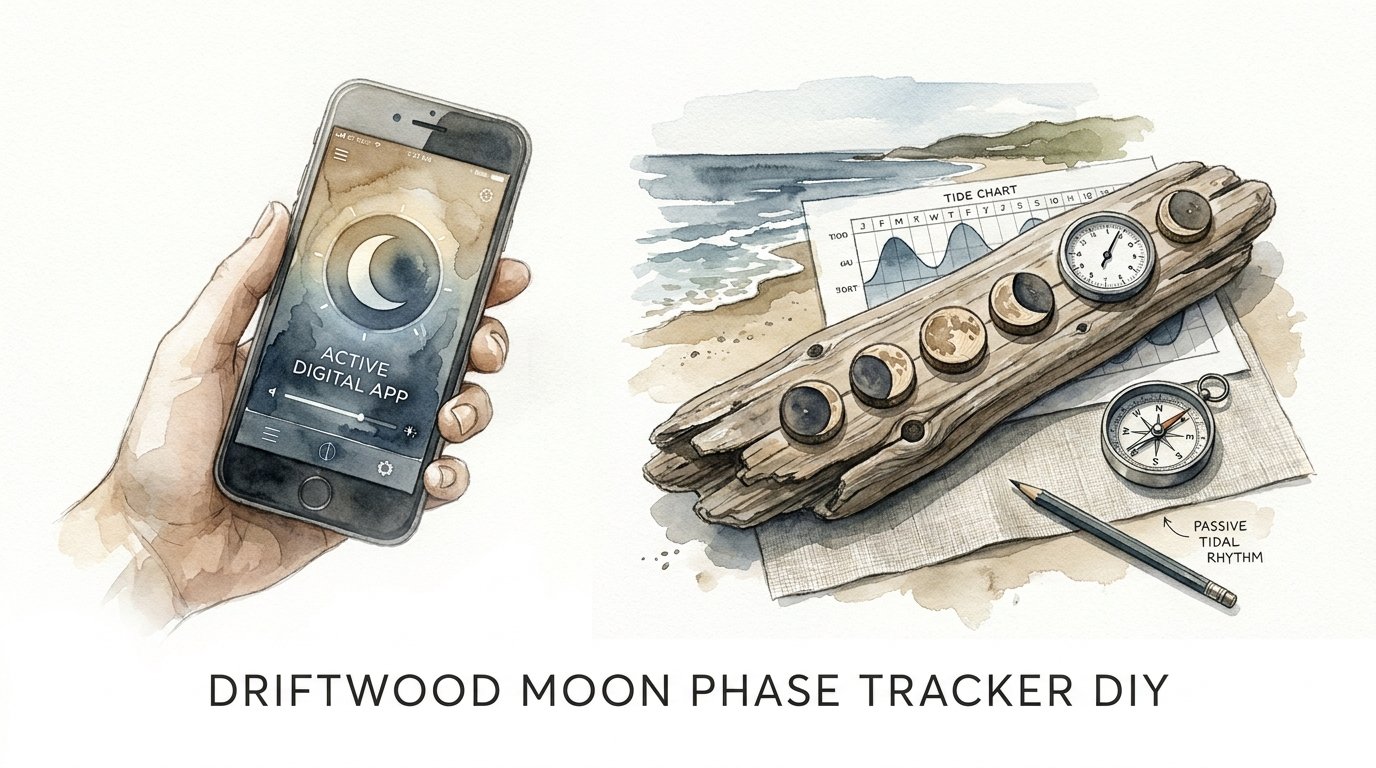
Driftwood Moon Phase Tracker Diy
Are you tracking the tides with a battery that dies, or with the very timber the ocean itself used to tell the time? Why depend on a glitchy app to connect with the coast? Our ancestors didn’t have notifications; they had the pulse of the moon carved into the landscape. This passive wall tracker turns a piece of storm-tossed timber into a living calendar that never needs a charge and never asks for an update. It’s time to trade your blue light for a shadow-cast rhythm.
[affiai]Connecting with the natural world requires tools that speak its language. A smartphone offers data, but a physical tracker offers presence. When you look at a piece of wood pulled from the surf, you are seeing years of exposure, salt-soaking, and solar bleaching. It is the perfect medium for a lunar clock because it has already survived the very elements the moon controls. This project is about returning to a simpler, more rugged form of timekeeping that favors observation over automation.
The moon dictates more than just the night sky. It pulls the oceans, guides the migration of fish, and once told our forefathers exactly when to plant and when to hunker down. Building your own tracker is an exercise in pioneer grit. It demands a bit of sweat, a sharp eye for materials, and the discipline to move a peg every morning. This is how you reclaim the rhythm of the tides.
Driftwood Moon Phase Tracker Diy
A driftwood moon phase tracker is a manual, analog device used to monitor the 29.5-day synodic lunar cycle. Unlike digital clocks that use quartz and silicon, this tool uses the tactile feedback of a physical marker moving across a series of increments. It serves as a visual bridge between your living space and the celestial mechanics overhead.
Historically, this method of timekeeping is one of the oldest human technologies. Archeologists have uncovered bone fragments and wooden staves dating back over 30,000 years, such as the Blanchard Bone, which feature notched sequences corresponding to the waxing and waning of the moon. In the modern context, this DIY project repurposes found beach timber into a functional piece of art that tracks the lunar month from new moon to full moon and back again.
Real-world application for this tracker goes beyond simple decoration. Coastal dwellers use it to anticipate “spring tides”—the extra-high and extra-low tides that occur during new and full moons. Gardeners use it to plan “planting by the signs,” a tradition of sowing seeds during the waxing phase to encourage upward growth. For the modern pioneer, it is a tool for mental grounding, forcing a daily moment of reflection on the passage of time without the interference of a screen.
The Mechanics of Lunar Timekeeping
To build an accurate tracker, you must first understand the synodic month. This is the time it takes for the moon to return to the same position relative to the sun as seen from Earth. While a sidereal month (the moon’s actual orbit) is about 27.3 days, the synodic month averages 29.53 days. This slight difference exists because the Earth is also moving around the sun, requiring the moon to “catch up” to reach the same phase again.
Your tracker needs to accommodate this 29.5-day cycle. Most DIY designs utilize 30 distinct markers or holes. This allows for the standard 29 or 30 days found in traditional lunar calendars. To stay accurate over several months, you simply reset the marker to the “New Moon” position on the specific day the new cycle begins, as reported by local observations or a simple lunar chart.
The tracker works through a series of physical stations. These represent the eight primary phases: New Moon, Waxing Crescent, First Quarter, Waxing Gibbous, Full Moon, Waning Gibbous, Third Quarter, and Waning Crescent. By drilling holes or carving notches into the driftwood, you create a path for a peg or a stone to travel, making the invisible progress of the moon visible and heavy in your hand.
How to Build Your Driftwood Tracker
Building this tracker starts with a trip to the shoreline. Look for a piece of driftwood that feels substantial—something with a relatively flat surface or a long, straight grain. Hardwoods like oak or cedar that have been weathered by salt are ideal because they resist rot and have a beautiful, silvered patina.
Step 1: Preparation and Cleaning
Freshly found driftwood is often home to salt, sand, and microscopic hitchhikers. Soak your timber in a solution of one part bleach to ten parts water for at least 24 hours. This kills any mold or insects living deep in the grain. After the soak, scrub the surface with a stiff brush to remove loose bark and debris.
Dry the wood thoroughly before working on it. This is a test of patience. Depending on the thickness of the wood, it may need to sit in the sun for several days or even weeks. Wood that is still damp on the inside will warp or crack later if you seal it too early. You want the timber to feel light for its size and sound hollow when tapped.
Step 2: Designing the Path
Decide on the layout of your tracker. A linear path is the simplest and most rugged, with 30 holes drilled in a straight line from left to right. Alternatively, an arc or a circle can mimic the moon’s path across the sky. Use a pencil to mark the locations of the 30 holes. Space them evenly, but leave a slightly larger gap every 7 or 8 holes to denote the primary quarters.
Step 3: Drilling and Sanding
Use a drill bit that matches the size of your chosen peg. A 1/4-inch bit is usually standard for small wooden pegs or brass pins. Drill the holes approximately half an inch deep. Ensure the holes are straight; a drill press is helpful here, but a steady hand and a hand drill will get the job done. Once the holes are drilled, lightly sand the surface with 120-grit sandpaper to remove any splinters without stripping away the weathered texture of the wood.
Step 4: Marking the Phases
You can leave the tracker minimal or add markings to identify the key lunar stages. Carve symbols for the New Moon (a dark circle) and the Full Moon (a bright circle) using a wood-burning tool or a small chisel. Many pioneers prefer to use simple notches—one notch for the quarters and three notches for the full moon. This keeps the aesthetic raw and functional.
Benefits of the Passive Rhythm
The primary advantage of a driftwood tracker is its immunity to the digital world. It does not require a signal, it never needs a battery replacement, and it cannot be “disrupted” by a software update. In a survival or off-grid scenario, a manual tracker is a reliable way to keep a long-form calendar. It relies entirely on your interaction with the environment.
Beyond utility, there is a measurable psychological benefit to manual tracking. Moving a peg each morning creates a ritual. It forces you to look out the window, observe the actual sky, and acknowledge the pace of the universe. This is an “active” interaction with a “passive” device, which stands in stark contrast to the passive consumption of active digital notifications.
Finally, driftwood itself is a carbon-neutral, free material. By upcycling ocean debris, you are creating a high-value tool from something that was once considered waste. The silvered wood and organic shapes provide a rustic aesthetic that fits perfectly in a cabin, workshop, or coastal home, serving as a conversation piece that actually does something useful.
Challenges and Common Mistakes
The most frequent error in DIY driftwood projects is rushing the drying process. If you drill into “green” or waterlogged wood, the holes will shrink and tighten as the wood dries, eventually trapping your peg or causing the timber to split down the grain. Patience is the pioneer’s greatest tool. Give the wood the time it needs to stabilize before you apply a drill or a blade.
Accuracy can also be a challenge. Because the lunar month is 29.5 days, a 30-day tracker will eventually drift. If you move the peg every 24 hours, you will be half a day off by the end of the month. To solve this, you must “reset” the tracker on the day of the New Moon. Some practitioners prefer to leave the peg in the “New Moon” hole for two days every other month to compensate for the fractional day.
Another mistake is over-sealing the wood. While you want to protect the tracker from moisture, thick layers of glossy polyurethane can make driftwood look like plastic. This kills the “pioneer grit” vibe of the project. Use a matte finish or a simple rub-on wax to preserve the silvered look while still providing a barrier against indoor humidity.
Limitations: When Wood Isn’t Enough
A driftwood tracker is not a precision instrument for astronomical navigation. It gives you a general idea of the moon’s phase, but it cannot tell you the exact minute of a moonrise or the specific height of a tide in feet. If you are planning a high-stakes maritime journey or need to know the exact lighting conditions for professional night photography, you will still need a nautical almanac or a specialized digital tool.
Environment also plays a role. If you live in an extremely humid climate and hang your tracker in an unconditioned space, the wood will naturally expand and contract. This can lead to loose pegs or surface mold if the wood wasn’t properly bleached during the preparation phase. Driftwood is resilient, but it is still organic matter subject to the laws of decay.
Comparison: Digital Apps vs. Passive Driftwood Tracker
| Feature | Digital Moon App | Driftwood Tracker |
|---|---|---|
| Power Source | Battery / Electricity | None (Passive) |
| Maintenance | Software Updates | Daily Manual Movement |
| Durability | Fragile (Glass/Circuits) | Rugged (Weathered Wood) |
| Cost | Subscription / Data | Free (Found Materials) |
| Experience | Passive Consumption | Active Observation |
Practical Tips and Best Practices
Choosing the right peg is vital for the tracker’s longevity. While wooden dowels are common, consider using a brass pin or a polished beach stone. Metal won’t swell with humidity, ensuring the peg always fits the hole perfectly. If you use a stone, you can carve a small “seat” into the driftwood for each day instead of drilling deep holes.
Calibration is best done on the night of the New Moon. This is the “zero point” of the cycle. You can find this date in any standard calendar. Once you set your peg in the first hole, commit to moving it at the same time every day—either at dawn or just before bed. Consistency is what turns a piece of wood into a reliable instrument.
If the wood begins to look “thirsty” or starts to silver too aggressively, apply a light coat of beeswax or linseed oil. This won’t change the color significantly but will feed the fibers and prevent the wood from becoming brittle. Rub the oil in with a lint-free cloth and let it sit for 24 hours before resuming use.
Advanced Considerations: Expanding the Tracker
Experienced makers often add a second track for the tides. Since tides are primarily driven by the moon, you can add a small secondary slider that indicates High, Low, Ebb, and Flow. This requires a 12.4-hour cycle, which is more complex to track manually but provides a full picture of coastal mechanics.
You can also incorporate “intercalary” markings. Historically, some cultures added a 13th month every few years to keep the lunar and solar years aligned. On your driftwood tracker, you can mark specific seasonal points, such as the Solstices or Equinoxes, to see how the lunar cycles drift against the sun’s path over the course of a year.
Scaling the project is another option. A small piece of driftwood works well for a desk, but a large, six-foot timber can be turned into a “Lunar Staff” or a floor-to-ceiling wall installation. For large-scale trackers, use heavier indicators like wrought iron spikes or oversized copper rings to match the scale of the wood.
Example Scenario: The Coastal Homesteader
Imagine a small cabin on the coast of Maine. The owner, a fisherman, needs to know when the extreme low tides will occur for harvesting clams. Instead of checking a phone with wet, salty hands, he keeps a large piece of cedar driftwood mounted by the door.
Every morning as he drinks his coffee, he moves a brass peg one hole to the right. As the peg nears the center hole—the Full Moon—he knows the “Spring Tides” are coming. The visual distance of the peg from the center tells him exactly how many days he has left to prepare his gear. This isn’t just about time; it’s about the physical preparation for the labor the moon demands.
Final Thoughts
The driftwood moon phase tracker is a return to a form of competence that modern life has largely abandoned. It replaces the frantic ping of a notification with the steady, quiet movement of a peg across a weathered grain. By building one, you are not just making a piece of decor; you are choosing to participate in a cycle that has governed the Earth since the oceans first formed.
The beauty of this project lies in its imperfection. Each piece of driftwood has a different history, and each tracker will have its own quirks. This is a tool that rewards the patient and the observant. It asks for thirty seconds of your attention each day, and in return, it gives you a profound connection to the tides and the sky.
Start your project by heading to the nearest water source. Look for the timber that has been shaped by the current and bleached by the sun. Once you bring it home and carve the lunar path into its surface, you will find that time feels different. It feels heavier, slower, and much more meaningful. Experiment with different woods, refine your layout, and let the moon be your guide.
Sources
1 moonsisters.com (https://en.moonsisters.com/blogs/nieuws/geschiedenis-van-de-maankalender) | 2 livingwiththemoon.com (https://www.livingwiththemoon.com/origin-moon-calendar/) | 3 ccsu.edu (https://sites.ccsu.edu/astronomy/calendars.htm) | 4 humanoriginproject.com (https://humanoriginproject.com/the-lunar-calendar-and-how-moon-phases-work/) | 5 habitcoach.ai (https://www.habitcoach.ai/blog/physical-habit-tracker) | 6 thewildenchantment.com (https://thewildenchantment.com/how-to-create-a-rustic-wood-slice-moon-phase-wall-hanging/) | 7 completely-coastal.com (https://www.completely-coastal.com/2022/06/driftwood-ideas-garden-backyard-decor-benches-sculptures.html) | 8 quora.com (https://www.quora.com/Whats-the-best-way-to-seal-a-piece-of-driftwood-for-an-art-project) | 9 generationgenius.com (https://www.generationgenius.com/wp-content/uploads/diy-activities/moon-phases-diy-en.pdf) | 10 memtime.com (https://www.memtime.com/blog/how-passive-time-tracking-transforms-work) | 11 youtube.com (https://www.youtube.com/watch?v=aFWLyAPowMA) | 12 diyinspired.com (https://diyinspired.com/lunar-moon-wall-art/) | 13 astropixels.com (https://astropixels.com/ephemeris/moon/synodicmonth2001.html) | 14 wikipedia.org (https://en.wikipedia.org/wiki/Lunar_month) | 15 study.com (https://study.com/academy/lesson/the-lunar-calendar-metonic-cycle.html) | 16 time.now (https://time.now/faq/moon/how-many-days-are-in-a-lunar-cycle-synodic-month/) | 17 mymumthedreamer.com (https://mymumthedreamer.com/how-to-clean-driftwood-for-crafting/) | 18 wikihow.com (https://www.wikihow.com/Preserve-Driftwood) | 19 wikihow.com (https://www.wikihow.com/Make-a-Moon-Phases-Chart)