Long-lasting Diy Home Decor: Driftwood Garlands
Why trust your home’s beauty to a glue gun when the ocean has already provided a permanent solution? Most indoor decor is one humid day away from a total collapse. But timber that has survived the Pacific Ocean laughs at your HVAC system. A properly lashed driftwood garland isn’t just a decoration; it’s a structural masterpiece that outlasts the house.
[affiai]Choosing to work with driftwood requires a shift in mindset. You aren’t just assembling a craft; you are engineering a piece of the shoreline to live within your walls. This guide explores the intersection of traditional maritime lashing and modern interior design, ensuring your coastal accents remain as steadfast as a ship’s rigging.
Long-lasting Diy Home Decor: Driftwood Garlands
A driftwood garland is a string of weathered wood segments, often interspersed with stones, sea glass, or shells, used to add texture and history to a space. Unlike factory-made plastic replicas, true driftwood carries the story of its journey through salt, sun, and sand. It exists because it was strong enough to withstand the relentless energy of the sea.
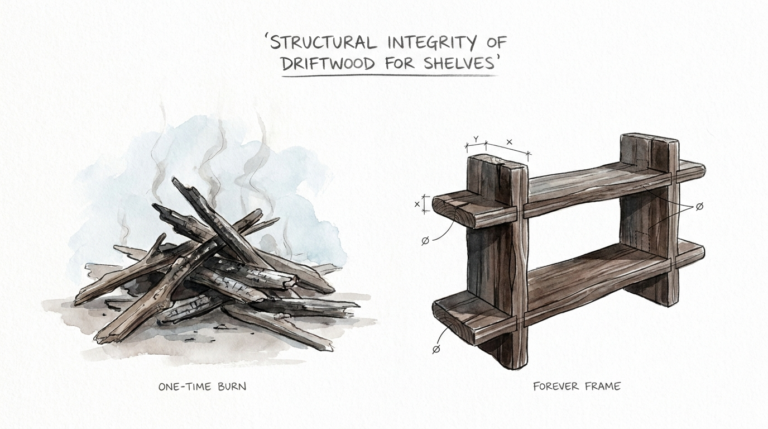
In the real world, these garlands serve as more than just wall hangings. They function as organic room dividers, fireplace mantel anchors, or even structural accents for outdoor pergolas. Because the wood is already “cured” by the elements, it possesses a unique stability. However, the true longevity of the piece depends entirely on how you join those segments together.
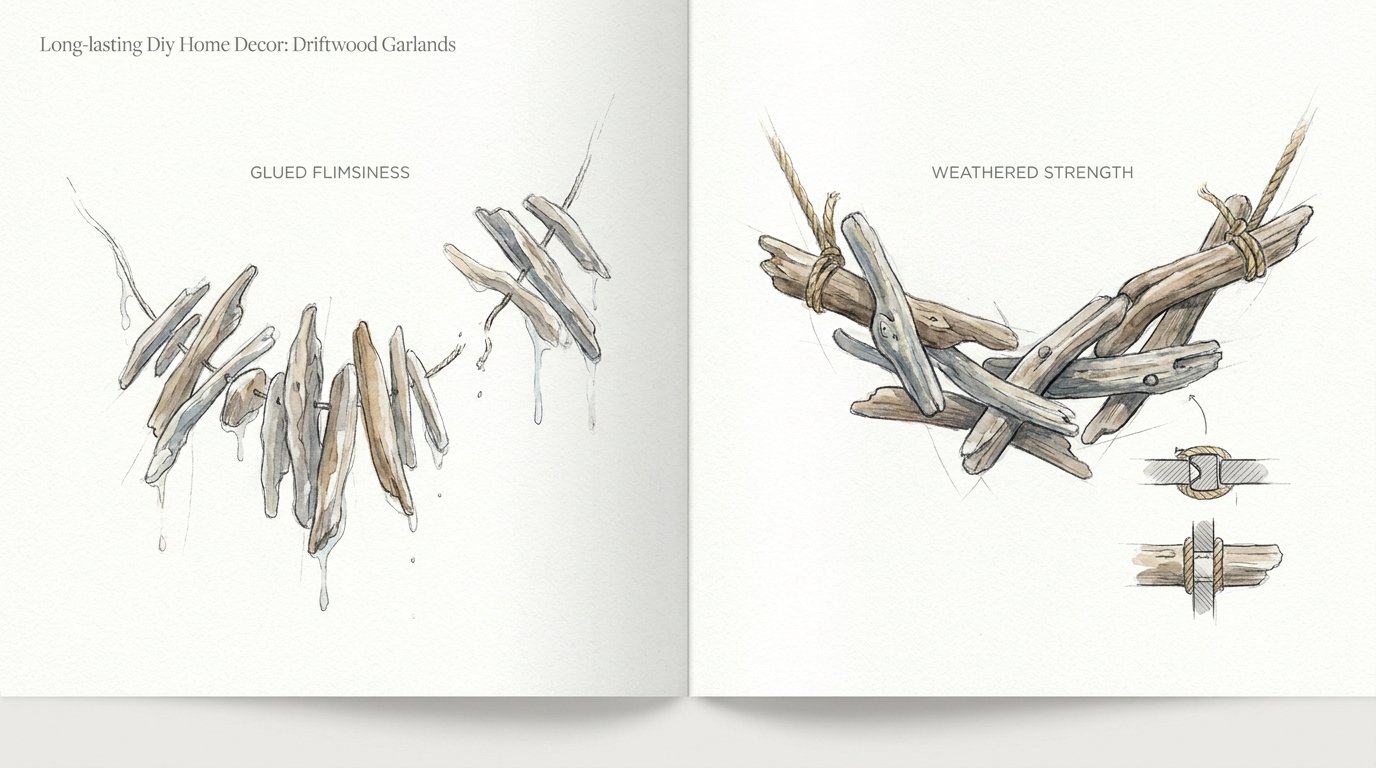
We call this the principle of weathered strength. While modern adhesives can fail when temperatures shift or humidity rises, traditional cordage and lashing techniques create a mechanical bond. This method respects the wood’s natural expansion and contraction, ensuring the garland never sags or snaps.
How to Prep and Build a Structural Garland
Building a garland that lasts decades starts long before you tie the first knot. You must prepare the wood to transition from a high-saline, high-moisture environment to the dry, climate-controlled interior of a home.
Sourcing and Selection
Search for “hard” driftwood like Manzanita or Malaysian driftwood if you want maximum density. These woods are highly resistant to decay and offer a grounded, substantial feel to your decor. If you prefer a more branchy, airy aesthetic, look for Spider wood, though it may require more careful lashing due to its delicate extensions.
Cleaning and Sanitizing
Never bring “raw” beach wood directly into your home. It likely contains salt, sand, and microscopic organisms that can lead to rot or pest infestations.
- Dry Brushing: Use a stiff nylon brush to remove loose sand and debris from every crevice.
- Bleach Soaking: Submerge the wood in a solution of 1 part bleach to 10 parts water for at least 12 to 24 hours. This sanitizes the wood and can lighten the color to a classic “sun-bleached” white.
- Desalination: If you plan to use the wood near plants or delicate fabrics, soak it in fresh water for several days, changing the water daily to draw out the salt.
The Drying Phase
Drying is the most critical step for structural integrity. If you lash damp wood, the cordage will loosen as the wood shrinks. Place the wood in a well-ventilated area for at least one to two weeks. For smaller pieces, you can accelerate the process in a low-temperature oven (200°F) for 2-4 hours, but watch closely to prevent cracking.
The Lashing Process
Instead of drilling holes and threading a single string—which places all the stress on a single point—use structural lashing.
- The Clove Hitch: Start your garland by securing your cordage to the first piece of wood with a clove hitch. It provides a non-slip foundation.
- Wrapping and Frapping: When joining two pieces of wood, “wrap” the cord around the wood to pull them together, then “frap” (wrap the cord around the cordage itself between the wood pieces). Frapping creates a tension that acts like a spring, holding the joint tight even if the wood moves.
- Continuous Wrap: For a vertical “ladder” style garland, use a continuous wrap technique where each piece of wood is cradled by a knot, preventing the pieces from sliding down the string over time.
Benefits of Lashing Over Adhesives
The primary advantage of a lashed driftwood garland is its resilience. Indoor environments are surprisingly harsh on glue. Humidity from kitchens or bathrooms weakens standard wood glue, while the heat near a fireplace can cause hot glue to soften and fail.
Lashing offers a mechanical connection that is visually superior and structurally redundant. If one fiber of a hemp rope frays, the thousands of other fibers maintain the bond. In contrast, once a glue bond “cracks,” the entire piece is compromised.
Furthermore, lashed decor is repairable. If a piece of wood eventually breaks or if you wish to rearrange the garland, you can simply untie the knots. Glue is permanent in its placement but temporary in its strength; lashing is permanent in its strength but adaptable in its placement.
Challenges and Common Mistakes
One frequent error is failing to account for the weight of the wood. A five-foot garland made of dense Malaysian driftwood can weigh upwards of fifteen pounds. Using thin jute or decorative “baker’s twine” will result in a snapped line within months.
Another mistake is “choking” the wood. Beginners often pull their knots as tight as possible without considering the wood’s surface. On softer driftwood, high-tension cordage can actually “cut” into the fibers, creating a weak point where the wood may eventually snap.
Finally, ignoring the “salt factor” is a recipe for disaster. Salt is hygroscopic, meaning it pulls moisture from the air. If you don’t properly desalinize your wood, your garland will feel perpetually damp or “clammy” on humid days, which eventually leads to mold growth on the cordage.
Limitations of Driftwood Decor
While driftwood is exceptionally durable, it is not invincible. One major limitation is its weight-to-mount ratio. Because driftwood is often denser than standard kiln-dried lumber, you cannot simply hang a large garland from a small finishing nail in drywall. You must find a stud or use heavy-duty anchors.
Additionally, driftwood is naturally porous. This means it can absorb household odors or smoke over time. If the garland is placed in a kitchen, it may eventually require a deep cleaning to remove grease buildup.
In extremely dry climates, very old driftwood can become brittle. Without its natural moisture, the wood fibers lose their flexibility. In these cases, a light application of linseed oil can help, but it will darken the wood significantly, changing that sought-after “weathered” look.
Comparison: Lashing vs. Hot Glue
| Feature | Hot Glue (Flimsiness) | Traditional Lashing (Strength) |
|---|---|---|
| Heat Resistance | Low (Melts near fireplaces) | High (Unaffected by home heat) |
| Humidity Tolerance | Poor (Peels over time) | Excellent (Natural fibers adapt) |
| Structural Load | Surface only | Weight-bearing capability |
| Aesthetic | Visible “beads” of plastic | Integrated, nautical look |
Practical Tips and Best Practices
- Choose Your Cordage Wisely: Use hemp rope for structural garlands that need to hold significant weight. Use jute for lighter, more decorative pieces where you want a softer, fuzzier texture.
- The Marlinspike Trick: When tightening lashings, use a small metal rod or a “marlinspike” to gain leverage. This allows you to pull the cordage tighter than you ever could with bare hands.
- Wax the Ends: Dip the ends of your cordage in beeswax. This prevents fraying during the assembly process and adds a layer of moisture protection to the knots.
- Varnish for Longevity: If your garland will hang in a high-moisture area like a bathroom, apply three coats of spray varnish. Let the wood breathe for 3-4 hours between coats to ensure a deep bond.
Advanced Considerations for the Serious Builder
For those looking to create a true legacy piece, consider the interplay of physics and aesthetics. A “Valhalla’s Ladder” style garland uses varying lengths of wood to create a forced perspective. Start with the heaviest, longest pieces at the bottom to lower the center of gravity, which prevents the garland from swaying excessively when doors open or people walk by.
You may also want to integrate “found” objects that share the driftwood’s history. Adding sea glass or river stones requires a different lashing technique, often involving a “netting” or “cage” knot. This ensures the stones are trapped by the cordage rather than glued to the surface.
If you are scaling your project for outdoor use, natural fibers like cotton will rot quickly. In these scenarios, switch to a high-quality manila rope (abaca fiber), which is naturally resistant to saltwater and UV damage. It provides the same rustic look as hemp but with the durability required for the garden.
Example: The Mantelpiece Anchor Project
Imagine a fireplace mantel in a coastal home. A standard garland of beads feels out of scale against the heavy stone. To create a Mantelpiece Anchor, you would source three large, dense pieces of driftwood (approximately 12-18 inches each).
Using a Tripod Lashing, you join the tops of these three pieces. This creates a stable, three-dimensional structure that can sit on the mantel without being nailed down. You then “drape” smaller, lashed garlands of sea glass and light-weight twigs between the legs of the tripod. The result is a piece of decor that feels like it was recovered from a shipwreck, held together by the same knots used by sailors for centuries.
Final Thoughts
Creating a driftwood garland with traditional lashing is an exercise in patience and respect for the natural world. By choosing mechanical strength over chemical shortcuts, you ensure that your home decor remains as resilient as the timber it is made from. The ocean has done the hard work of shaping and strengthening the wood; your job is simply to honor that process through good craftsmanship.
As you experiment with different knots and cordage, you will find that the process is as rewarding as the final result. There is a profound satisfaction in knowing that your decor isn’t just “stuck” together—it is engineered to last. Apply these techniques to your next project and bring a piece of the coast’s permanent beauty into your living space.
Sources
1 youtube.com (https://www.youtube.com/watch?v=_6dx-lGjceQ) | 2 fortunebay.org (https://fortunebay.org/learn-the-best-lashing-knots/) | 3 silverantoutdoors.com (https://silverantoutdoors.com/blogs/the-silverant-blog/beyond-knots-harnessing-the-power-of-lashings-and-bindings) | 4 artofmanliness.com (https://www.artofmanliness.com/skills/manly-know-how/how-to-tie-lashings/) | 5 youtube.com (https://www.youtube.com/watch?v=LBGEVMfPT_4) | 6 sgtknots.com (https://sgtknots.com/blogs/news/rope-guide)