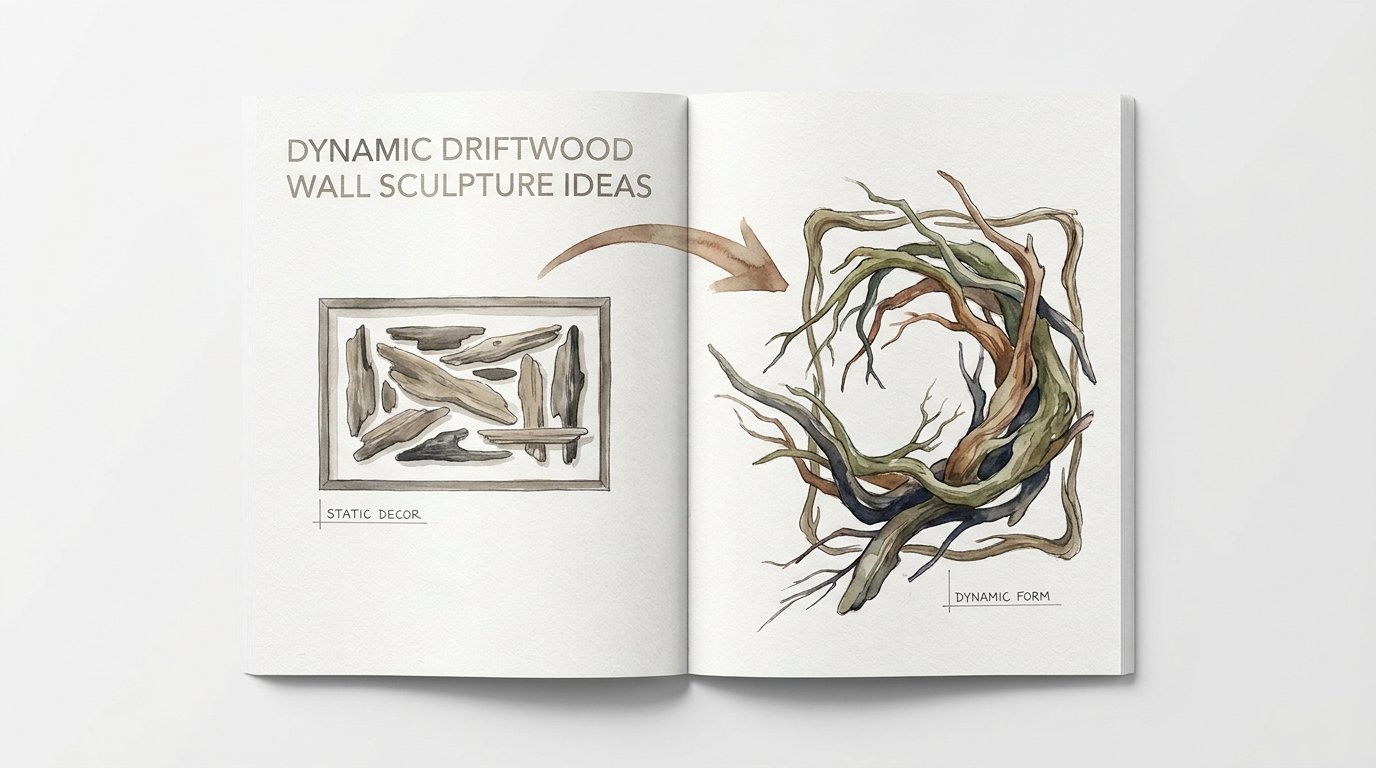
Dynamic Driftwood Wall Sculpture Ideas
Is your wall art just a flat image, or is it a sculpture that evolves with the movement of the sun? Most wall art is a dead end—a flat image trapped in a square frame. But a minimalist driftwood spine is a dynamic system. As the sun moves through your room, the shadows lengthen, shift, and dance, turning your architecture into a living coastal ecosystem. Stop buying static pictures and start harvesting dynamic shadows.
[affiai]Bringing the raw, weathered bones of the earth into your home is not about decoration. It is about a fundamental shift in how you perceive your living space. A single, well-chosen piece of driftwood mounted with intentionality does more than fill a void on a white wall; it acts as a bridge between the clinical precision of modern construction and the chaotic, beautiful logic of the natural world.
This guide will show you how to move past the amateur “beachy” look and toward a sophisticated, gallery-grade installation. We will examine the mechanics of shadow, the biology of different wood species, and the technical requirements of secure mounting.
Dynamic Driftwood Wall Sculpture Ideas
A dynamic driftwood wall sculpture is a three-dimensional installation that uses weathered wood to create a changing visual experience. Unlike a painting, which remains the same regardless of the hour, these sculptures are designed to interact with light. The “dynamic” quality comes from the interplay between the wood’s complex texture and the light sources around it.
In real-world applications, these sculptures serve as focal points in minimalist or modern coastal interiors. They are often used in transition spaces—like entryways or hallways—where the movement of the person and the changing light of the day can be fully appreciated. Because each piece of wood is unique, these installations provide a level of authenticity that mass-produced art cannot replicate.
Consider the “Vertical Spine” concept. This involves mounting a single, long, slender piece of wood—often a branch of Ghostwood or a root of Manzanita—vertically on a narrow wall. The verticality draws the eye upward, making the ceiling feel higher, while the intricate branching casts a network of shadows that expands the visual footprint of the piece.
Another popular approach is the “Horizon Line” installation. Here, multiple smaller pieces are arranged in a horizontal row, mimicking the uneven coastline. This works exceptionally well over a long sofa or a dining table. The key is to keep the arrangement sparse; the space between the wood is as important as the wood itself.
The Anatomy of a Driftwood Spine
The term “driftwood spine” refers to the central, structural element of the sculpture. In nature, this was the primary support for a tree or the main artery of a root system. When brought indoors, this spine becomes the anchor for the entire visual composition.
A high-quality spine should have a sense of movement. Look for pieces that have a natural “S” curve or a subtle twist. This suggests the forces that shaped it—the current of a river or the prevailing winds of a coastal cliff. Straight pieces often feel stiff and artificial in an interior setting.
The texture of the spine is equally important. Weathered wood often features “checks”—longitudinal cracks that follow the grain—and silvered surfaces caused by UV exposure. These details catch the light at different angles, creating a shimmering effect that changes as you walk past the piece.
How to Source and Prepare Your Wood
Finding the right piece of wood requires a keen eye and a bit of patience. While you can scavenge for driftwood along riverbanks or beaches, you must be aware of local regulations. Many protected coastal areas prohibit the removal of natural materials.
If you are buying wood, look for specialized suppliers who offer “Ghostwood” or “Manzanita.” Ghostwood is often sandblasted to remove the bark and soft outer layers, revealing a bone-white, extremely hard interior that is perfect for minimalist art.
Once you have your wood, it must be cleaned and cured for indoor use. Raw wood often harbors insects, mold, or salt deposits that can damage your home or the wood itself.
Cleaning and Sanitization
Begin by scrubbing the wood with a stiff-bristled brush to remove loose dirt and debris. For deeply weathered pieces, a wire brush may be necessary to reach into the crevices. Next, soak the wood in a solution of one part household bleach to nine parts water. Let it soak for 24 to 48 hours to kill any remaining bacteria or pests.
Drying and Stabilizing
After the bleach bath, the wood must be dried completely. Placing it in direct sunlight for several days is the most natural method. If you are in a rush, you can use a kiln or an oven set to the lowest possible temperature (around 110°F) for several hours, but be careful not to crack the wood further with rapid heat.
Finishing for Longevity
Minimalist art usually looks best when the wood remains matte. However, a light application of clear, non-yellowing matte sealant or a high-quality wood wax can help preserve the silver-grey patina. Avoid shiny varnishes, as they reflect light in a way that obscures the natural texture of the wood.
The Physics of Shadow: Lighting Your Sculpture
The sculpture is only half of the art; the other half is the shadow. To create a dynamic system, you must understand how light interacts with the three-dimensional form of the driftwood.
Shadows are created by the occlusion of light. The sharper the light source, the crisper the shadow. If you use a diffuse light source, like a large frosted bulb, the shadows will be soft and blurry. For a driftwood spine, you want a balance between clarity and depth.
The 30-Degree Rule
Most galleries mount their lights at a 30-degree angle from the vertical. This is known as the “Gold Standard” of art lighting. When light hits the wood at this angle, it emphasizes the texture without casting shadows that are so long they become distracting.
Beam Angles and Intensity
Use a spotlight with a narrow beam angle (between 10 and 25 degrees) to focus the light directly on the spine. This creates a high-contrast look where the wood is bright and the surrounding wall remains relatively dim. This technique makes the sculpture appear to float in space.
Color Rendering Index (CRI)
The quality of light matters. Look for LED bulbs with a CRI of 90 or higher. A high CRI ensures that the subtle greys, tans, and whites of the driftwood appear natural and vibrant. Low CRI lighting can make the wood look greenish or “dead.”
Benefits of Dynamic Driftwood Art
Choosing a dynamic driftwood sculpture over traditional flat art offers several measurable benefits for your living environment.
Biophilic Connection: Studies in biophilic design show that viewing natural forms reduces cortisol levels and improves cognitive function. The fractal patterns found in driftwood—where small branches mimic the shape of larger ones—are particularly soothing to the human brain.
Spatial Depth: Because the sculpture and its shadows occupy different planes, the wall ceases to be a flat boundary. The shadows create an illusion of depth that can make a small room feel significantly larger.
Acoustic Diffusion: While not a primary function, the irregular surfaces of a large driftwood sculpture can help break up sound waves, reducing the “echo” in minimalist rooms with many hard surfaces.
Sustainability: Using driftwood is a form of upcycling. You are taking a piece of nature that was headed for decay and turning it into a long-lasting aesthetic asset.
Common Mistakes to Avoid
Many beginners fail to treat driftwood with the respect it deserves, leading to installations that look cluttered rather than curated.
The “Christmas Tree” Effect: This happens when you try to hang too many things on the wood. Do not use your driftwood sculpture as a jewelry rack or a place to hang air plants unless that is the specific, intentional goal. For a minimalist spine, the wood should stand alone.
Poor Mounting Hardware: Using visible wire or cheap plastic hooks ruins the illusion. The mounting hardware should be invisible, making it appear as though the wood is growing directly out of the wall.
Ignoring the Sun: If you place the sculpture in a room that receives no natural light, you lose the “dynamic” part of the equation. Ensure the piece is positioned where the sun can reach it at some point during the day.
Limitations and Constraints
While beautiful, driftwood art is not suitable for every environment. There are practical boundaries you must consider before committing to a large installation.
Wall Structural Integrity: Large driftwood spines can be surprisingly heavy. You cannot simply use a nail and a prayer. These pieces often require heavy-duty wall anchors or must be screwed directly into the wall studs.
Dust Accumulation: The very textures that make driftwood beautiful also make it a magnet for dust. Unlike a framed print under glass, you will need to blow out the crevices of your sculpture with compressed air or a soft brush regularly.
Light Sensitivity: Even though the wood is already weathered, constant exposure to intense, direct midday sun can cause it to become brittle over time. A balanced light environment is better for the long-term health of the sculpture.
Comparison: Static vs. Dynamic Decor
| Feature | Static Decor (Framed Print) | Dynamic Form (Driftwood Spine) |
|---|---|---|
| Visual Interaction | Fixed; does not change with light. | Evolves throughout the day as shadows move. |
| Depth | Two-dimensional; flat. | Three-dimensional; physically occupies space. |
| Maintenance | Low; occasional glass cleaning. | Moderate; requires dusting and humidity checks. |
| Unique Value | Often mass-produced. | 100% unique; impossible to replicate. |
Practical Tips for Installation
To achieve a professional, gallery-style look, you must master the art of the “invisible mount.”
- Use Standoff Pins: Instead of mounting the wood flush against the wall, use stainless steel standoff pins. This pushes the wood 2 to 4 inches away from the wall, allowing shadows to cast behind it. This is the secret to a truly dynamic piece.
- Keyhole Slots: For heavier spines, use a router to cut keyhole slots directly into the back of the wood. This allows the sculpture to hang securely on screws driven into the wall without any visible hardware.
- Weight Distribution: Always find the center of gravity for your piece before drilling. Driftwood is often lopsided. Hold the piece with one finger until it balances; this is where your primary mounting point should be.
- Template First: Trace your driftwood onto a large piece of butcher paper. Tape the paper to the wall to test the placement before you drill a single hole.
Advanced Considerations: Integrated Lighting
For those who want to take the concept even further, consider integrating the light source into the sculpture itself. Small, battery-powered LED “fairy lights” are too whimsical for this style. Instead, look into recessed LED tape or micro-spotlights that can be hidden behind the thickest part of the driftwood spine.
This creates an “inner glow” effect, where the light originates from the wood and casts shadows outward in all directions. This is particularly effective in rooms that are used primarily in the evening, such as a master bedroom or a home theater.
Another advanced technique is the use of “Uplighting.” By placing a small, floor-mounted spotlight directed upward at the driftwood, you cast shadows toward the ceiling. This reverses the natural logic of the sun and creates a dramatic, moody atmosphere that highlights the underside of the wood’s texture.
Example Scenario: The Urban Coastal Loft
Imagine a high-ceilinged loft in a city, far from the ocean. The walls are white, the floors are polished concrete, and the furniture is industrial. The space feels cold.
The owner installs a six-foot-tall Ghostwood spine vertically on the main pillar of the room. A single 15-degree LED spot is mounted on a track ten feet away.
In the morning, the natural light from the east-facing windows hits the wood at a shallow angle, casting long, soft shadows across the floor. By midday, the ceiling-mounted spotlight takes over, creating sharp, dramatic shadows that make the wood look like a piece of bleached bone. In the evening, the owner dims the light, and the sculpture becomes a quiet, textured presence that softens the harsh lines of the industrial space.
Final Thoughts
Transforming your home with a minimalist driftwood spine is an exercise in restraint and observation. It is a rejection of the “more is more” philosophy of modern consumerism in favor of something more ancient and enduring. You are not just hanging a piece of wood; you are inviting a piece of the world’s history—shaped by salt, wind, and water—into your personal sanctuary.
As you experiment with different pieces and lighting angles, you will find that your room begins to feel less like a box and more like a living environment. The movement of the shadows serves as a visual clock, connecting you to the natural rhythms of the day.
Start small if you must, but start with quality. Find a piece of wood that speaks to you, clean it with care, and mount it with intention. The result will be a piece of art that never looks the same way twice.
Sources
1 dolphingalleries.com (https://dolphingalleries.com/collections/driftwood-wall-art) | 2 aquariumcoop.com (https://forum.aquariumcoop.com/topic/49935-ghost-vs-pacific-driftwood/) | 3 homify.com.my (https://www.homify.com.my/diy/52765/preserve-driftwood-with-5-things-and-make-a-decorative-object-out-of-it) | 4 lakewedoweelife.com (https://www.lakewedoweelife.com/lake-life/driftwood-art-and-treasures-by-tammy-lovvorn) | 5 dksstores.com (https://dksstores.com/blog-post49) | 6 specialeditionart.com (https://specialeditionart.com/blogs/theoracle/how-to-hang-driftwood-on-your-wall-a-comprehensive-guide) | 7 medium.com (https://medium.com/@deanmcleodphotography/6-tips-to-light-your-art-like-a-pro-51e3ad1ee223) | 8 unionfas.com (https://unionfas.com/optimal-lighting-angles-for-art-installation/) | 9 detaillighting.co.uk (https://detaillighting.co.uk/artwork-lighting-techniques-practical-guidance-for-interior-designers/) | 10 lumen-8.com.au (https://lumen-8.com.au/news/three-golden-rules-artwork-lighting) | 11 biophilicproducts.org (https://biophilicproducts.org/biophilic-design-blog/biophilic-design/benefits-of-biophilic-design/)