Eco Friendly Driftwood Wall Art Ideas
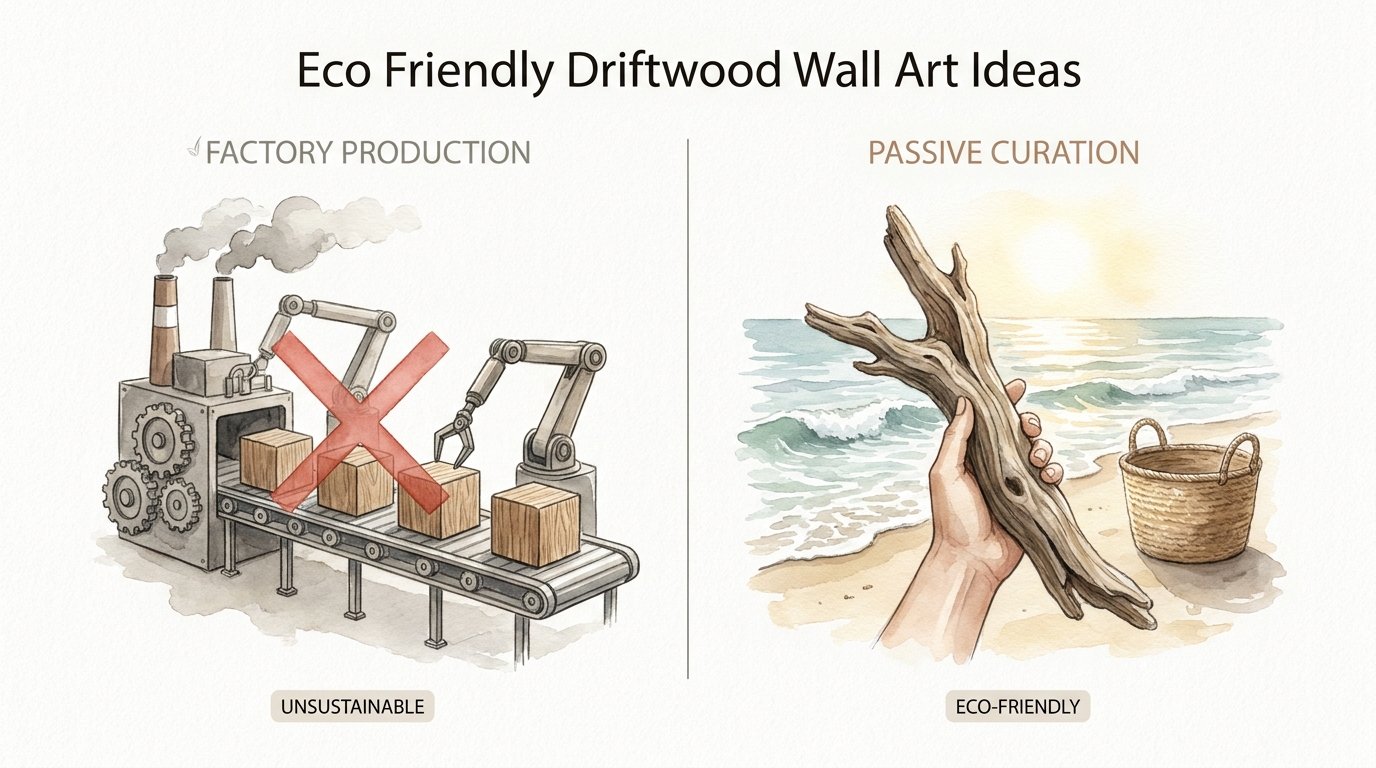
Why pay a factory to burn energy mimicking nature when the tide has already spent decades sculpting the perfect masterpiece for zero cost? We have been trained to think that high-end decor requires massive energy inputs and industrial precision. But the ocean has been working on a better solution for 20 years. Discover why passive curation beats active manufacturing every time when it comes to the soul of your home.
[affiai]Walking along a shoreline after a storm feels like entering a gallery where the artist has just left. Every piece of sun-bleached wood tells a story of survival, current, and time. These are not just sticks; they are the skeletal remains of ancient forests, hardened by salt and smoothed by the relentless movement of the tides.
Bringing these elements into your living space is more than a design choice. It is a commitment to a lifestyle that values what is already here over what must be forced into existence. You are choosing to be a curator rather than just a consumer. This approach respects the natural cycle of the planet while providing your walls with a texture that no machine can replicate.
Eco-friendly driftwood art allows us to bypass the traditional supply chain. Instead of supporting factories that pump out plastic-molded “faux wood” accents, you are pulling beauty directly from the environment. This process of passive curation honors the pioneer spirit of using what the land provides to build a home with character.
Eco Friendly Driftwood Wall Art Ideas
Sustainable decor often focuses on what we should stop doing, but driftwood art focuses on what we can discover. Driftwood is essentially reclaimed wood that has been processed by the Earth’s most powerful recycling system: the hydrosphere. It exists at the intersection of land and sea, offering a rugged aesthetic that fits anywhere from a minimalist urban loft to a classic coastal cottage.
Interior designers increasingly turn to these natural sculptures to introduce biophilic elements into modern homes. Biophilic design is the practice of connecting people with nature within the built environment. Research suggests that the presence of natural wood grains can lower blood pressure and reduce stress levels in occupants. Driftwood, with its visible history of weathering, provides a particularly potent connection to the outdoors.
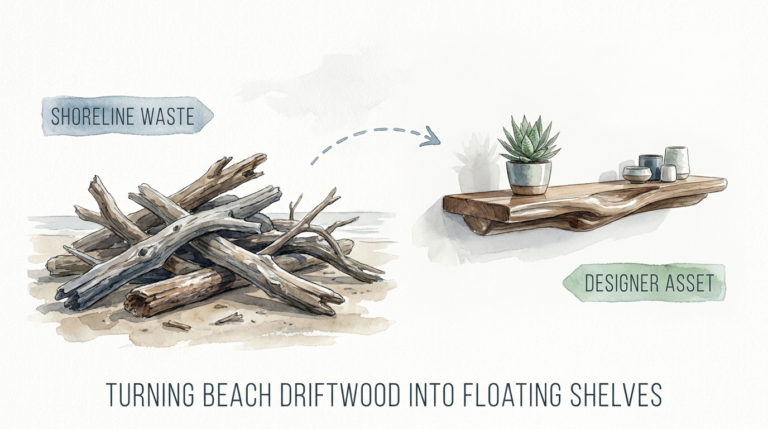
Real-world applications of driftwood art are nearly limitless. A single, massive branch can serve as a “hero” piece over a mantel, drawing the eye with its complex twists and silvery patina. Smaller pieces can be grouped into geometric patterns or used to create functional items like mirrors and shelving. The goal is to let the wood speak for itself rather than over-processing it into something unrecognizable.
Modern Minimalist Sunbursts
Modern sunburst designs use dozens of small, uniform driftwood sticks arranged in a circular pattern. This style mimics the sun’s rays and adds a sense of movement to a flat wall. Choosing pieces with similar diameters creates a clean, intentional look that bridges the gap between raw nature and structured design.
Coastal Statement Panels
Coastal panels involve mounting several vertical or horizontal driftwood planks onto a backing board. These panels act as textured wallpaper, providing a backdrop for other decor or standing alone as a large-scale installation. The variety in wood species—from cedar to oak—ensures that no two panels ever look the same.
Living Driftwood Sculptures
Living sculptures combine the skeletal beauty of the wood with the vibrant green of air plants or moss. Because air plants do not require soil, they can be tucked into the natural crevices and hollows of a driftwood branch. This creates a self-contained ecosystem on your wall that changes and grows over time.
How to Prepare and Preserve Your Finds
Transforming a raw find into a finished piece of art requires a systematic approach to cleaning and stabilizing. Freshly gathered wood often carries salt, sand, and tiny hitchhikers that you do not want in your home. Taking the time to properly treat the wood ensures that your art will last for decades without decaying or attracting pests.
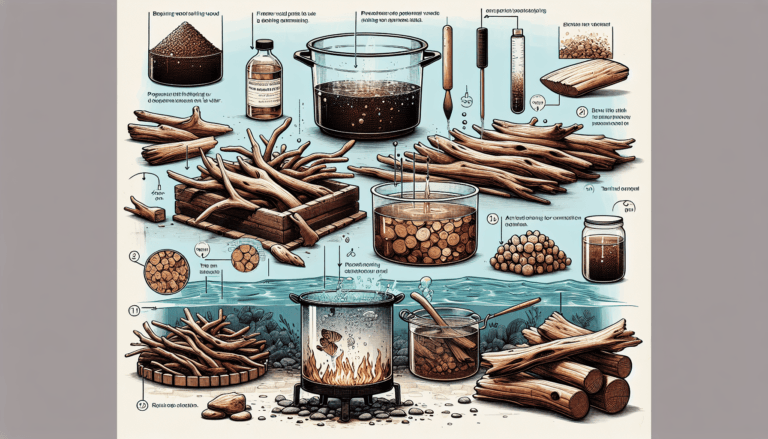
Initial cleaning starts with a stiff-bristled brush and fresh water. Scrub away any loose bark, dried mud, or surface salt. For pieces found in salt water, soaking them in fresh water for several days is necessary to leach out the salt crystals. Salt is hygroscopic, meaning it attracts moisture from the air, which can cause the wood to stay damp and eventually rot if not removed.
Sanitization is the next critical step. A solution of one part bleach to ten parts water is the standard for killing bacteria and insect larvae. Submerge the wood for at least 24 to 48 hours. If the wood is too large for a container, you can use a spray bottle to saturate the surface repeatedly, though soaking is always more effective for reaching deep into the grain.
Drying must be done slowly and thoroughly. Avoid placing wet wood directly in front of a heater, as rapid temperature changes can cause the wood to crack or warp. Let it air dry in a well-ventilated area for at least a week. Serious practitioners often use a moisture meter to ensure the internal humidity of the wood is below 10% before they begin the final assembly.
Finishing touches bring out the hidden depth of the wood. Most driftwood art looks best when left in its natural “drift” state, but a light application of tung oil or beeswax can protect the surface without adding an artificial shine. These natural finishes nourish the wood fibers and highlight the subtle silver and grey tones earned through years of sun exposure.
Benefits of Passive Curation
Choosing to curate driftwood instead of purchasing mass-produced decor offers significant environmental and psychological advantages. The most immediate benefit is the near-zero carbon footprint of the material itself. No trees were felled to create your art; the wood was already “downed” by natural forces and transported to you by water.
Natural materials possess an “imperfection” that machines cannot simulate. This is often referred to as Wabi-sabi, the Japanese aesthetic centered on the acceptance of transience and imperfection. In a world of mass-produced, identical items, a piece of driftwood is a reminder that beauty often lies in the rugged and the weathered. It adds a sense of history and “grit” to a room that feels overly sterile.
Biophilic benefits are backed by environmental psychology. Studies have shown that seeing wood grain and natural textures in a room can lower cortisol levels. This connection to the organic world helps humans feel more grounded and less anxious in their living spaces. Driftwood art serves as a visual anchor, bringing the calming energy of the coastline indoors.
Financial savings are another practical advantage. High-end art galleries often charge thousands of dollars for “reclaimed” sculptures. By becoming your own beachcomber, you are accessing high-quality, unique materials for the cost of a walk on the beach. This makes sophisticated, large-scale wall art accessible to anyone willing to put in the effort of searching and cleaning.
Challenges and Common Mistakes
Working with driftwood is not without its hurdles. One of the most common errors is failing to recognize “punky” or rotten wood. Just because a piece looks beautiful on the sand does not mean it is structurally sound. Always test the integrity of the wood by pressing your thumbnail into it; if it sinks in easily, the wood is likely too soft to hold screws or mounting hardware.
Ignoring the legalities of beachcombing can also lead to trouble. Many state and national parks have strict “leave no trace” policies that prohibit the removal of any natural materials, including driftwood. These rules exist to protect local ecosystems, as driftwood provides vital habitat for birds and prevents shoreline erosion. Always check local regulations before you start loading your truck.
Another frequent mistake is improper mounting. Driftwood is often much heavier than it looks, especially if it is a dense hardwood like oak or mahogany. Using simple nails or adhesive strips is a recipe for a fallen piece of art. Large installations require heavy-duty anchors and a solid understanding of wall stud placement to ensure safety.
Over-processing the wood can strip away the very character that makes it valuable. Using heavy sanders or thick, glossy varnishes can make driftwood look like cheap plastic. The goal of eco-friendly art is to preserve the “passive” work done by nature. Respect the work the ocean has already done by using a light hand during the refinement process.
Limitations and Environmental Constraints
Driftwood art is not a universal solution for every room. In environments with extreme humidity fluctuations, like bathrooms without proper ventilation, untreated driftwood can expand and contract significantly. This movement can cause glue joints to fail or the wood to develop mold if it was not properly sealed.
Weight is a significant constraint for renters or those with thin plaster walls. A large, water-logged root system can weigh upwards of 50 pounds even after drying. Mounting such a piece requires drilling into studs, which may not be an option in every living situation. In these cases, smaller, lightweight branch clusters are a more practical choice.
Sourcing is also limited by geography. If you do not live near a coast, a major river, or a large lake, finding high-quality driftwood requires travel. While you can purchase driftwood online, this introduces shipping emissions into the equation, which slightly detracts from the “zero-waste” philosophy of the project. True passive curation is most effective when it is truly local.
Passive Curation vs. Active Manufacturing
Understanding the difference between these two approaches helps you make better decisions for your home. Active manufacturing relies on high energy inputs, synthetic materials, and a “top-down” design process where a human decides exactly what the final product will look like. Passive curation is a “bottom-up” process where the environment dictates the form, and the human simply chooses how to display it.
| Feature | Factory Production | Passive Curation (Driftwood) |
|---|---|---|
| Carbon Footprint | High (milling, shipping, plastics) | Near Zero (natural transport) |
| Uniqueness | Mass-produced / Identical | One-of-a-kind |
| Material Integrity | Often MDF or Plastic resin | Solid aged hardwood or softwood |
| Cost | Moderate to High | Zero (Sweat equity only) |
| Energy Source | Industrial Grid | Tides, Sun, and Wind |
Factory-produced items are often designed for planned obsolescence. They look good for a season but lack the structural durability of a piece of wood that has survived decades in the open ocean. Choosing driftwood is an investment in a piece of art that has already proven its resilience against the harshest elements on Earth.
Practical Tips for Success
Getting started with your own driftwood project is easier when you have the right tools. Beyond the wood itself, you will need a few essentials to ensure a professional-looking result. A high-quality drill with wood bits is necessary for creating pilot holes. Never try to drive a screw directly into old driftwood without a pilot hole, as the wood is often very brittle and will split instantly.
Use stainless steel or galvanized hardware. Since driftwood often retains trace amounts of salt even after cleaning, standard steel screws can rust over time when exposed to humidity. Stainless steel stays clean and prevents those unsightly rust streaks from appearing on your wall or the wood itself.
Consider the “hang” before you finish. For irregular pieces, finding the center of gravity is the hardest part. Tie a piece of string around different points of the branch and lift it to see how it sits. Once you find the perfect angle, mark the balance point. This is where your primary mounting hardware should go.
Lighting can transform a simple branch into a high-end gallery piece. Using small, battery-operated LED spotlights or “fairy lights” tucked behind the wood can create dramatic shadows on the wall. These shadows emphasize the crags and curves of the wood, making it look much larger and more complex than it actually is.
Advanced Considerations for Large Installations
Serious practitioners often look toward oversized installations that cover entire walls. These projects require a different level of engineering. For pieces weighing over 30 pounds, a French cleat system is the most reliable method. One half of the cleat is screwed into the wall studs, and the other is attached to the driftwood. The two pieces interlock, distributing the weight evenly across the wall.
Integrating driftwood with other materials like metal or glass is another way to level up your designs. Some artists use copper wire to “stitch” multiple pieces of wood together, creating a look that is both organic and industrial. Others may use a piece of driftwood as a base for a glass-topped floating shelf, combining natural texture with modern transparency.
Preservation in high-traffic areas requires more durable finishes. While beeswax is great for a bedroom, a piece in a narrow hallway might need a thin coat of matte polyurethane. This protects the wood from skin oils and accidental bumps without adding a fake-looking shine. Always test your finish on a small, hidden section of the wood first to see how it affects the color.
Example Scenario: The Living Room Focal Point
Imagine a modern living room with clean lines, white walls, and a grey sofa. The space feels “correct” but lacks soul. The homeowner finds a five-foot-long piece of driftwood on a local riverbank. It is a sun-bleached cedar branch with a “twisted” center where two limbs have grown together.
After cleaning and drying the piece, they decide to mount it horizontally above the sofa. Instead of using a single hook, they use two heavy-duty toggle bolts and black industrial-style wire to suspend the branch six inches away from the wall. This creates a “floating” effect that lets shadows play behind the wood.
To finish the look, they tuck three small air plants into the natural hollows of the wood. The result is a statement piece that cost less than fifty dollars in materials but looks like it belongs in a high-end coastal resort. It provides a tactile, organic contrast to the sharp lines of the furniture, making the entire room feel more inviting and lived-in.
Final Thoughts
Embracing eco-friendly driftwood wall art is about more than just filling a space on a wall. It is a way to reclaim our connection to the natural world and reject the “burn energy to make plastic” cycle of modern manufacturing. By choosing passive curation, you are allowing the Earth to be the primary artist in your home.
Building a home with “soul” takes time and effort, but the results are far more rewarding than anything you can buy in a box. Each piece of wood you find and prepare carries the history of its journey. When you look at your wall, you aren’t just seeing decor; you are seeing a testament to the power and patience of nature. We encourage you to head to the nearest shoreline after the next big rain. Look for the silver, the grey, and the twisted. Your next masterpiece is already waiting for you, sculpted by the sea and delivered to your feet for free.
Sources
1 hometalk.com (https://www.hometalk.com/diy/decorate/rooms/q-how-to-hang-a-large-heavy-driftwood-piece-42096700) | 2 oldplank.com (https://oldplank.com/blog/sustainable-living-the-environmental-benefits-of-choosing-reclaimed-wood/) | 3 dksstores.com (https://dksstores.com/blog-post6) | 4 specialeditionart.com (https://specialeditionart.com/blogs/theoracle/how-to-hang-driftwood-on-your-wall-a-comprehensive-guide) | 5 goodearthplants.com (https://goodearthplants.com/wood-as-a-biophilic-element/) | 6 elmwoodreclaimedtimber.com (https://www.elmwoodreclaimedtimber.com/blog/biophilic-design-benefits-reclaimed-sustainable-woods/) | 7 thinkwood.com (https://www.thinkwood.com/wood-construction-benefits/biophilic-design) | 8 naturallywood.com (https://www.naturallywood.com/wood-performance/health-biophilia/) | 9 markslumber.us (https://markslumber.us/blog/biophilic-design-the-health-benefits-of-using-wood-products-in-your-home) | 10 lakewedoweelife.com (https://www.lakewedoweelife.com/lake-life/driftwood-art-and-treasures-by-tammy-lovvorn) | 11 coco-papaya.com (https://www.coco-papaya.com/en/blog/ethnic-decoration-handicrafts-from-around-the-world/driftwood-decoration-a-unique-and-natural-choice-to-beautify-your-interior) | 12 wikihow.com (https://www.wikihow.com/Preserve-Driftwood) | 13 reddit.com (https://www.reddit.com/r/Washington/comments/t0hpgt/is_it_legal_to_harvest_driftwood_for_firewood/) | 14 quora.com (https://www.quora.com/Is-it-illegal-to-take-driftwood-from-a-beach) | 15 99wfmk.com (https://99wfmk.com/michigan-driftwood-collection-rules/) | 16 etwoodcrafts.com (https://etwoodcrafts.com/blogs/news/how-to-hang-heavy-wooden-art) | 17 tailorwoodhaven.com (https://tailorwoodhaven.com/blogs/wood-wall-art/driftwood-wall-art-diy-ideas-to-transform-your-space) | 18 woodburncorner.com (https://www.woodburncorner.com/burnblog/the-best-hanging-options-for-wood-art-and-pyrography-pieces) | 19 skylineworkshop.com (https://www.skylineworkshop.com/blogs/news/heavy-wall-art-heres-how-best-to-hang-it) | 20 coohom.com (https://www.coohom.com/article/creative-ideas-for-large-driftwood-wall-decor)