How To Decorate With Large Driftwood
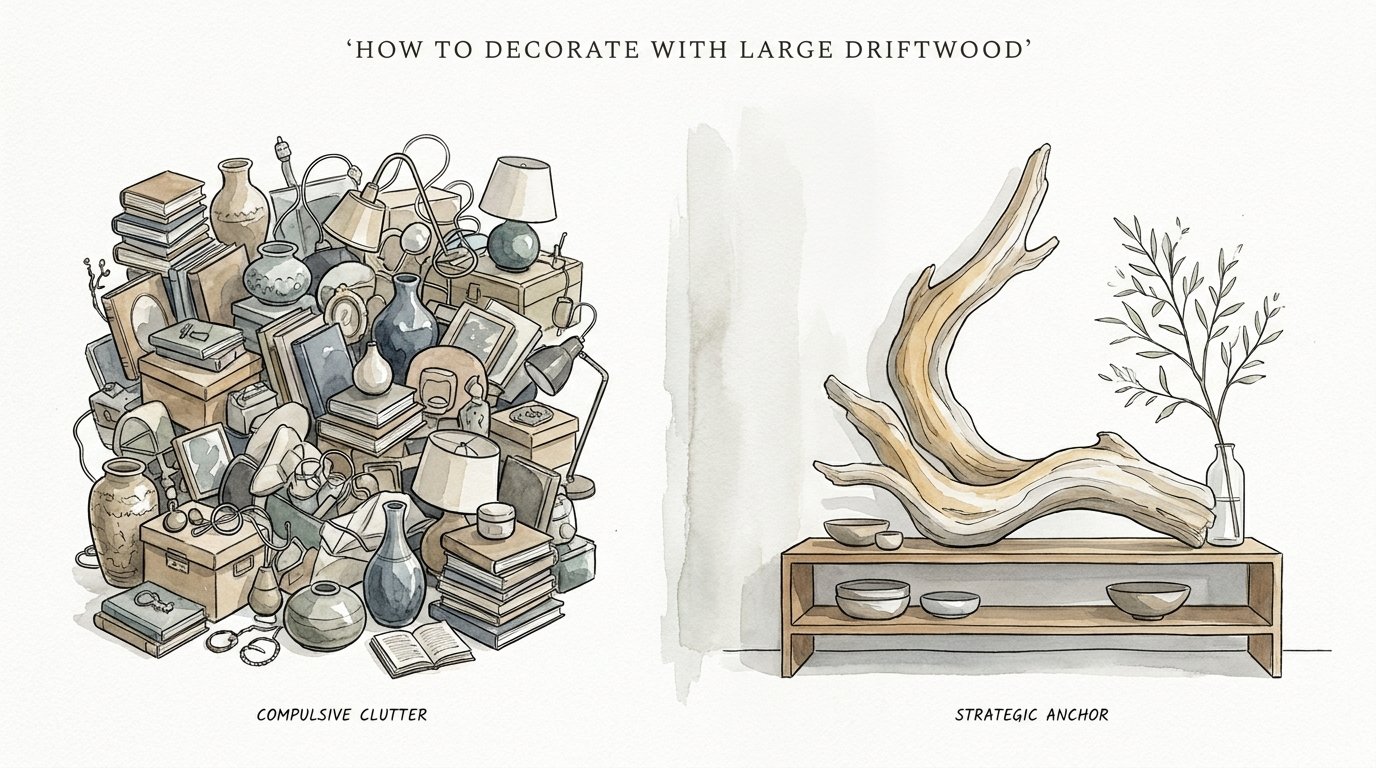
Are you working too hard to buy a vibe when one strategic piece of the ocean architecture could do all the work for you? Most people try to achieve the coastal look by buying dozens of small trinkets, creating visual noise and constant cleaning. The strategic designer finds one massive, salt-cured anchor that tells a story and does the work of an entire room decor in a single mount.
[affiai]Choosing to work with large driftwood is a commitment to honesty in materials. You are not just hanging a piece of wood; you are installing a witness to the sea’s power. This approach rejects the clutter of mass-produced plastic shells in favor of a singular, weather-beaten statement that requires grit to prepare and wisdom to place.
In this guide, you will learn how to source, sanitize, and secure these behemoths of the beach. We will move past the superficial and into the structural, ensuring your home feels grounded by nature rather than crowded by it.
How To Decorate With Large Driftwood
Decorating with large driftwood means moving beyond the shelf-sized twig and embracing the architectural potential of water-sculpted timber. These pieces are often the remains of massive root systems or heartwood from ancient trees that have spent months or years being sand-blasted by tides and bleached by the sun. They exist as raw, sculptural elements that bridge the gap between interior design and natural history.
In real-world situations, large driftwood serves as a focal point that anchors a room’s aesthetic. A single six-foot limb mounted above a fireplace or a gnarled stump serving as the base for a glass table provides a sense of scale that smaller items cannot replicate. Designers use these pieces to introduce “organic irregularity” into modern spaces that are often too dominated by sharp angles and flat surfaces.
Think of a large piece of driftwood as a room’s “strategic anchor.” In the same way a heavy iron stove anchors a cabin, a massive piece of sea-weathered oak or cedar anchors a living space. It provides a visual resting place, drawing the eye and quieting the surrounding decor.
The Process: From Shoreline to Showpiece
Taking a piece of the wild and bringing it indoors requires a systematic approach to ensure it is both safe and stable. You cannot simply drag a log into your living room without consequences. The wood must be cured, cleaned, and properly treated to prevent rot or pest infestations.
Preparation begins with a deep cleaning. You must remove the salt, sand, and organic debris trapped in the deep crevices of the grain. Use a stiff nylon brush and a high-pressure hose to blast out the surface grit. For larger pieces, a soak in a solution of one part bleach to ten parts water is necessary to kill any wood-boring insects or mold spores. If the piece is too large for a container, you must saturate the wood repeatedly with the solution and allow it to penetrate.
Curing is the next critical step. Driftwood found on the beach is often waterlogged or holds high internal moisture. Bringing damp wood into a climate-controlled home causes it to shrink, crack, or grow mildew. Place your piece in a shaded, well-ventilated area for several weeks. Avoid direct sunlight during this initial drying phase, as rapid evaporation can cause the wood to check or split prematurely. Once the wood feels light and sounds hollow when tapped, it is ready for finishing.
Finishing should remain minimal to preserve the “pioneer-grit” aesthetic. A light application of linseed oil or beeswax can deepen the color without adding a synthetic sheen. If you prefer the silver-gray look of sun-bleached wood, a simple clear matte sealant is sufficient to lock in the fibers and prevent splintering.
Benefits of the Strategic Anchor Approach
One massive piece of driftwood provides measurable psychological and aesthetic advantages. In the realm of biophilic design, natural wood elements are proven to lower cortisol levels and reduce heart rate. The complex, non-repeating patterns of the wood grain provide “soft fascination,” a type of visual interest that allows the brain to rest and recover from the high-intensity focus required by digital screens.
Sustainability is another significant advantage. Unlike furniture manufactured from virgin timber, driftwood is salvaged material. You are effectively reclaiming a waste product of the natural world. This reduces the carbon footprint of your decor and ensures that your home features materials that were never part of an industrial supply chain.
Durability is inherent in sea-cured wood. Driftwood that has survived the ocean’s salt and constant motion is typically the heartwood—the densest and most resistant part of the tree. When properly treated and kept indoors, these pieces will outlast any piece of particle-board furniture. They do not go out of style because they were never in style; they are timeless elements of the physical world.
Challenges and Common Mistakes
The most frequent error in driftwood decorating is underestimating the weight of the material. A piece of driftwood that looks airy and spindly can still weigh forty to sixty pounds once it is fully dried. Failing to secure the piece into wall studs or using inadequate anchors leads to structural failure and potential injury.
Another common pitfall is the “clutter creep.” People often find a great piece of driftwood and then feel the need to surround it with other coastal items like nets, anchors, or jars of sand. This dilutes the power of the strategic anchor. To maintain the authoritative tone of the piece, it must be allowed to stand alone. The negative space around the wood is as important as the wood itself.
Ignoring the “pests and salt” factor is a mistake that shows up months later. Salt is hygroscopic, meaning it pulls moisture from the air. If you do not thoroughly leach the salt out of the wood, your driftwood may feel damp on humid days, leading to surface mold or damage to the wall it is mounted against. Likewise, wood-boring beetles can lie dormant for months before emerging to feast on your floorboards. Never skip the sanitation phase.
Limitations and Environmental Constraints
Driftwood decor is not suitable for every environment. In extremely humid climates, untreated driftwood can act as a sponge, encouraging the growth of mildew. Conversely, in very dry homes with intense central heating, the wood may continue to dry and crack, producing audible “pops” as the internal fibers shift. This is a natural process, but it may be distressing to those who prefer pristine, unchanging furniture.
Environmental ethics also place limits on where and how you can forage. Many coastal regions prohibit the removal of driftwood because it provides critical habitat for beach-dwelling organisms and helps prevent shoreline erosion. Always check local regulations in states like California or Oregon, where there are often strict limits on the weight or number of pieces you can legally remove.
Scale is the final limitation. A piece of driftwood that looks small on a vast, open beach will look gargantuan in a standard eight-foot-ceiling apartment. You must measure your space with precision before committing to a piece, as an oversized limb can make a room feel cramped and claustrophobic rather than expansive and natural.
Natural Driftwood vs. Synthetic Reproductions
| Feature | Natural Driftwood | Synthetic/Resin Cast |
|---|---|---|
| Visual Integrity | High; unique grain and texture. | Moderate; repeating patterns. |
| Durability | Exceptional if cured. | High, but prone to chipping. |
| Maintenance | Requires initial curing/cleaning. | Zero initial prep; dust only. |
| Eco-Impact | Low; reclaimed material. | High; plastic/petrochemicals. |
| Installation | Complex; heavy and irregular. | Simple; lightweight and uniform. |
Practical Tips for Wall Mounting
Securing a heavy, irregular object to a vertical surface requires more than just a nail. You should use a French cleat for the most stable installation. A French cleat consists of two interlocking strips of wood or metal, one mounted to the wall and one to the back of the driftwood. This system distributes the weight across multiple wall studs and allows for slight horizontal adjustments.
If the wood is too gnarled for a flat cleat, consider using heavy-duty toggle bolts or lag screws driven directly into the studs. Always pre-drill your pilot holes in the driftwood to prevent the ancient, brittle fibers from splitting. Use a stud finder to locate the structural framing of your house; never rely on drywall alone to hold the weight of a large limb.
Lighting is the final touch for a successful mount. Avoid flat, overhead lighting which washes out the texture. Instead, use directional spotlights or wall washers positioned at an angle. This creates long shadows within the wood’s crevices, emphasizing the gnarled character and making the piece appear more three-dimensional.
Advanced Considerations: Structural Integration
For those looking to go beyond a simple wall mount, large driftwood can be integrated into the architecture of the home. This includes using a massive, vertical trunk as a structural-looking pillar in a corner or suspending a horizontal limb from the ceiling to serve as a natural chandelier.
When suspending wood, use high-tensile steel aircraft cable rather than rope. While rope fits the aesthetic, it can stretch over time, leading to an unlevel fixture. For lighting, wrap the limb in thin-gauge copper LED wires or drill discreet channels to hide the wiring for Edison-style bulbs. This turns the wood into a functional light sculpture that provides a warm, amber glow, perfect for highlighting the silver and gray tones of the bark.
Consider the “negative space” in your room. An advanced practitioner of this style knows that the wall behind the driftwood should be a neutral, matte color. A busy wallpaper or a bright, glossy paint will fight with the complex texture of the wood. A soft charcoal, a deep forest green, or a simple warm white allows the driftwood’s silhouette to remain the primary focus.
Scenario: The Living Room Sentinel
Imagine a living room with a minimalist, modern design: white walls, a gray linen sofa, and concrete floors. In the corner stands a seven-foot-tall piece of cedar driftwood, found at the mouth of a northern river. It is gnarled at the base where the roots once gripped the earth and smoothed at the top where the water polished it.
This “sentinel” piece eliminates the need for floor lamps, corner shelves, or potted plants. It provides height and verticality to the room. By lighting it from the floor with a small, warm-toned LED uplight, the shadows of its branches extend across the ceiling, creating a sense of movement and depth. The room feels complete, not because it is full of objects, but because it is anchored by a single, powerful element.
In another scenario, a five-foot horizontal limb is mounted above a dining table. Instead of a traditional art gallery wall, this single piece of wood occupies the space. It acts as a conversation starter, its silvered grain reflecting the light of the candles on the table. The “visual noise” of the room is reduced, allowing the company and the meal to take center stage.
Final Thoughts
Decorating with large driftwood is an exercise in restraint and respect for the natural world. It requires you to stop “buying a vibe” and start curating an environment. By selecting one strategic anchor, you free yourself from the cycle of cleaning and organizing small, meaningless trinkets. You trade clutter for character.
Success with this medium comes down to the preparation. Do not rush the cleaning or curing process. Respect the weight and the history of the wood by using proper structural hardware. When you treat a piece of sea-cured timber with the same care you would a piece of fine furniture, it rewards you with a presence that no factory-made item can match.
Experiment with the placement and lighting of your piece. Observe how the shadows change throughout the day as the sun moves. You will find that a large piece of driftwood is not a static object; it is a living part of your home’s architecture that continues to tell the story of the elements long after it has left the shore.
Sources
1 bulkreefsupply.com (https://fresh.bulkreefsupply.com/content/post/driftwood-hardscapes) | 2 hygger-online.com (https://www.hygger-online.com/choose-the-best-driftwood-before-building-aquariums/) | 3 aqua-fish.net (https://en.aqua-fish.net/articles/aquarium-driftwood-faq-guide) | 4 homify.co.uk (https://www.homify.co.uk/diy/12998/5-things-used-to-preserve-driftwood-and-make-it-home-decor) | 5 youtube.com (https://www.youtube.com/watch?v=bibML6DW_7Y) | 6 lakewedoweelife.com (https://www.lakewedoweelife.com/lake-life/driftwood-art-and-treasures-by-tammy-lovvorn) | 7 naturallywood.com (https://www.naturallywood.com/wood-performance/health-biophilia/) | 8 taigaconcept.fi (https://taigaconcept.fi/blog/wooden-surfaces-in-biophilic-design-bringing-calm-and-focus) | 9 Source (https://www.google.com/search?q=time+in+Fresno+County,+US) | 10 youtube.com (https://www.youtube.com/watch?v=3XiawA03X0E) | 11 weyerhaeuser.com (https://www.weyerhaeuser.com/blog/the-benefits-of-biophilic-design-and-the-role-of-cedar/) | 12 skylineworkshop.com (https://www.skylineworkshop.com/blogs/news/heavy-wall-art-heres-how-best-to-hang-it) | 13 theshrimpfarm.com (https://www.theshrimpfarm.com/posts/transform-your-tank-choosing-the-best-aquarium-driftwood-for-a-natural-aquascape/) | 14 parklanejewelry.com (https://www2.parklanejewelry.com/how-to-wash-driftwood/) | 15 mixtiles.com (https://www.mixtiles.com/blog/wall-art-home-decor/how-hang-heavy-art-wall) | 16 etwoodcrafts.com (https://etwoodcrafts.com/blogs/news/how-to-hang-heavy-wooden-art) | 17 clidesign.com (https://clidesign.com/the-art-of-lighting-sculptures-in-interior-design/) | 18 dksstores.com (https://dksstores.com/blog-post49) | 19 specialeditionart.com (https://specialeditionart.com/blogs/theoracle/how-to-hang-driftwood-on-your-wall-a-comprehensive-guide)