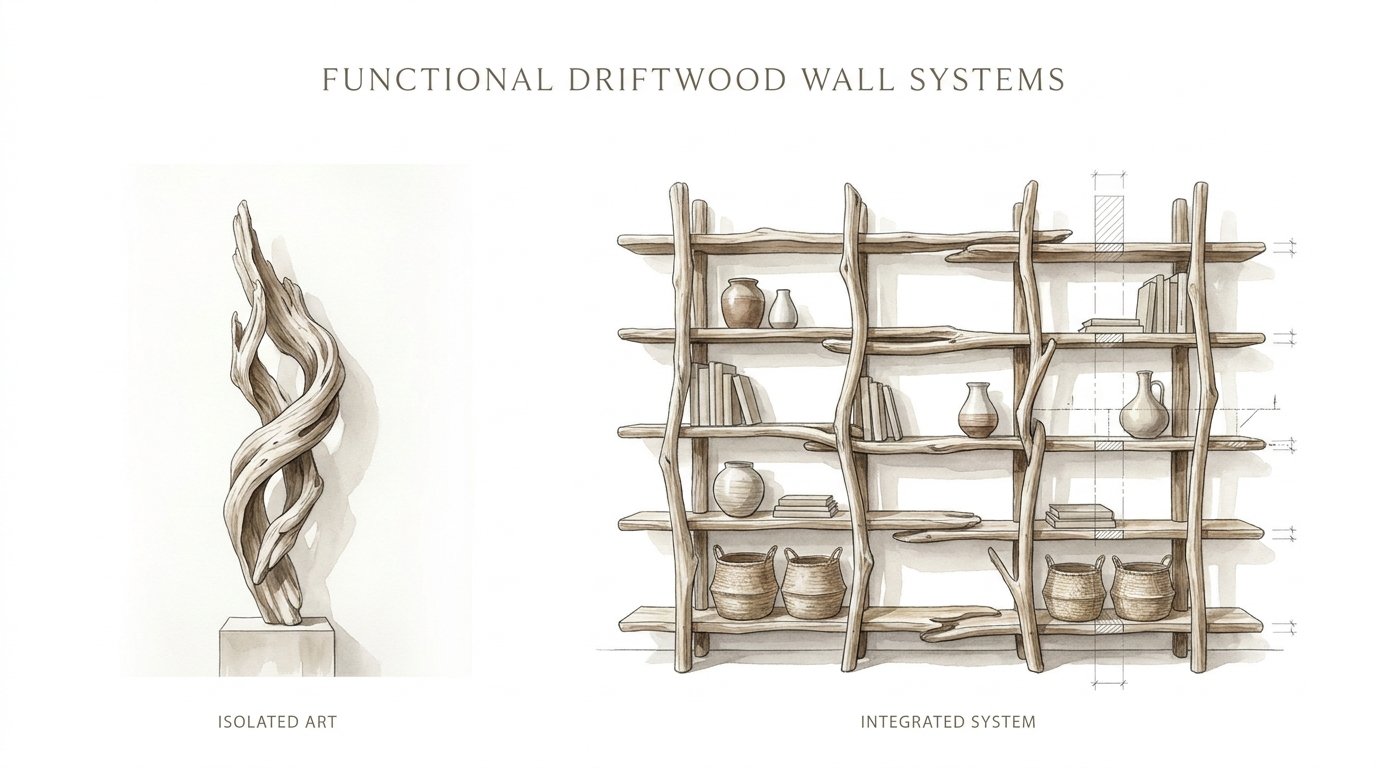
Functional Driftwood Wall Systems
A picture frame just takes up space; a driftwood system provides a habitat for your entire daily routine. Isolated decor is a dead end for your wall space. Using the natural, multi-dimensional architecture of driftwood, you can create a system that holds your life, your plants, and your light in one beautiful, organic flow.
[affiai]Standard interior design often treats the wall as a flat canvas for hanging objects. This approach misses the opportunity to treat the vertical plane as a functional landscape. A driftwood system rejects the idea of the “accent piece” in favor of an integrated structure that serves a purpose. Whether you are supporting a heavy shelf, anchoring a lighting array, or creating a vertical garden, these weathered timbers offer a structural integrity that factory-made solutions cannot replicate.
Transitioning to an integrated system requires a shift in mindset. You are no longer looking for a pretty branch; you are scouting for a chassis. This article explores the mechanics, the physics, and the gritty reality of building wall systems out of the ocean’s refuse. It is a guide for those who want their home to feel less like a showroom and more like a rugged, living environment.
Functional Driftwood Wall Systems
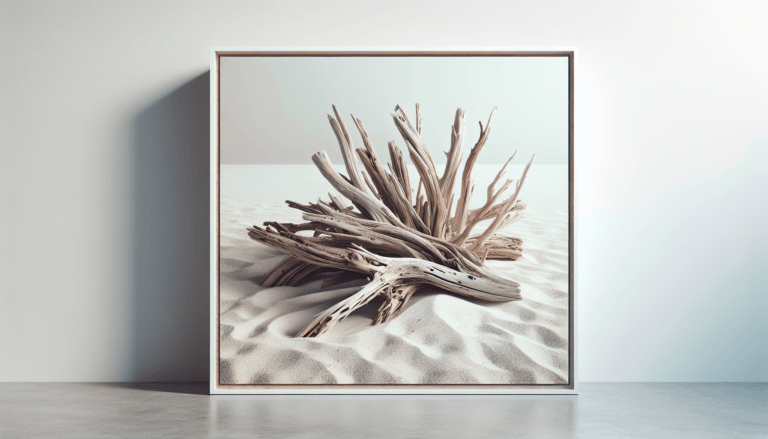
A functional driftwood wall system is a structural installation that uses reclaimed, weathered wood as the primary load-bearing or utility-providing element. Unlike a piece of art that simply hangs, a system interacts with its environment. It might house hidden LED channels, support cantilevered shelving, or provide the organic trellis for epiphytic plants. These systems exist because modern living often feels disconnected from the tactile, irregular realities of nature. Bringing in a massive, salt-cured timber reintroduces a sense of permanence and grit into a room.
Real-world application of these systems ranges from mudroom organizers to full-scale living room biomes. In a hallway, a single, sturdy limb can act as a high-capacity coat rack and key station. In a bedroom, a sprawling branch can serve as a headboard that also supports reading lights and integrated shelving. The “driftwood” label often refers to wood found on beaches, but the same principles apply to forest-floor “ghost wood” or river-recovered timber. The common thread is the weathering process—years of sun, water, and wind have stripped away the soft sapwood, leaving behind a hardened, rot-resistant core of lignin and heartwood.
Think of these systems as the skeleton of your wall. A thin piece of drywall cannot handle the torque of a heavy, irregular branch on its own. You are building a bridge between the wild, unpredictable shape of the wood and the rigid, 16-inch-on-center reality of your home’s framing. Successful systems respect both the natural history of the timber and the structural requirements of modern architecture.
How to Build and Install an Integrated System
Building a functional wall system starts long before you pick up a drill. The process is a sequence of harvesting, sanitizing, and engineering. Every piece of wood has a history written in its grain, but it also potentially carries hitchhikers like salt, mold, or insects that you do not want in your home.
Sourcing and Legalities
Responsible harvesting is the first rule of the woods. Federal and state laws often regulate the collection of driftwood to protect coastal ecosystems. Public lands like National Parks usually prohibit the removal of any natural material. State parks often have weight limits, sometimes allowing only one piece or up to 50 pounds per person per day. Always verify local regulations before you start lugging timber to your truck. Private property is usually the safest bet, provided you have explicit permission from the owner.
Preparation and Sanitization
Freshly found wood is a liability. It is heavy with moisture and potentially infested. You must begin by cleaning the exterior with a stiff brush or a high-pressure washer to remove sand, loose bark, and debris. Once the surface is clean, sanitization is mandatory. A solution of one part bleach to nine parts water is standard for soaking smaller pieces for 24 hours. For massive timbers that cannot be submerged, you can use a concentrated spray-down and wrap the wood in plastic to let the fumes work.
Drying is the most time-consuming phase. Large pieces of cedar or oak can take months or even years to reach an equilibrium moisture content suitable for indoor use. Attempting to mount “green” wood will result in warping, checking, and potentially pulling your anchors right out of the wall as the wood shrinks. Store the wood in a dry, well-ventilated area, elevated off the ground, until a moisture meter reads below 12%.
The Physics of Mounting
Installing a functional system requires more than a few nails. Because driftwood is rarely flat, you must create flat mounting points or use hardware that accommodates irregularity.
- Stud Integration: Never rely on drywall anchors for structural systems. You must locate the wall studs using a high-quality sensor. Your primary load-bearing screws must penetrate at least two inches into the solid wood of the stud.
- Dowel Screws: For a “floating” look, use 1/4-inch x 2 1/2-inch dowel screws. Half the screw goes into the wood, and the other half into a wall anchor or stud. This is ideal for lighter systems like hat racks or small plant holders.
- Pipe Brackets: Using black iron pipe as a hidden support is a classic “pioneer-grit” technique. Thread a pipe into a flange mounted on a stud, then drill a corresponding hole into the driftwood and slide it over the pipe. This provides immense cantilever strength for heavy shelving.
- French Cleats: For wide, flat-backed driftwood sections, a wooden French cleat allows you to distribute weight across multiple studs while making the piece easy to remove for maintenance.
The Practical Benefits of Organic Systems
Choosing a driftwood system over a modular steel rack is a decision rooted in both aesthetics and psychology. Biophilic design—the practice of connecting indoor spaces with the natural world—has measurable benefits. Research indicates that exposure to natural wood textures can lower heart rates, reduce blood pressure, and decrease cortisol levels. In an office environment, these systems have been shown to increase productivity by up to 15%.
Beyond the mental health benefits, driftwood is structurally superior in specific contexts. Weathered wood has already been through nature’s “durability assembly line.” The sun has bleached out the sugars that attract insects, and the water has washed away the soft tissues. What remains is a dense, impact-resistant structure. Unlike particleboard or cheap pine, a properly cured piece of driftwood will not sag over time. It offers a high strength-to-weight ratio, especially in species like Cedar, White Oak, or Manzanita.
Furthermore, these systems are inherently sustainable. You are not commissioning a factory to harvest new timber, process it with glues and resins, and ship it across an ocean. You are reclaiming a piece of carbon that was already headed for decomposition. This is a low-energy, high-utility approach to furnishing a home.
Common Challenges and Pitfalls
The most frequent mistake in driftwood construction is underestimating the torque. Because a branch might extend far from the wall, it acts as a lever. A ten-pound branch that sticks out two feet exerts much more force on its mounting point than a ten-pound picture frame. If you do not anchor into studs, the weight will eventually “cheese-cutter” through your drywall.
Leveling is another significant challenge. Driftwood does not have straight lines. If you are building a shelf, you cannot just trust your eyes. You must use a spirit level on the actual shelf surface, not the branch supporting it. This often requires “shimming” or carving out a small flat notch in the wood where the shelf will sit.
Pests are a hidden danger. Even if the wood looks clean, wood-boring beetles can live deep inside the heartwood for years. If you don’t heat-treat the wood (reaching an internal temperature of 133°F for several hours) or use a borate-based preservative, you risk introducing an infestation to your home’s structural framing.
Limitations and Environmental Constraints
Driftwood systems are not a universal solution. In high-humidity environments like a small, poorly ventilated bathroom, untreated driftwood can absorb moisture, leading to mold growth and odor. While some specialized panels like the “Naturhardpanel-W” are designed for moisture-rich zones, raw driftwood needs a high-quality marine-grade sealant if it’s going to live near a shower.
Weight is the ultimate boundary. In some modern “thin-wall” constructions or rentals with strict “no-hole” policies, a massive driftwood installation is simply not feasible. You cannot hang a 50-pound timber with Command strips. Additionally, the irregular shape makes these systems difficult to clean. Dust settles in the deep grooves and crevices of the weathered grain, requiring a vacuum with a brush attachment rather than a simple wipe-down.
System Comparison: Modular vs. Driftwood
Understanding the trade-offs between a standard manufactured system and a custom driftwood system is essential for planning your budget and time.
| Factor | Standard Modular Shelving | Functional Driftwood System |
|---|---|---|
| Cost | $50 – $500 (Predictable) | Free to $200 (Sourcing vs. Hardware) |
| Installation Time | 1 – 2 hours | 10 – 40 hours (including prep) |
| Weight Capacity | High (per manufacturer specs) | Very High (if stud-mounted) |
| Skill Level | Beginner | Intermediate to Advanced |
| Durability | Moderate (Particleboard wears out) | Extreme (Weathered heartwood) |
Practical Tips and Best Practices
If you are ready to start your build, keep these tactical tips in mind to ensure a professional result.
- Test the Weight: Before mounting, weigh your wood. Use a luggage scale to get an accurate reading. Ensure your anchors and screws are rated for at least double that weight to account for the leverage (torque).
- Hide the Wires: If you are integrating lighting, use a router or a Dremel tool to carve a thin channel along the back of the branch. This allows you to tuck LED strips or wires out of sight, maintaining the organic silhouette.
- Use Borax: For an eco-friendly pesticide, dissolve Borax in warm water and saturate the wood. It creates a salt barrier that is toxic to most wood-destroying organisms but safe for humans and pets.
- Sanding Strategy: Do not over-sand. Use a light touch with 120-grit paper to remove splinters while preserving the “silver” patina of weathered wood. If you sand too deep, you’ll reveal the yellow or tan inner wood, losing the driftwood aesthetic.
Advanced Considerations: Integrated Biomes
For the serious practitioner, a driftwood system can become a self-contained ecosystem. Integrated biomes use the wood as a substrate for living plants. Epiphytes—plants like Tillandsia (air plants) or certain orchids—do not need soil. They grow on the surface of the wood, drawing moisture from the air.
Advanced setups use hidden drip lines or internal reservoirs. You can drill a hollow channel through a vertical driftwood “trunk” to hide a 1/4-inch irrigation line. This line feeds a misting system at the top of the wall, allowing you to water a dozen plants at once without removing them from the wall. This requires careful consideration of drainage. Seal the wood with a high-build epoxy in any area where water might pool to prevent rot.
When integrating light, consider the CRI (Color Rendering Index). If you want your plants to thrive, use LEDs with a CRI above 90 and a color temperature of 5000K-6500K. Mounting these lights directly into the underside of a driftwood branch provides the necessary spectrum for the plants while creating a dramatic “glow” that highlights the wood’s texture.
Example Scenario: The Entryway Hub
Imagine a small, cluttered entryway in a coastal home. The owners replace their flimsy wire rack with a six-foot piece of storm-tossed cedar. They mount the cedar horizontally across three studs using 5-inch structural screws.
To make it functional, they drill four 1/2-inch holes at a slight upward angle and glue in 4-inch pegs made from smaller, smoothed driftwood twigs. These become heavy-duty coat hooks. On the top edge, they carve a flat 2-foot section and attach a thick piece of tempered glass, creating a shelf for mail and keys. Finally, they wrap a low-voltage Edison bulb pendant around a natural crook in the wood.
The result is a system that handles 80 pounds of winter coats, provides a landing spot for daily carry items, and illuminates the hallway. It feels intentional, rugged, and permanent. The cost was less than $40 in hardware, but the value added to the home’s character is immeasurable.
Final Thoughts
Functional driftwood wall systems represent a return to a more tactile, honest way of building. You are taking a material that the world discarded and giving it a new life as a structural backbone for your home. This process is not as fast as a trip to a big-box furniture store, but the result is a one-of-a-kind installation that tells a story of tide and time.
Embrace the irregularities. The knots, the cracks, and the twists are not flaws; they are the features that make the system work. By respecting the physics of the wood and the integrity of your walls, you can create a habitat that feels both ancient and perfectly suited for modern life. Start with a small project—perhaps a single branch for hats—and work your way up to full-wall systems. The grit you put into the preparation will pay off in a structure that lasts a lifetime.
Sources
1 wordpress.com (https://mikesdriftwood.wordpress.com/why-driftwood/) | 2 dirtt.com (https://www.dirtt.com/insights/the-benefits-of-biophilic-design/) | 3 quora.com (https://www.quora.com/How-is-furniture-made-from-driftwood-different-from-other-wooden-furniture) | 4 vietaquaticwoods.com (https://vietaquaticwoods.com/driftwood-lamps/) | 5 99wfmk.com (https://99wfmk.com/michigan-driftwood-collection-rules/) | 6 cornell.edu (https://www.law.cornell.edu/regulations/california/14-CCR-4306) | 7 doityourself.com (https://www.doityourself.com/stry/driftwood-home-decor-diys) | 8 hometalk.com (https://www.hometalk.com/diy/decorate/rooms/q-how-to-hang-a-large-heavy-driftwood-piece-42096700) | 9 integrishealth.org (https://integrishealth.org/resources/on-your-health/2024/january/biophilic-design) | 10 parklexprodema.com (https://parklexprodema.com/usa/blog/biophilic-design-with-wood-finishes/) | 11 specialeditionart.com (https://specialeditionart.com/blogs/theoracle/how-to-hang-driftwood-on-your-wall-a-comprehensive-guide) | 12 Source (https://www.google.com/search?q=time+in+United+States+of+America) | 13 theroomsart.com (https://theroomsart.com/driftwood-wall-decor-guide/) | 14 youtube.com (https://www.youtube.com/watch?v=aJBc3ae0-mw)