Minimalist Driftwood Wall Organization
Your home isn’t too small; it just lacks the organic logic that the coastline has been using for eons to organize the wild. We often think ‘organization’ means plastic bins and metal grids. But the ocean offers a more peaceful kind of order. A single, well-placed piece of coastal timber can turn your morning chaos into a moment of visual zen.
[affiai]When we talk about bringing order to a living space, we are really talking about managing energy. A cluttered entryway or a tangled jewelry box isn’t just a physical mess; it is a drain on your mental focus. Using materials shaped by the sea allows you to tap into a design language that feels ancient and sturdy. This isn’t about mere decoration. It is about a functional partnership between the rugged outdoors and the sanctuary of your home.
Coastal timber, or driftwood, carries a history of resilience. It has survived salt, sun, and the crushing weight of the tides. When you mount a piece of this wood on your wall, you aren’t just adding a hook; you are anchoring your daily routine to something that has already stood the test of time. This guide will walk you through the process of selecting, treating, and installing driftwood systems that turn clutter into a curated experience.
Minimalist Driftwood Wall Organization
Minimalist driftwood wall organization is the practice of using naturally weathered wood to create functional storage solutions that emphasize clean lines and organic textures. In a world dominated by mass-produced plastic, this approach prioritizes sustainability and individual character. Every piece of driftwood is unique, meaning your organization system becomes a one-of-a-kind installation rather than a carbon copy of a catalog page.
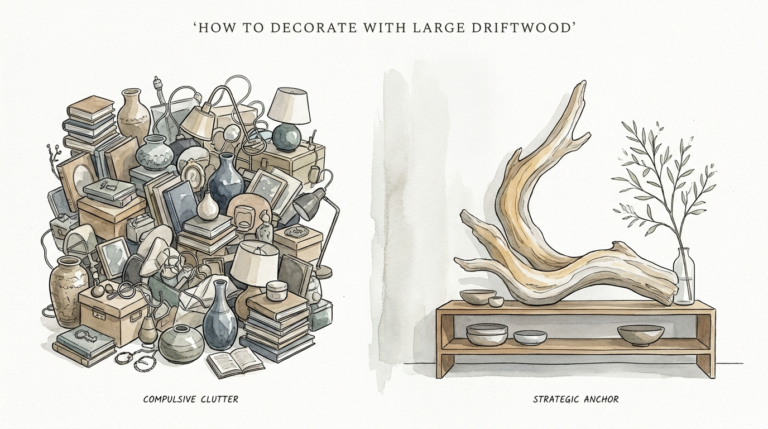
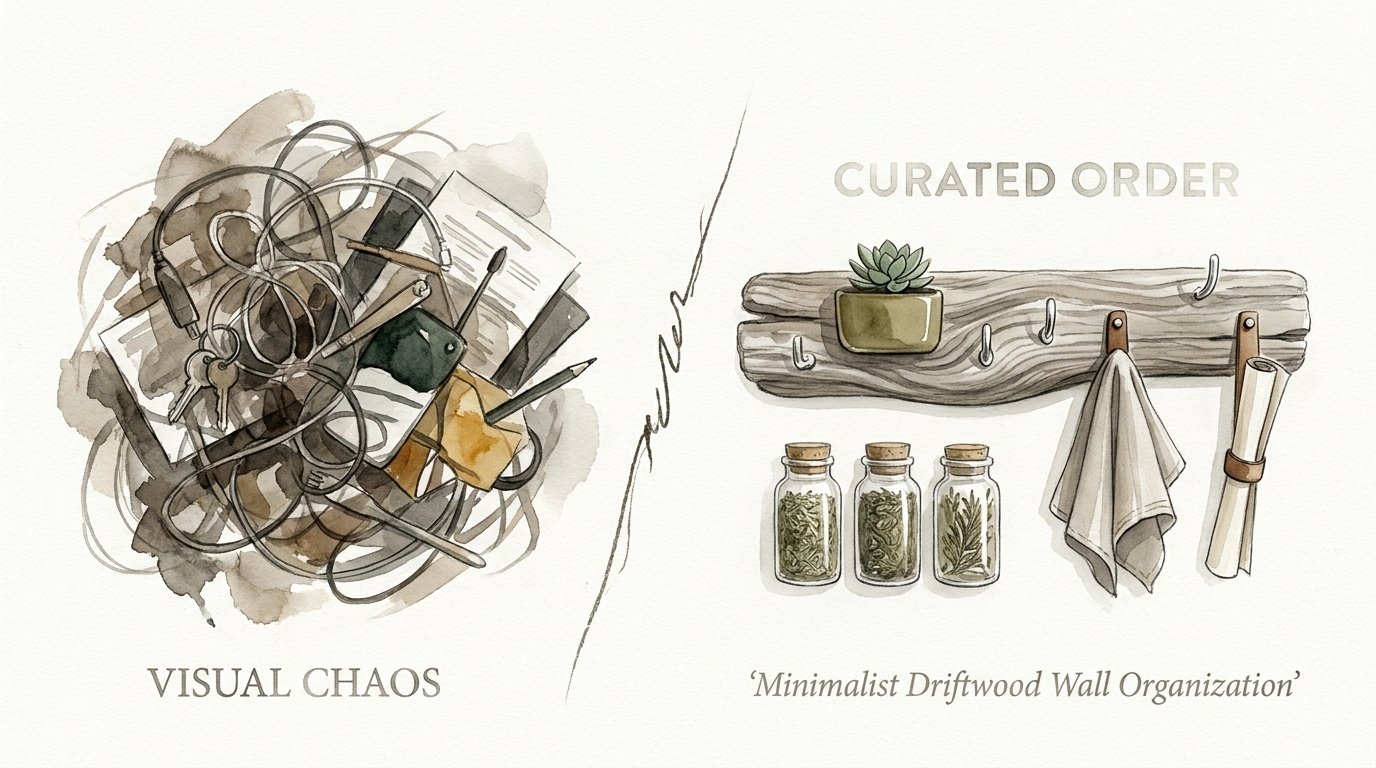
In real-world terms, this might look like a single, silver-grey branch mounted in an entryway to hold keys and hats. It could be a sturdy, sun-bleached log serving as a floating shelf for a few essential books. The concept exists because humans have a biological pull toward natural materials—a concept known as biophilic design. It is used in modern apartments to break up the “visual chaos” of sharp corners and in rustic homes to reinforce a connection to the land.
The beauty of this method lies in its “curated order.” Instead of hiding your belongings in a drawer, you are giving them a stage. When your keys hang from a weathered knot or your necklaces drape over a smooth, water-worn branch, the items themselves look less like clutter and more like part of a composition. This shift in perspective is the hallmark of a minimalist, nature-focused home.
How to Sourcing, Prep, and Install Coastal Timber
The journey from the beach to your wall requires a steady hand and a bit of patience. You cannot simply pick up a piece of wet wood and screw it into your drywall. There is a logic to the preparation that ensures the wood stays beautiful and your walls stay intact.
Sourcing the Right Timber
Begin by searching along coastlines, riverbanks, or lakeshores where water has naturally deposited debris. Look for hardwoods like oak, maple, or cedar if you can find them, as these offer the most durability. Hardwoods like Malaysian driftwood or Mopani are prized for their density and ability to resist rot over many years. Avoid soft, punky wood that crumbles under pressure; if you can poke a finger into the grain, it is too far gone for organizational use.
Cleaning and Sanitization
Once you have your piece, it must be cleansed of the sea’s “hitchhikers.” Start by scrubbing the surface with a soft-bristled brush to remove sand, salt, and loose bark. For safety and longevity, submerge the wood in a solution of one part bleach to ten parts water. A soak of 24 hours is standard to kill any lingering bacteria, mold, or parasites. If you prefer a chemical-free approach, boiling small pieces for 1-2 hours can also sanitize them, though larger logs will require a tub soak.
The Drying Process
Patience is the pioneer’s greatest tool during the drying stage. Place the wood in a well-ventilated area with good airflow. Avoid placing it directly next to a heater, as rapid temperature changes can cause the wood to crack or warp. Depending on the thickness of the timber, drying can take anywhere from three days to two weeks. You will know it is ready when the wood feels light for its size and has a uniform, matte finish.
Mounting with Precision
Installation depends entirely on the weight of the piece and the items it will hold. For light branch-style organizers, “monkey tail” hooks are excellent because they push through drywall and can hold up to 50 pounds without needing a stud. For heavier logs or shelving, you must locate a wall stud. Use D-hooks or eye screws on the back of the timber for a flush mount. If the wood is particularly gnarled, you may need to use a level and a pencil to mark the exact contact points where the wood touches the wall before drilling your anchors.
Practical Benefits of Natural Organization
Choosing a driftwood system over an industrial alternative offers several measurable advantages that go beyond aesthetics.
- Sustainable Longevity: Driftwood is a reclaimed material. Using it prevents the need for new plastic manufacturing and gives a second life to what nature discarded.
- Tactile Durability: Weathered timber has already been “stress-tested” by the elements. If properly dried and sealed, it will not warp or degrade in a standard home environment for decades.
- Visual Zen: The irregular, soft shapes of driftwood act as a “visual anchor,” drawing the eye away from the sharp, stressful lines of modern electronics and appliances.
- Customizability: You can drill holes, add vintage brass hooks, or even wrap sections in twine to suit your specific needs. No two setups are ever identical.
These systems work particularly well in high-traffic areas where “morning chaos” is most prevalent. An entryway driftwood rack allows you to see everything at a glance—keys, bags, and scarves—without the frustration of digging through a dark closet or a cluttered bowl.
Challenges and Common Mistakes
Working with natural materials presents unique hurdles that the pioneer must respect. Errors in the preparation phase often lead to problems months down the line.
The most frequent mistake is failing to treat the wood for pests. Beachcombed timber can house sand gnats, beetles, or even termite larvae. If you skip the bleach soak or the deep-dry phase, you risk introducing these insects into your home’s structural framing. Always inspect the wood for tiny “pinholes” which indicate active or past boring insects.
Another challenge is weight distribution. Driftwood is often heavier on one side than the other due to its irregular growth. If you don’t account for the center of gravity, the piece will pull away from the wall or sag. You should always test the balance by holding the piece with one finger before deciding where to place your mounting hardware.
Limitations of Driftwood Decor
While coastal timber is robust, it is not a universal solution for every environment. Certain constraints must be acknowledged to maintain a balanced home.
Humid environments like bathrooms require extra care. Untreated driftwood is porous and will absorb moisture from showers, which can lead to mold or a “swampy” smell. If you plan to use driftwood as a towel rack, you must seal it with a high-quality matte polyurethane or linseed oil to create a moisture barrier.
Rentals also present a limitation. Heavy driftwood requires significant anchoring, often involving large holes in the drywall. If your lease prohibits heavy mounting, you may be limited to smaller, lighter branches that can be supported by adhesive hooks or leaned against the wall as a “ladder” style organizer.
Finally, consider the scale of the wood. A massive, salt-crusted log in a tiny studio apartment can feel claustrophobic rather than peaceful. The goal is “curated order,” and sometimes that means choosing a slimmer, more refined branch over a dramatic, sprawling root system.
Comparing Natural Timber and Industrial Systems
When deciding between driftwood and standard organizational tools, it helps to look at the trade-offs in complexity and cost.
| Factor | Driftwood System | Industrial Metal/Plastic |
|---|---|---|
| Material Cost | Free (Sourced) or Low (Artisan) | Moderate to High |
| Preparation Time | High (Days to Weeks) | Zero |
| Ease of Installation | Moderate (Requires balancing) | Easy (Pre-drilled holes) |
| Aesthetic Impact | High (Unique/Organic) | Low (Standardized) |
| Maintenance | Low (Occasional dusting/oiling) | Low (Wipe down) |
Industrial systems offer speed and predictability, while coastal timber offers character and a sense of calm. For those willing to put in the “grit” of preparation, the driftwood approach pays dividends in how the home feels to inhabit.
Practical Tips and Best Practices
If you are ready to start your project, follow these best practices to ensure a professional, long-lasting result.
- The Side-Lighting Trick: Driftwood has incredible surface texture that can look “flat” under overhead lights. Position your wall organization where it can catch light from a nearby window or a side-lamp. This creates shadows that emphasize the wood’s history.
- Use Linseed Oil: After the wood is dry and sanitized, it may look a bit chalky. Rubbing a light coat of linseed oil or even a high-quality wood wax will restore the depth of the grain without making it look “shiny” or fake.
- Mark Before You Drill: Hold the wood against the wall and have a partner mark the outline with a pencil. Because the back of driftwood is rarely flat, this helps you identify exactly where you need to place spacers or shims to keep it level.
- Pre-Drill Hooks: If you are adding hooks to the wood itself, always pre-drill a small pilot hole. Weathered wood is prone to splitting if you force a screw directly into the fibers.
Advanced Considerations for Serious Practitioners
For those who want to take their organization further, consider integrating other natural elements. Drilling small, shallow holes into a thick piece of timber allows you to nestle in glass test tubes. These can hold single-stem flowers or even propagation cuttings, turning your key rack into a living wall.
Advanced mounting techniques might involve “floating” the wood slightly off the wall. Using long bolts with spacers creates a shadow gap behind the piece, making it appear as though it is hovering. This is particularly effective for large, sculptural pieces used in entryways.
Consider the “logic of the tides” when choosing hooks. Instead of modern steel, search for vintage brass or hand-forged iron. The combination of salt-worn wood and aged metal creates a “pioneer-grit” aesthetic that feels rooted in the 19th century while serving the needs of the 21st.
Example Scenario: The Entryway Zen Station
Imagine a small, cluttered hallway where mail, keys, and dog leashes are currently piled on a plastic bin. To fix this using coastal timber:
First, source a 3-foot section of silvered cedar from a riverbank. After a 24-hour bleach soak and a week of sun-drying, you find the wood has a natural “crook” that fits perfectly in the corner. You mount the piece using two heavy-duty toggle anchors into the drywall studs.
Next, you screw three aged brass hooks into the underside of the main branch for keys and leashes. On the top “shelf” portion of the wood, you place a small stone bowl for loose change. The result is a clean, organized space that feels like a piece of the coast. The “visual chaos” of the hallway is replaced by a single, sturdy anchor point that simplifies every exit and entrance.
Final Thoughts
Turning a piece of coastal timber into a wall organizer is an exercise in seeing the potential in what others might call debris. It requires a willingness to slow down, to clean and prep with care, and to mount with a focus on physics as much as art. This is not “fast furniture.” It is a deliberate choice to build a home that respects the organic logic of the world outside.
The practical value of this approach is undeniable. It clears your surfaces, organizes your essentials, and brings a moment of zen to the parts of your day that are usually the most rushed. Whether you are organizing a jewelry collection or a chaotic mudroom, the ocean has already provided the materials you need.
Experiment with different shapes and textures. Start with a small branch for your keys and see how the energy of the room shifts. Once you understand how to work with the grain and the weight of the wood, you can scale up to larger systems that define the character of your entire home. Nature has been organizing the wild for eons; it is time to let it do the same for your sanctuary.
Sources
1 ausmarhomes.com.au (https://ausmarhomes.com.au/blog/popular-home-design-trends-2024-25) | 2 coohom.com (https://www.coohom.com/article/creative-driftwood-wall-decoration-ideas) | 3 parklanejewelry.com (https://www2.parklanejewelry.com/how-to-wash-driftwood/) | 4 instructables.com (https://www.instructables.com/Driftwood-into-art/) | 5 hawk-hill.com (https://www.hawk-hill.com/how-to-clean-driftwood/) | 6 tnnursery.net (https://tnnursery.net/blogs/garden-blog/driftwood-has-many-uses) | 7 specialeditionart.com (https://specialeditionart.com/blogs/theoracle/how-to-hang-driftwood-on-your-wall-a-comprehensive-guide) | 8 lemon8-app.com (https://www.lemon8-app.com/@beawesomekid/7449199701238301226?region=us) | 9 marcusfishtanks.com (https://marcusfishtanks.com/blogs/news/caring-for-different-types-of-driftwood-tips-and-techniques) | 10 dksstores.com (https://dksstores.com/blog-post49) | 11 oceanhomemag.com (https://www.oceanhomemag.com/home-design/driftwood-decor/) | 12 hygger-online.com (https://www.hygger-online.com/natural-driftwood-in-aquarium-aquascape-home-decoration/) | 13 pjbbuilds.com (https://pjbbuilds.com/embracing-the-breeze-top-coastal-home-remodel-trends-for-2024/) | 14 lanphearbuilders.com (https://www.lanphearbuilders.com/top-10-coastal-home-design-trends-for-2024-elevate-your-living-space/) | 15 carolynjohnsongallery.com (https://carolynjohnsongallery.com/top-interior-coastal-art-trends-for-2024/) | 16 wonderfuldiy.com (https://wonderfuldiy.com/diy-driftwood-wall-hanging-ideas/) | 17 giftshopmag.com (https://giftshopmag.com/article/embracing-modern-coastal-home-decor-and-outdoor-living-trends/)