healthy screen time for teens
A fragile mind is controlled by the algorithm. A resilient teen learns to control the tool. We aren’t just limiting minutes; we’re building digital resilience. Teach your teens how to own their attention rather than renting it out to apps. #TeenHealth #DigitalLiteracy #MentalHealth
[affiai]The digital world isn’t a separate place anymore. It is the environment where our teenagers live, learn, and socialize. Attempting to lock the doors entirely often leads to a “forbidden fruit” effect that leaves teens unprepared for the realities of adulthood. Instead of merely building walls, we need to build the internal muscles of resilience.
Every swipe, like, and notification is part of a complex system designed to keep eyes on screens. This article guides you through the process of moving from a state of fragile dependence—where a teen relies on external rules and filters—to resilient autonomy, where they make conscious choices because they understand the value of their own attention. Let’s explore how to transform technology from a master into a tool.
healthy screen time for teens
Healthy screen time is no longer just about counting minutes on a clock. In 2025, teenagers spend an average of seven to eight hours daily on screens, primarily driven by social media platforms like TikTok, Instagram, and Snapchat. While the quantity of time matters, the quality and intent behind that time are what define digital health.
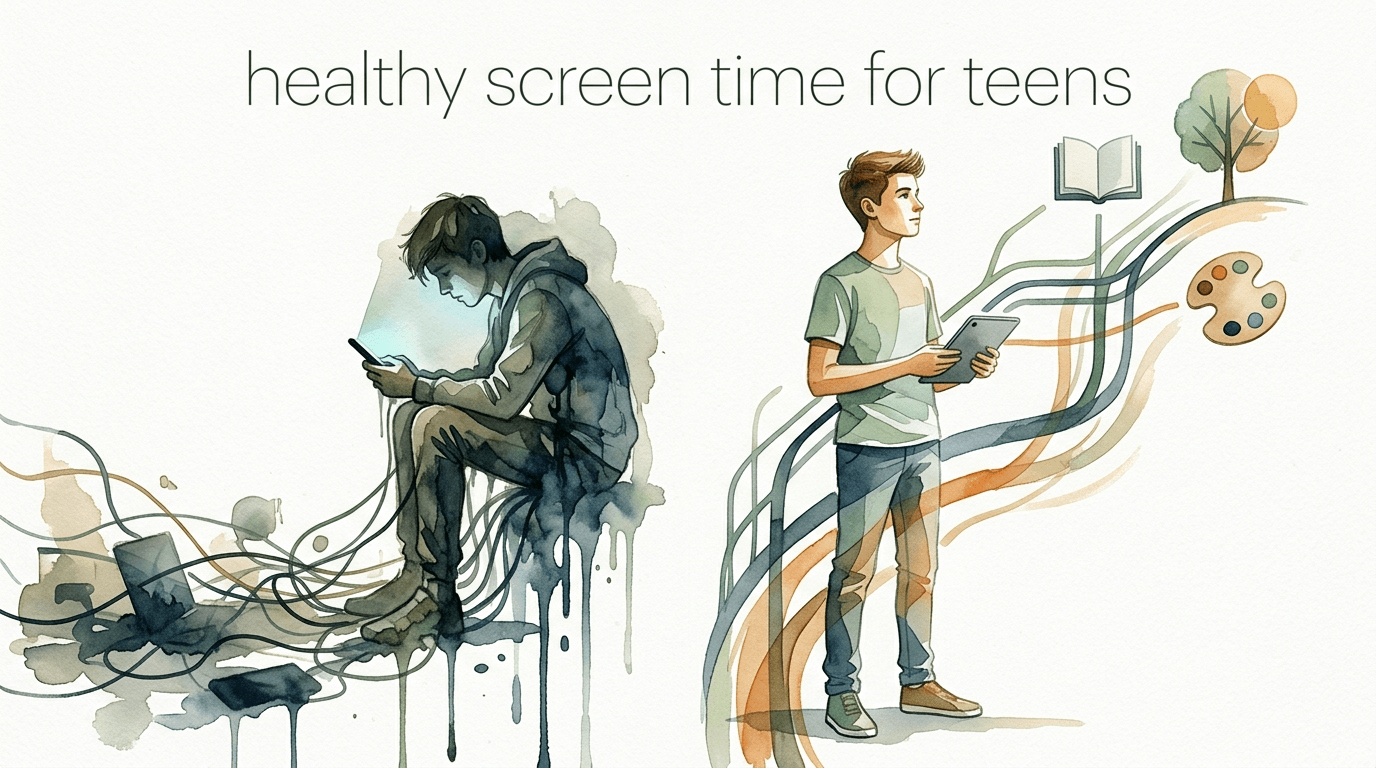
Digital resilience is the ability to navigate online challenges, recognize manipulative design, and maintain emotional balance despite the pressures of the internet. A teen with healthy habits can distinguish between “active” screen time—such as coding, creating digital art, or researching a hobby—and “passive” screen time, which involves mindless scrolling through algorithm-driven feeds.
Modern social media is built on variable reward systems. This is essentially a “slot machine” in their pocket. Every time a teen refreshes their feed, they don’t know what they will get. It might be a funny video, a social compliment, or nothing at all. This unpredictability creates a dopamine loop that is particularly powerful in the teenage brain, which is biologically wired to seek social rewards and peer approval.
Real-world healthy screen time looks like a teenager who can use a phone to coordinate a group project, enjoy a few funny videos, and then put the device down to sleep without feeling a compulsive need to check it one last time. It is about agency. When a teen controls the tool, technology supports their goals. When the algorithm controls the teen, technology exploits their vulnerabilities.
How to Build Digital Resilience
Building resilience requires a shift from policing to coaching. This process involves teaching teens the underlying mechanics of the apps they use. Most platforms are businesses that profit from “attention harvesting.” Explaining this simple fact helps teens realize they are the product, not the customer.
Start with a digital audit. Sit down with your teen and look at the “Screen Time” or “Digital Wellbeing” settings on their device. Look specifically at the “Pickups” data—how many times a day do they unlock their phone? Seeing that they check their device 150 times in a day can be a powerful “aha” moment that bypasses parental lecturing and relies on objective data.
Implement a “First Things First” system. Digital resilience isn’t about “no screens,” but about “screens in their place.” Establish that high-value activities—homework, physical movement, face-to-face family time, and sleep—happen before deep-diving into social media. This teaches the brain to prioritize real-world rewards over digital ones.
Encourage the “Pause and Reflect” technique. Teach your teen to ask one question before they open an app: “What is my goal right now?” If the goal is to message a friend about soccer practice, they should do that and close the app. If the goal is “I’m bored,” they should recognize that the app will likely lead to an hour of mindless scrolling rather than solving the boredom.
Benefits of Resilient Autonomy
Moving toward resilient autonomy provides measurable advantages for a teenager’s development. One of the most significant benefits is improved focus. Algorithms are designed to fragment attention, teaching the brain to crave a new stimulus every 15 seconds. Reclaiming control allows the prefrontal cortex—the part of the brain responsible for decision-making and impulse control—to strengthen.
Mental health stability is another primary advantage. Research shows a strong correlation between heavy, passive social media use and increased rates of anxiety and depression. Resilient teens who engage in active, creative screen time or who can set their own boundaries report higher levels of life satisfaction and lower levels of social comparison distress.
Social intelligence also flourishes when digital life is kept in check. While apps offer “connection,” they often lack the “serve and return” communication that builds empathy. Resilient teens prioritize face-to-face interactions, learning to read body language and tone—skills that are essential for future career success and healthy adult relationships.
Academic performance often sees a boost as a secondary effect. When a teen isn’t constantly battling the “ping” of a notification, they can enter a “flow state” during study sessions. This leads to deeper learning and less time spent on tasks overall, leaving more room for actual rest and hobbies.
Challenges and Common Mistakes
One of the biggest pitfalls parents face is relying entirely on restrictive software. While filters and blockers have a place for younger children, they often fail for older teens. Tech-savvy adolescents can easily bypass these tools using VPNs, “stealth” apps, or by simply using a friend’s device. Relying only on a lock ensures that when the lock is eventually removed, the teen has no internal braking system.
Inconsistency is another common error. If “no phones at dinner” is a rule, but parents are checking work emails between bites, the message of digital health is lost. Teenagers are highly sensitive to hypocrisy. Modeling the behavior you want to see is more effective than any speech about the dangers of TikTok.
Using screen time as a primary punishment or reward can also backfire. This places the device on a pedestal, making it seem like the ultimate “prize.” Instead, frame digital access as a responsibility. When a teen demonstrates they can manage their time and emotions, they earn more autonomy. When they struggle, they need more coaching, not necessarily a “ban.”
Ignoring the “why” behind the use is a missed opportunity. If a teen is scrolling because they feel lonely or stressed, taking the phone away doesn’t solve the underlying problem. It just removes their coping mechanism. Resilience involves finding healthier ways to deal with those emotions in the real world.
Limitations of Restrictions
Physical boundaries are necessary, but they have realistic constraints. A parent can turn off the home Wi-Fi at 10 PM, but they cannot control the 5G signal on a teen’s phone or the social pressure that makes a teen feel like they are missing out on a vital group chat. Restrictions are a temporary scaffold, not a permanent structure.
Environmental trade-offs must be considered. In some school systems, tablets and laptops are mandatory for homework. A “total ban” on screens is often impossible in a modern educational setting. Parents must navigate the “digital canyon”—the risk of a teen falling behind in digital literacy if they are completely disconnected from the tools used by their peers.
Social isolation is a practical boundary to watch. For many teens, their primary social circle exists in Discord servers or group chats. Cutting them off entirely can lead to a sense of social “death,” which triggers the brain’s stress response. The goal should be to balance these digital connections with physical ones, rather than eliminating them.
Fragile Dependence vs. Resilient Autonomy
Understanding the difference between these two states is crucial for long-term success. Fragile dependence relies on external forces to keep a teen safe. Resilient autonomy relies on internal skills.
| Factor | Fragile Dependence | Resilient Autonomy |
|---|---|---|
| Primary Control | Parental locks and app blockers. | Self-regulation and internal “brakes.” |
| Motivation | Avoiding punishment or getting caught. | Valuing mental clarity and focus. |
| Reaction to Stress | Retreats into mindless scrolling. | Recognizes the “scroll-trap” and logs off. |
| Long-term Outcome | Vulnerable when rules are gone. | Prepared for adult digital responsibilities. |
Practical Tips for Digital Self-Mastery
Helping a teen gain mastery over their devices involves small, tactical changes. These “hacks” can help break the dopaminergic loops created by app designers.
- Grayscale Mode: Most apps are colorful for a reason—the brain loves bright, saturated colors. Switching the phone to grayscale in the accessibility settings makes the “slot machine” significantly less enticing.
- Notification Audit: Help your teen turn off all non-human notifications. If it’s not a message from a real person, they don’t need a buzz in their pocket. This stops the app from “pulling” them in.
- The “Bedroom Ban”: Establish the bedroom as a screen-free zone for everyone, including parents. Charge phones in a central location like the kitchen. This protects sleep, which is the foundation of mental health.
- App Swapping: Encourage “high-agency” apps over “low-agency” ones. Instead of scrolling TikTok, suggest apps for photo editing, music production, or learning a language like Duolingo.
- Timed Experiments: Ask your teen to try a “24-hour digital detox” as an experiment. Have them write down how they felt—was it boring? Peaceful? Stressful? This builds self-awareness.
Advanced Considerations: Algorithmic Literacy
For parents and teens who want to go deeper, understanding “algorithmic literacy” is the next step. This involves recognizing that what you see online is not a mirror of reality, but a curated version of it. The algorithm shows you what it thinks will keep you engaged, which often includes extreme views, filtered “perfection,” or sensationalized news.
Discuss the business model of social media. Why does TikTok want you to stay for another ten minutes? It is because they sell that time to advertisers. When a teen realizes they are being manipulated for profit, their natural desire for independence often kicks in. They don’t want to be “owned” by a corporation.
Scaling these skills into the world of AI is also critical. With the rise of deepfakes and AI-generated content, the ability to fact-check and think critically is more important than ever. Teach your teen to ask: “Who made this, and why?” This skepticism is a superpower in the modern age.
Real-World Scenario: The 11 PM Choice
Imagine two teenagers, Alex and Maya. Alex is in a state of fragile dependence. His parents have a 10 PM “internet shutoff.” When Alex goes to a friend’s house for a sleepover where there is no shutoff, he stays up until 4 AM scrolling. He has no internal mechanism to stop because he has always relied on his parents’ Wi-Fi router to be his willpower.
Maya, on the other hand, is practicing resilient autonomy. Her parents have coached her on the “11 PM Scroll.” Maya knows that if she keeps scrolling after 11 PM, she will feel like “a zombie” at her morning soccer game. She feels the pull of the algorithm, but she also values her performance and her sleep. Maya chooses to put the phone in the kitchen herself. She isn’t following a rule; she is exercising a skill.
Building this skill takes time. It involves failures, late nights, and difficult conversations. But the result is a teenager who can navigate a digital world without losing themselves in it. That is the ultimate goal of digital resilience.
Final Thoughts
Resilience is a muscle that grows through use. We cannot protect our teens from the digital world, but we can prepare them for it. Moving from a mindset of “limiting minutes” to “building autonomy” changes the dynamic from a power struggle to a partnership. When teens understand the science of their own brains and the business of their apps, they gain the power to choose.
Encourage your teen to experiment with their habits. Let them lead the conversation about which boundaries are working and which are not. Every time they choose to put the phone down voluntarily, they are strengthening their prefrontal cortex and building a foundation for a healthy adult life. Technology is a powerful servant, but a terrible master—teach your teen to be the one holding the remote.
Sources
1 researchgate.net (https://www.researchgate.net/post/Should_We_Limit_Childrens_Use_of_Digital_Media-or_Teach_Them_to_Cope) | 2 techhealthyfamilies.com (https://www.techhealthyfamilies.com/blog/active-vs-passive-consumption) | 3 nexusteenacademy.com (https://nexusteenacademy.com/phone-addiction-statistics/) | 4 neurosity.co (https://neurosity.co/guides/social-media-brain-dopamine-attention) | 5 trswarriors.com (https://trswarriors.com/consumer-to-creator-digital-literacy-empowers-teen/) | 6 edmentum.com (https://www.edmentum.com/articles/digital-literacy-skills/)