how to reduce kids screen time
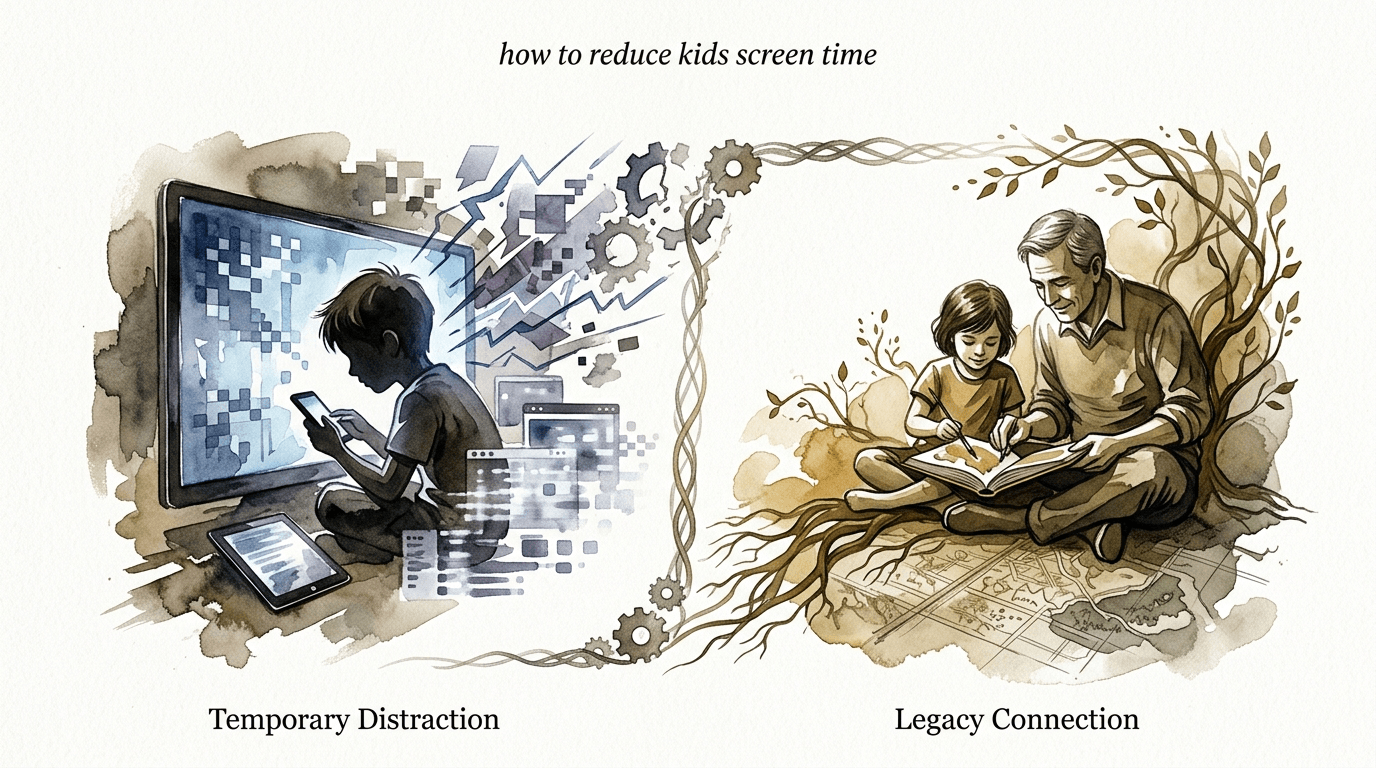
Screens are a temporary fix for boredom. Engagement is a legacy of life skills. It’s tempting to use the ‘digital pacifier’ for a moment of peace. But those ‘boring’ moments are actually the best times to build a legacy of curiosity and social skills. Here is what we do instead.
[affiai]Parenting in the modern era feels like an uphill battle against glowing rectangles. We see the glazed-over eyes and the instant irritability when the tablet is taken away. We know something needs to change, but the convenience of the screen is hard to resist during a long car ride or a stressful dinner prep.
Understanding the difference between a temporary distraction and a legacy connection is the first step toward reclaiming your family’s time. Reducing screen time is not about being “anti-tech.” It is about being “pro-human.” When we clear the digital clutter, we make room for the messy, beautiful development that only happens in the real world.
how to reduce kids screen time
Reducing kids’ screen time involves more than just hiding the iPad or turning off the television. It is a strategic shift in how a family interacts with technology and each other. This process focuses on replacing passive consumption with active engagement, physical movement, and social interaction.
At its core, this concept exists to protect the developmental “prime time” of childhood. Research from the American Academy of Pediatrics (AAP) and the World Health Organization (WHO) consistently shows that excessive media use can displace sleep, physical activity, and face-to-face social play. These three pillars are essential for healthy brain development and emotional regulation.
In real-world situations, reducing screen time looks like setting firm boundaries during mealtimes or creating “tech-free zones” in the home. It is used to help children transition from being “users” of an interface to “creators” of their own fun. Think of it like a nutritional diet. Screens are the “digital dessert,” while active play and family connection are the “main course” of a child’s development.
The Mechanics of Digital Engagement and The Convenience Trap
Understanding how screens keep children hooked is vital for any parent looking to make a change. Most apps and platforms are built using “engagement-based design.” This includes features like autoplay, endless scrolling, and frequent rewards that trigger dopamine releases in a child’s brain.
This “Stimulation Loop” creates a high threshold for excitement. When a child is used to the rapid-fire pace of a cartoon or the instant gratification of a game, the real world starts to feel painfully slow. This is why “boring” tasks like cleaning up toys or sitting at a restaurant feel intolerable to a screen-dependent child.
The “Convenience Trap” is the parental side of this mechanic. We often use screens as a “digital pacifier” to manage a child’s behavior in public or to secure a few minutes of peace. While effective in the short term, this reinforces the idea that the child does not need to learn self-soothing or social patience. Breaking this loop requires a gradual “downshifting” of the child’s nervous system to appreciate slower, real-world stimuli.
The Benefits of Reclaiming the “Boredom Gap”
The most significant benefit of reducing screen time is the return of boredom, which is actually a developmental superpower. Boredom acts as a catalyst for creativity. When a child is not being constantly entertained by a device, their brain is forced to look inward and innovate.
Practical and measurable benefits of this approach include:
- Enhanced Executive Function: Children learn to plan their own activities and solve problems without a digital guide.
- Improved Emotional Regulation: Sitting with the “blah” feeling of boredom builds frustration tolerance and patience.
- Stronger Social Skills: Replacing screens with family conversation fosters empathy, eye contact, and the ability to read non-verbal cues.
- Better Sleep Quality: Reducing blue light exposure—especially before bed—leads to faster sleep onset and deeper rest.
- Physical Health: More time spent away from screens naturally translates to more movement, reducing risks of sedentary-related health issues.
Choosing this approach over the alternative of unlimited access builds a “legacy of curiosity.” Instead of just following an algorithm, your child learns to follow their own interests, whether that is building complex LEGO structures, drawing, or exploring the outdoors.
Challenges and Why Typical Limits Often Fail
Many parents struggle to reduce screen time because they rely solely on “rules” without providing “structure.” Simply saying “no more tablet” often leads to a vacuum of time that the child doesn’t know how to fill. This results in the dreaded “iPad tantrum,” where the child’s nervous system reacts as if it is losing a vital source of regulation.
Common mistakes include:
- The Sudden “Cold Turkey” Approach: For a child deeply entrenched in a stimulation loop, an abrupt total ban can be overwhelming and lead to extreme behavioral outbursts.
- Lack of Parental Modeling: If parents are constantly on their own phones while telling children to go play, the message loses all credibility.
- Empty Threats: Setting a limit and then immediately caving when the child complains teaches them that persistence will eventually win back the screen.
- Inconsistent Rules: Having different rules for different days or caregivers creates confusion and leads to constant “negotiating” from the child.
These mistakes happen because screens have become a fundamental part of our social and physical environment. Overcoming them requires a shift in the entire family culture rather than just a set of isolated prohibitions.
Limitations and Realistic Constraints
It is important to acknowledge that a “zero-screen” lifestyle is neither realistic nor necessarily ideal for every family in the 21st century. Modern education and social connection often require some level of digital literacy. There are situations where technology is a valuable tool rather than a distraction.
Constraints to consider include:
- Educational Requirements: Many schools now assign homework on digital platforms, making some screen time mandatory.
- Neurodiversity: For some children with specific developmental needs, certain screen-based tools can assist with communication or sensory regulation.
- Safety and Geography: In environments where outdoor play is limited by safety or extreme weather, screens might become a more frequent fallback.
- Parental Work Demands: For single parents or those working from home, screens may occasionally be a necessary “babysitter” during critical work hours.
Recognizing these boundaries helps prevent “parental guilt.” The goal is not to achieve a perfectly tech-free life but to ensure that technology serves the family’s needs rather than dictating their lifestyle.
Legacy Connection vs. Temporary Distraction
When evaluating an activity, it helps to compare the long-term impact on the child’s development. Use this table to distinguish between activities that provide “cheap dopamine” and those that build “life skills.”
| Factor | Temporary Distraction (Screens) | Legacy Connection (Active Play) |
|---|---|---|
| Child’s Role | Passive Consumer | Active Creator |
| Mental Effort | Low (Algorithmically Fed) | High (Imagination Required) |
| Skill Built | Digital Navigation | Problem Solving / Social Empathy |
| Long-term Value | Fleeting Entertainment | Internalized Hobbies & Curiosity |
| Social Dynamic | Isolation or Pseudo-Connection | Face-to-Face Bonding |
Practical Tips for a Balanced Digital Life
Applying these strategies immediately can help ease the transition for both you and your child. Start with small, manageable wins rather than trying to overhaul everything overnight.
- Use Visual Timers: Children often lack a sense of time. A visual timer that counts down allows them to see exactly how much “digital dessert” is left, reducing the shock of the “off” button.
- Implement the “10-5-1” Warning: Give warnings at 10 minutes, 5 minutes, and 1 minute before the screen goes away. This helps the child’s brain prepare for the transition.
- Establish Tech-Free Zones: Declare the dinner table and all bedrooms as phone-free areas. This preserves space for conversation and sleep hygiene.
- The “One Screen at a Time” Rule: Turn off the background TV while the kids are playing with toys. This reduces sensory overload and improves focus.
- Focus on Co-Viewing: Instead of letting a child watch alone, sit with them and talk about what is happening on the screen. This turns a passive activity into a social and educational one.
- The “Boredom Basket”: Create a physical basket filled with art supplies, puzzles, and open-ended toys. When the child says “I’m bored,” point them to the basket rather than the remote.
Advanced Considerations for the Digital Ecosystem
For parents who have mastered the basics, looking at the “digital ecosystem” is the next step. Not all screen time is created equal. The 2026 AAP guidelines emphasize “Quality, Context, and Conversation” over mere minutes on a clock.
Moving beyond strict time limits involves analyzing the content your child consumes. Slow-paced, educational content with high “child-centered design” is far better for the developing brain than fast-paced, “engagement-based” videos full of ads and rapid cuts. Understanding how algorithms work can help you curate a safer, more intentional digital environment.
Scaling these habits as your child enters their teen years is also critical. A Family Media Plan should evolve from “parent-dictated limits” to “collaborative digital citizenship.” This involves teaching your child how to recognize manipulative marketing, protect their privacy, and manage their own digital wellbeing as they gain more independence.
Real-World Scenario: Transitioning from Meltdowns to Play
Imagine a typical Tuesday evening. A 5-year-old is watching a high-energy cartoon on a tablet while the parent tries to cook dinner. Usually, when dinner is ready, the parent takes the tablet away, leading to a 15-minute screaming match and a stressful meal.
Instead, the parent follows a new system. Ten minutes before dinner, they give a warning. Five minutes later, they sit down for 60 seconds and ask the child what the character in the show is doing. This “reconnects” the child to the real world and the parent. At the one-minute mark, the parent uses a visual timer. When it goes off, the child is asked to put the “tablet to sleep” themselves.
Because the parent has also spent the last week encouraging “independent play” with a new set of blocks nearby, the child doesn’t feel a void. They might spend five minutes building a “garage” for their cars before sitting down to eat. The transition is smooth because it was planned, collaborative, and respected the child’s need for autonomy.
Final Thoughts
Reducing kids’ screen time is not an act of deprivation. It is an act of liberation. By setting boundaries around the “digital pacifier,” you are giving your child the greatest gift possible: the space to discover who they are and the skills to interact with the world around them.
Remember that you are the most important model for your child’s digital habits. Every time you put your phone down to make eye contact or engage in a “boring” moment together, you are building that legacy of curiosity. It takes time, and there will be difficult days, but the long-term payoff in your child’s emotional and social health is worth every bit of effort.
Start small today. Pick one tech-free zone or one hour of the day where the screens go away. Watch what happens when the digital noise stops. You might be surprised at the creativity and connection that starts to grow in the silence.
Sources
1 mayo.edu (https://sncs-prod-external.mayo.edu/hometown-health/speaking-of-health/6-tips-to-reduce-childrens-screen-time) | 2 mayoclinichealthsystem.org (https://www.mayoclinichealthsystem.org/hometown-health/speaking-of-health/6-tips-to-reduce-childrens-screen-time) | 3 wi.gov (https://preventionboard.wi.gov/Documents/Publications/Video%205_Handouts_Family.pdf) | 4 youtube.com (https://www.youtube.com/watch?v=kUwJ8jMkkIE) | 5 youtube.com (https://www.youtube.com/watch?v=kUwJ8jMkkIE) | 6 aap.org (https://publications.aap.org/pediatrics/article/157/2/e2025075320/206129/Digital-Ecosystems-Children-and-Adolescents-Policy) | 7 myhspediatrics.com (https://myhspediatrics.com/screen-time-your-childs-brain-healthy-habits-for-2025/) | 8 cacfp.org (https://www.cacfp.org/2025/07/07/reducing-screen-time/) | 9 choc.org (https://health.choc.org/updated-aap-recommendations-for-screen-time/) | 10 healthychildren.org (https://www.healthychildren.org/English/family-life/Media/Pages/How-to-Make-a-Family-Media-Use-Plan.aspx) | 11 childcareed.com (https://www.childcareed.com/a/how-can-i-make-a-family-media-plan-for-young-children.html) | 12 safariltd.com (https://www.safariltd.com/blogs/toys-that-teach/the-benefits-of-boredom-for-kids-unlocking-creativity-building-resilience-and-cultivating-life-skills) | 13 beaconservices.org.uk (https://www.beaconservices.org.uk/screentime-meltdown/) | 14 monarchassessment.com (https://www.monarchassessment.com/post/the-power-of-boredom) | 15 childmind.org (https://childmind.org/article/the-benefits-of-boredom/) | 16 youthfirstinc.org (https://youthfirstinc.org/why-its-important-for-your-child-to-be-bored/) | 17 innovativeresources.org (https://innovativeresources.org/im-bored-how-boredom-can-help-children-develop-creativity-critical-thinking-and-emotional-intelligence/) | 18 youtube.com (https://www.youtube.com/watch?v=wrTRNcbVFbc) | 19 mayoclinic.org (https://www.mayoclinic.org/healthy-lifestyle/childrens-health/in-depth/screen-time/art-20047952) | 20 thrivealliancegroup.com (https://blog.thrivealliancegroup.com/family-media-plan) | 21 tguard.com (https://tguard.com/5-alternatives-to-pacifiers-parents-should-consider/) | 22 ccrcca.org (https://www.ccrcca.org/parents/strengthening-families-blog/item/a-parents-practical-guide-to-managing-screen-time-for-kids/) | 23 finalsite.net (https://resources.finalsite.net/images/v1763501755/foothillchristian/acw7ujdtfqoccxkgfmxo/FamilyMediaPlanGuide.pdf) | 24 cbwchc.org (https://www.cbwchc.org/news/guide-to-healthy-screen-time) | 25 actionforhealthykids.org (https://www.actionforhealthykids.org/activity/limit-screen-time/) | 26 mabelslabels.com (https://mabelslabels.com/blog/2023/10/25/unique-ways-to-wean-off-the-pacifier/)