Multi-functional Large Driftwood Wall Ideas
If your wall decor isn’t working as hard as you do, it is just a waste of vertical space. In a small home, every inch must earn its keep. Why settle for a piece of wood that just sits there when the ocean has provided a multi-dimensional scaffold for your life? From supporting heavy shelving to acting as a structural lighting rig, your large driftwood wall piece can be the hardest working employee in your home office.
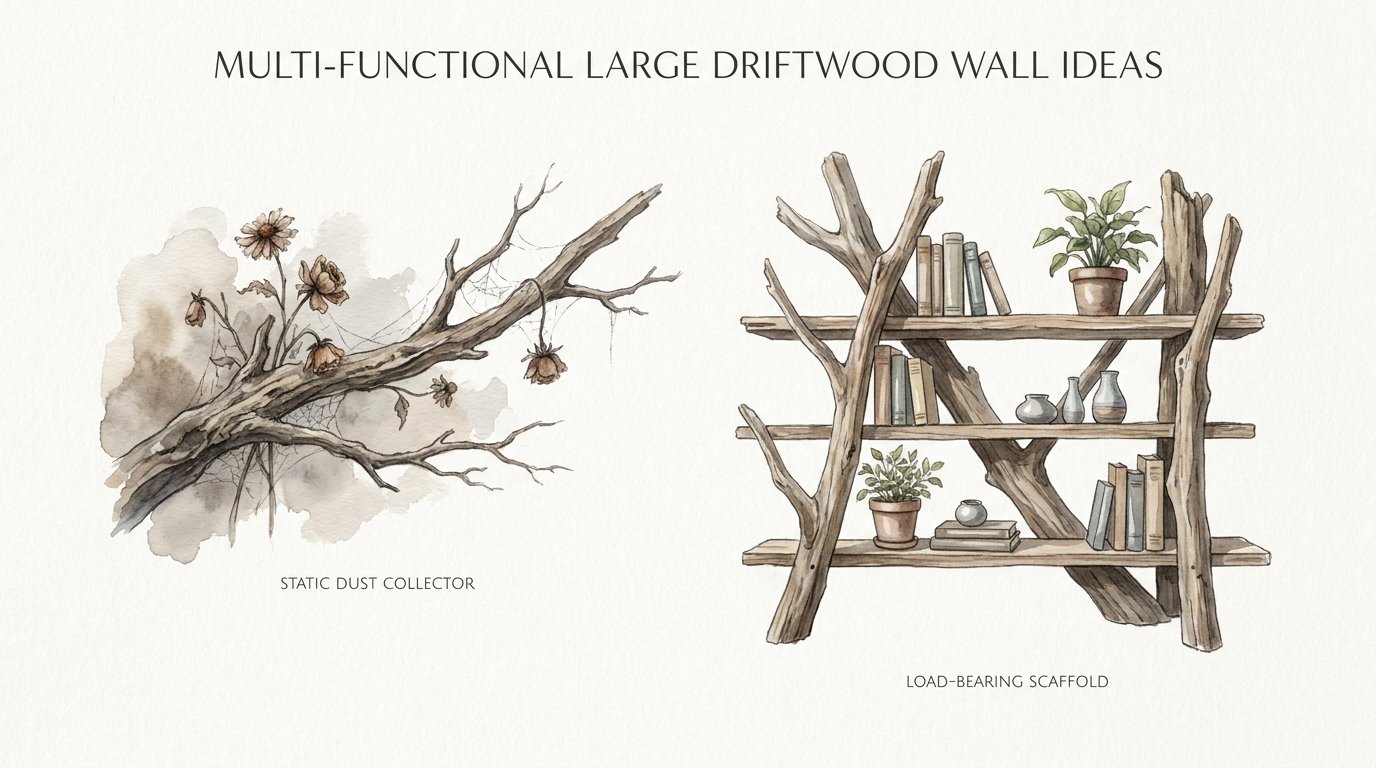
[affiai]Walking the shoreline, you might see a twisted branch and think of a sculpture. A seasoned pioneer looks at that same sun-bleached cedar and sees a backbone for a bookshelf or a natural conduit for electrical wiring. The goal here is to stop treating nature as a passive ornament and start utilizing it as a rugged, functional framework. We are moving away from the “static dust collector” and toward the “load-bearing scaffold.”
This transition requires more than just a hammer and a prayer. It demands an understanding of wood density, wall-fastening physics, and the patience to prepare a piece of timber that has spent a decade at sea. If you want your home to feel like a fortified coastal sanctuary rather than a flimsy showroom, you must learn to marry the organic with the industrial.
Multi-functional Large Driftwood Wall Ideas
A large piece of driftwood is essentially a free-form architectural element. Unlike a straight-cut 2×4 from the local hardware store, a weathered branch offers multiple planes, varying thicknesses, and built-in hooks that can be adapted for a dozen different chores. In a real-world setting, this means your wall art can simultaneously hold your computer monitor, organize your cables, and provide ambient light for late-night work sessions.
Imagine a six-foot length of ghost wood mounted horizontally above a desk. The thickest part of the trunk can be drilled to accept heavy-duty industrial pipe, creating a cantilevered shelf for reference books. Meanwhile, a smaller, outstretching limb can serve as a natural hook for your headphones or a lantern. This isn’t just about looking “beachy”—it is about creating a customized organizational system that no factory-made modular unit can replicate.
In the kitchen, a vertical driftwood pillar can serve as the primary support for hanging pot racks. Instead of drilling twenty holes into your ceiling, you anchor one solid, sea-scoured timber to the wall studs and use its natural knots as mounting points for forged iron hooks. This approach leverages the wood’s inherent strength while adding a layer of visual grit that softens the clinical feel of stainless steel appliances.
For the home office, the most practical application involves integrated technology. Modern driftwood “scaffolds” often feature hidden channels routed into the backside to hide HDMI cables and power strips. This allows you to mount a flat-screen display or a series of smart-home sensors directly onto the wood, masking the cold plastic of the electronics with the warm, silvered texture of aged grain.
The Process: From Shoreline Salvage to Structural Support
Turning a raw find into a load-bearing asset requires a disciplined approach. You cannot simply pull a log out of the salt spray and screw it to your drywall. The wood must be stabilized, sanitized, and structurally reinforced before it enters your living space.
The first step is scouting. Look for “hard” driftwood—species like oak, cedar, or juniper that have been stripped of their soft outer sapwood by the tide. You want the heartwood, which is dense, heavy, and resistant to rot. If you can push your fingernail into the wood and leave a deep mark, that piece is too soft for structural use. It might look pretty, but it will eventually crumble under the pressure of a shelf bracket.
Once you have your timber, the cleaning phase begins. Submerge the piece in a solution of one part bleach to nine parts fresh water for at least 24 hours. This serves two purposes: it kills boring beetles and marine organisms that may be dormant in the fibers, and it leaches out the salt that would otherwise attract moisture and cause your hardware to rust. If the piece is too large for a bucket, you can build a temporary trough using a tarp and some scrap wood.
After the soak, the wood needs to dry—slowly. Rushing the process with a heater will cause the grain to check and split. Let it sit in a well-ventilated, shaded area for several weeks until the moisture content is below 12%. Only then should you begin the mechanical work. Use an orbital sander with 120-grit paper to remove any loose splinters, but leave the deep furrows and natural bleaching intact. This is the wood’s “pioneer grit,” and it is what gives the piece its character.
Benefits of the Load-Bearing Scaffold
Choosing a functional driftwood piece over a standard store-bought shelf provides several measurable advantages. The most immediate is the ratio of strength to weight. Wood that has survived the ocean has already been “stress-tested” by massive hydraulic forces. What remains is the toughest part of the tree, capable of supporting significant loads if mounted correctly.
Another benefit is the customization of space. In a small home, you often have awkward corners or narrow walls where a standard bookshelf won’t fit. A driftwood branch can be cut and angled to snake through these “dead zones,” providing utility where traditional furniture fails. You are essentially 3D-printing with nature, creating a storage solution that conforms to your home’s unique geometry.
Sustainability is the third pillar. Using reclaimed sea-wood means you aren’t contributing to the demand for new timber or the energy-intensive manufacturing of plastic and metal organizers. Every piece of driftwood you use is one less item being hauled to a landfill or left to rot into carbon emissions. It is an honest, low-impact way to build a home that feels connected to the world outside your door.
Finally, there is the psychological benefit. Living in a small space can feel claustrophobic if every surface is flat and sterile. The multi-dimensional nature of a large driftwood scaffold breaks up the visual monotony. It brings the randomness of the wild indoors, providing a tactile, grounding element that makes a home office feel less like a cubicle and more like a workshop.
Common Mistakes to Avoid
The most frequent error is underestimating the weight of the wood itself. A six-foot piece of water-logged oak can weigh fifty pounds or more. Even after it dries, it remains a heavy object. Attempting to hang a structural piece using simple nails or plastic drywall anchors is a recipe for disaster. You must find the wall studs. There is no shortcut here. If your driftwood doesn’t hit at least two studs, it isn’t a scaffold; it’s a liability.
Another mistake is neglecting the hidden side of the wood. People often focus on the beautiful front face and ignore the back. To get a piece of driftwood to sit flush against a wall, you usually need to use a drawknife or a planer to flatten the contact points. If the wood “wobbles” against the wall, every shelf or light fixture you attach to it will be unstable. A flat back is the secret to a professional-looking installation.
Ignoring the “pests” is a dangerous game. Just because a piece looks clean doesn’t mean it isn’t housing a colony of carpenter ants or powderpost beetles deep within the grain. If you skip the bleach soak or the heat treatment, you risk bringing an infestation into your home’s structural framing. Always assume the wood is “hot” until you have personally sanitized it.
Lastly, avoid over-finishing. Slathering a beautiful piece of silvered driftwood in high-gloss polyurethane ruins its natural appeal and makes it look like a cheap souvenir. Use a matte sealer or a simple tung oil if you must, but often, the wood is best left in its raw, scoured state. Let the texture do the talking.
Realistic Constraints and Limitations
While the driftwood scaffold is a powerhouse of utility, it isn’t a universal solution for every wall. If you live in an apartment with metal studs or thin plaster-and-lath walls, mounting a heavy, load-bearing timber may be impossible without significant reinforcement. In these cases, the weight of the wood plus the items on the shelves could pull the entire wall down.
Environmental factors also play a role. Driftwood is highly reactive to humidity. In a bathroom or a kitchen with poor ventilation, the wood may swell and contract, which can loosen the mounting hardware over time. You must check the tension of your screws every six months to ensure the “scaffold” remains rigid. This isn’t a “set it and forget it” project; it requires the vigilance of a pioneer tending to his cabin.
Scale is another constraint. A massive branch that looks majestic on a beach can easily overwhelm a tiny room. You have to balance the functional gain with the visual “noise.” If the wood takes up so much space that you can’t walk past your desk comfortably, it has failed its primary mission of making your home work harder.
Static Dust Collector vs. Load-Bearing Scaffold
To understand why you should put in the extra effort to make your driftwood functional, consider the differences in this comparison:
| Feature | Static Dust Collector | Load-Bearing Scaffold |
|---|---|---|
| Mounting | Picture wire or small nails. | Lag bolts or structural screws into studs. |
| Utility | Visual only; takes up space. | Supports shelves, lights, and tech. |
| Stability | Swings or shifts when touched. | Rigid extension of the wall itself. |
| Longevity | May rot if not properly treated. | Sanitized, dried, and structurally sound. |
Practical Tips for a Successful Build
When you are ready to mount your scaffold, start by creating a paper template of the wood’s footprint. Tape this template to the wall and mark your stud locations on the paper. This allows you to visualize where your heavy-duty fasteners will go without holding a fifty-pound log over your head for twenty minutes.
Use black iron pipe fittings for shelving supports. They have a rugged, industrial aesthetic that pairs perfectly with weathered wood. You can drill a hole into the driftwood that is slightly smaller than the pipe, then “thread” the pipe directly into the wood for a rock-solid connection. This creates a floating shelf look that can easily hold twenty or thirty pounds of books.
For lighting, look into LED strip lights or “Edison” bulbs with braided fabric cords. You can wrap these cords around the natural branches of the driftwood, using the wood’s own geometry to hide the wiring. If you want a cleaner look, use a small chisel to carve a shallow groove on the top of a horizontal limb and tuck the LED strip inside. This provides an “uplight” effect that highlights the texture of the grain.
Don’t be afraid to mix materials. A large driftwood piece looks incredible when paired with leather straps for hanging items or copper hooks for kitchen tools. These materials—wood, iron, leather, and copper—form a timeless palette that feels forged rather than bought.
Advanced Considerations: Structural Physics
For those looking to push the limits of what a driftwood scaffold can do, consider the concept of “torsion.” When you attach a shelf to a piece of wood that is only anchored at one or two points, the weight of the shelf wants to “twist” the wood away from the wall. To counter this, you need to use at least three points of contact in a triangular pattern.
If your piece of driftwood is exceptionally long, you may need to use a “French cleat” system. This involves cutting a 45-degree angle into a sturdy piece of lumber, mounting one half to the wall and the other to the back of the driftwood. This distributes the weight across a much larger surface area and allows for a perfectly flush mount.
Think about the “shear strength” of your fasteners. A standard drywall screw has almost no shear strength—it will snap if enough downward force is applied. For a load-bearing scaffold, you must use GRK structural screws or lag bolts. These are designed to bend rather than break, providing a critical margin of safety for your home and your equipment.
Scenario: The Hardest Working Office in the Territory
Let’s look at a practical application in a 100-square-foot home office. The occupant has a single wall to work with. By mounting a large, V-shaped piece of cedar driftwood, they transform that wall into a command center.
The bottom leg of the “V” acts as the monitor riser, with the screen mounted to a VESA bracket that is bolted through the thickest part of the timber. The top leg of the “V” extends toward the ceiling, supporting a series of small, reclaimed wood shelves held up by copper pipe. Tucked into the “crotch” of the branch is a power strip, with all the cables neatly zip-tied to the back of the wood where they are invisible from the desk.
At night, a single dimmable LED strip hidden in a natural hollow of the wood provides enough light to work by without the need for a bulky desk lamp. The desk itself remains completely clear, as the “scaffold” has moved all the storage and tech onto the vertical plane. This is the ultimate expression of the “hardworking” wall.
Final Thoughts
Building a functional driftwood scaffold is an act of reclamation. You are taking something the world threw away and turning it into the most reliable part of your home. It requires a blend of old-world patience and modern engineering, but the result is a space that feels both invincible and organic.
Do not be intimidated by the weight or the weirdness of the wood. Embrace the knots, the cracks, and the salt-stained silver. When you bolt that timber to your wall, you aren’t just adding a shelf; you are adding a piece of the earth’s history that is ready to stand guard over your daily work.
Experiment with different configurations. Start with a small coat rack to get a feel for the wood’s density, then move on to a full-scale shelving rig. Once you realize how much work a single piece of sea-scoured wood can do, you will never look at a blank wall—or a pile of beach debris—the same way again.
Sources
1 homedit.com (https://www.homedit.com/10-diy-driftwood-decoration-ideas/) | 2 wikihow.com (https://www.wikihow.com/Preserve-Driftwood) | 3 dksstores.com (https://dksstores.com/blog-post49) | 4 lakewedoweelife.com (https://www.lakewedoweelife.com/lake-life/driftwood-art-and-treasures-by-tammy-lovvorn) | 5 specialeditionart.com (https://specialeditionart.com/blogs/theoracle/how-to-hang-driftwood-on-your-wall-a-comprehensive-guide) | 6 youtube.com (https://www.youtube.com/watch?v=ggDsw1nQDQ8) | 7 hawk-hill.com (https://www.hawk-hill.com/how-to-clean-driftwood/) | 8 youtube.com (https://www.youtube.com/watch?v=SKWH708rsGA) | 9 hometalk.com (https://www.hometalk.com/diy/decorate/rooms/q-how-to-hang-a-large-heavy-driftwood-piece-42096700) | 10 hawk-hill.com (https://www.hawk-hill.com/diy-floating-driftwood-shelf/)