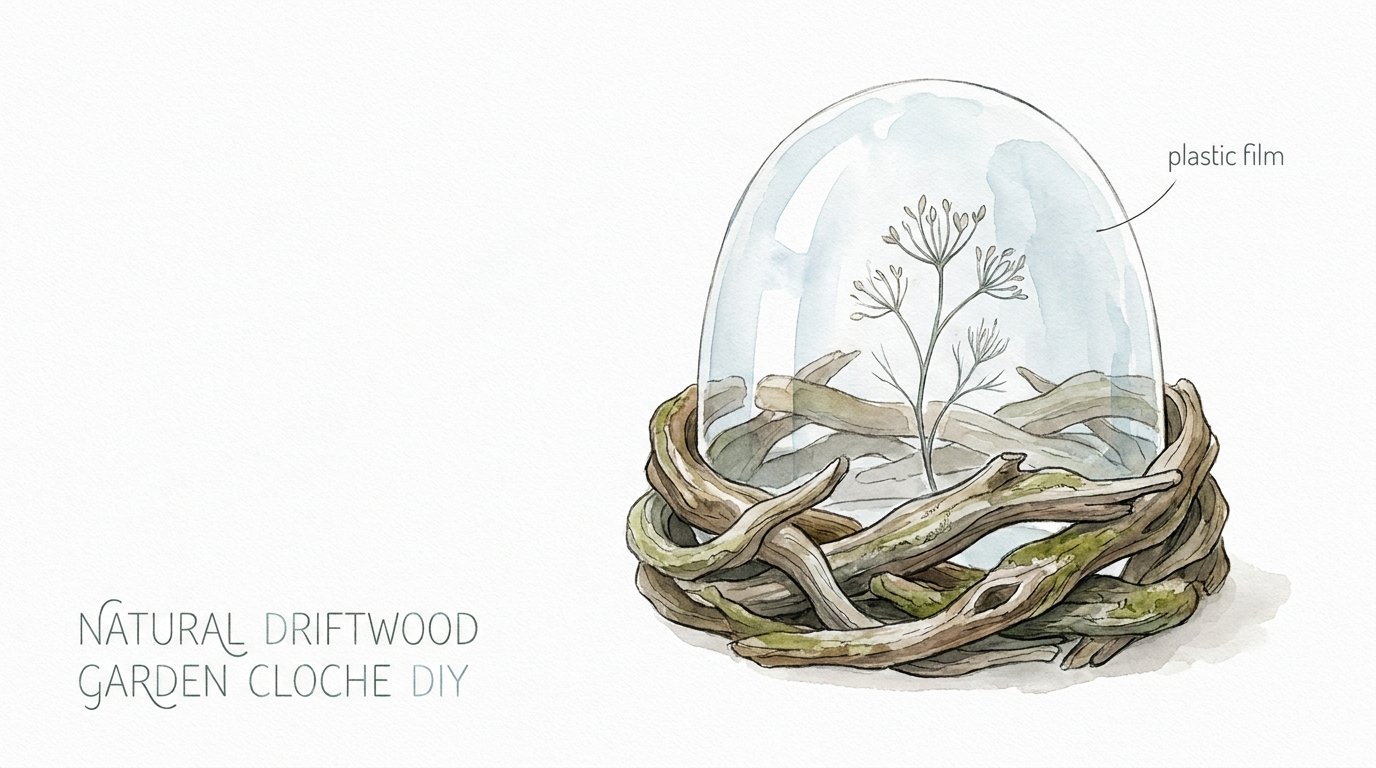
Natural Driftwood Garden Cloche Diy
Stop suffocating your spring garden in a plastic coffin and start sheltering it with the architecture of the coast. Most gardeners think they are ‘protecting’ their plants with plastic, but they’re actually creating a stagnant, high-heat prison. Driftwood cloches provide the perfect balance: breaking the wind while allowing the soil to breathe. Give your garden the coastal protection it was evolved for.
[affiai]Every spring, a familiar sight emerges in suburban backyards: rows of translucent plastic domes and sheets of polyethylene shimmering under the sun. While these materials promise warmth, they often deliver a suffocating humidity that invites fungus and dampening-off. There is a better way, a method carved by the tides and seasoned by the salt air.
Harnessing the raw, structural integrity of driftwood allows you to build a garden defense that looks as if it grew from the earth itself. This is not about delicate glass jars or flimsy synthetic films. This is about building armor. It is about creating a microclimate that respects the plant’s need for oxygen while shattering the force of the northern gale. Step into the world of coastal architecture and learn how to fortify your seedlings with the grit of a pioneer.
Natural Driftwood Garden Cloche Diy
A garden cloche, at its simplest, is a bell-shaped protector for vulnerable plants. Traditionally, these were made of heavy glass in 17th-century France to extend the growing season. However, the coastal adaptation of this tool trades fragile glass for the resilient, sun-bleached remains of trees that have survived the ocean’s churn. A driftwood garden cloche is a semi-permeable structure built from intertwined branches, roots, and sun-dried wood scavenged from shorelines or riverbanks.
This structure exists to serve as a biological windbreak. Unlike a plastic sheet that blocks all air movement, a driftwood cloche diffuses wind, turning a sharp gust into a gentle breeze. This prevents the “desiccation” or drying out of tender leaves while maintaining a stable temperature near the soil. You will find these structures in rugged maritime gardens where the environment is too harsh for delicate glass and too beautiful for ugly plastic.
Visualizing a driftwood cloche requires thinking of it as a skeleton. It is a lattice of silvered wood that cages the plant. In real-world coastal gardening, these structures are often used to protect early brassicas, tender herbs, or newly transplanted perennials from the erratic temperature swings of late March and April. They are permanent enough to stay through the season but light enough to be moved as your garden’s needs shift.
The Architecture of the Shore
When you look at driftwood, you are looking at wood that has had all its “weakness” pounded out of it by the surf. The bark is gone, the soft outer layers have eroded, and what remains is the dense, lignin-rich core. This makes it an ideal building material for the garden. It will not rot as quickly as fresh “green” wood, and it possesses a natural patina that blends seamlessly with soil and stone.
These cloches are more than just protectors; they are sculptural elements. In the winter, when the garden is bare, they stand as silver monuments to the coming spring. When the plants begin to grow, they provide a trellis-like support for those that wish to climb. It is a multi-functional piece of garden furniture that pays homage to the landscape it came from.
Engineering the Coastal Shield: How It Works
The science behind a natural driftwood cloche is rooted in the principle of wind diffusion. When wind hits a solid surface like plastic or glass, it creates turbulence. This turbulence can swirl around the edges and actually pull heat away from the plant. A driftwood cloche is a permeable barrier. It allows air to pass through its gaps, but the irregular shapes of the wood break up the laminar flow of the wind.
This diffusion creates what is known as a “boundary layer” of relatively still air around the plant. Within this layer, the plant can transpire naturally without the moisture being stripped away by the wind. It also prevents the “greenhouse effect” from becoming a “death trap.” On a sunny day, a plastic cloche can reach temperatures that cook a seedling in hours. The driftwood structure provides dappled shade and constant ventilation, keeping the temperature within a safe, productive range.
Soil health is also a primary beneficiary of this design. Plastic covers often lead to surface soil compaction and the growth of anaerobic bacteria due to lack of airflow. Driftwood allows the soil to remain “alive,” receiving natural gas exchange and preventing the buildup of surface mold. It is a system that works with the biology of the plant rather than trying to override it with synthetic isolation.
Microclimate Management
Building with wood allows for natural thermal mass. While wood is not as dense as stone, the thick, sun-bleached branches of a cloche absorb a surprising amount of solar energy during the day. This heat is slowly radiated back toward the plant during the cool evening hours. It is a subtle, steady heat, unlike the volatile spikes seen under film.
Furthermore, the irregular gaps in the driftwood act as natural humidity regulators. On damp mornings, moisture clings to the wood, creating a local zone of high humidity without the total saturation that leads to fungal rot. It is a self-regulating system that mimics the way plants grow in the lee of a fallen log in the wild.
Step-by-Step: Sourcing and Preparing Your Armor
The first step in this DIY process is not a trip to the hardware store; it is a journey to the water’s edge. Sourcing driftwood requires a keen eye and an understanding of the wood’s history. You are looking for pieces that are “seasoned”—lightweight for their size, silver or grey in color, and free of any remaining bark. These pieces have already completed their journey and are ready for their second life in your garden.
Avoid “green” wood that has recently fallen. This wood is still full of sap and moisture, which will attract wood-boring insects and rot quickly when in contact with garden soil. True driftwood is “dead” wood that has been sterilized by the sun and salt. However, that salt is something you must address before the wood touches your garden beds.
Once you have gathered your material, the preparation process begins. You will need to rinse the wood thoroughly. While some coastal plants are salt-tolerant, most garden vegetables are sensitive to sodium. Soaking the driftwood in a trough of fresh water for 48 hours, or leaving it out on a gravel pad to be washed by several rainstorms, is a critical step for the safety of your soil. This leaching process ensures the wood is a friend to your plants, not a source of saline stress.
Materials Checklist
- Primary Arches: Four to six curved pieces of driftwood, approximately 24-30 inches in length. These should be the sturdiest pieces in your collection.
- Horizontal Stabilizers: Thinner, straighter pieces of wood to connect the arches.
- Binding Material: Natural jute twine, hemp rope, or copper wire. Avoid plastic zip ties as they degrade in UV light and look out of place.
- Anchor Stakes: Four 12-inch lengths of rebar or heavy wood stakes to pin the structure to the earth.
- Tools: A hand saw for minor trimming, a drill with a small bit for “pre-drilling” attachment points, and a pair of pliers.
The Build: Constructing the Dome
Begin by selecting your two strongest curved pieces. These will form the “backbone” of the cloche. Lean them against each other to form a central arch. If you are protecting a single plant, a simple tripod shape may suffice. For a row or a larger cluster, you will want to create a tunnel or a dome. Position the base of these arches at the corners of the area you intend to protect.
Use your drill to create small pilot holes where the wood pieces intersect. This is crucial because old driftwood can be brittle; driving a screw or forcing a wire through it without a pilot hole can cause the wood to split. Once your holes are drilled, secure the intersection with copper wire or heavy hemp rope. Wrap the binding tightly in a “cross-stitch” pattern to ensure the joint does not wobble.
Add the secondary arches at 45-degree angles to the primary ones. This creates a rounded, dome-like skeleton. At this stage, the structure might still feel a bit loose. This is where the horizontal stabilizers come in. Weave thinner branches horizontally through the arches, securing them at every intersection. This weaving creates a rigid “basket” structure that can withstand high winds without shifting.
Anchoring for Endurance
A driftwood cloche is a lightweight structure, and a strong wind can turn it into a tumbleweed if it isn’t properly anchored. Use your rebar or heavy wooden stakes to pin the base of the arches into the ground. If you are using rope, tie the base of the wood directly to the stake. For a truly “pioneer-grit” finish, you can place large river stones around the base. These stones add weight and further contribute to the thermal mass of the microclimate.
Inspect the structure for any sharp “snags” that might damage the plant as it grows. While the wood is naturally weathered, sometimes a broken branch can leave a jagged edge. Use a bit of sandpaper or a small saw to smooth these areas. Your cloche should be a sanctuary, not a hazard.
The Advantages of Driftwood Armor
Choosing a natural driftwood cloche over a plastic one is a statement of intent. It is a choice to prioritize the long-term health of your garden over short-term convenience. The primary benefit is the longevity of the material. A well-built driftwood structure can last for a decade or more. Unlike plastic which becomes brittle and cracks after one or two seasons in the sun, driftwood has already been through the worst the world can throw at it. It only grows more beautiful as it ages, taking on a deeper silver patina.
Another measurable advantage is disease prevention. Because the driftwood cloche allows for constant airflow, the leaves of your plants stay dry. This is the single best defense against powdery mildew, rust, and botrytis. In a plastic tunnel, moisture evaporates from the soil and condenses on the plastic, eventually dripping back onto the leaves and creating a breeding ground for pathogens. Driftwood breaks this cycle completely.
Finally, there is the matter of sustainability. Driftwood is a carbon-neutral, harvested material that requires no industrial processing. When a driftwood cloche finally reaches the end of its life, it doesn’t end up in a landfill. It can be broken down into mulch or added to a hugelkultur bed, returning its nutrients and carbon to the very soil it once protected. It is a closed-loop system that respects the cycles of nature.
Aesthetic and Emotional Value
We often underestimate the impact of beauty in the garden. A row of plastic jugs is an eyesore that most gardeners tolerate only because they feel they have no choice. A driftwood cloche, however, is a work of art. It evokes the feeling of the coast, a sense of rugged endurance and timelessness. It turns a functional task—protecting seedlings—into a creative act that enhances the visual landscape of your home.
There is also a profound satisfaction in using materials you have harvested yourself. Every time you look at the cloche, you remember the day spent on the beach, the smell of the salt air, and the effort it took to bring that wood home. It connects the gardener to the wider world in a way that a store-bought product never can.
Challenges and Common Mistakes
The most common mistake gardeners make when building with driftwood is forgetting to leach the salt. Even if the wood looks dry, the pores are often saturated with salt crystals. When it rains, that salt washes directly into the root zone of your vulnerable seedlings. If your plants look stunted or the leaf edges are turning brown and crispy, salt burn is the likely culprit. Never skip the soaking or weathering stage.
Another challenge is the structural stability of irregular shapes. Because no two pieces of driftwood are the same, getting them to fit together can be frustrating. Many beginners try to force the wood into a perfect geometric shape. Instead, you must learn to “listen” to the wood. Work with the natural curves and crooks. If a piece wants to lean a certain way, let it. A slightly asymmetrical dome is often stronger than a forced, perfect one because it utilizes the natural grain and tension of the wood.
Weight management is the third hurdle. While driftwood is often lighter than fresh wood, large pieces can still be heavy enough to crush a young plant if the structure collapses. Always over-engineer your joints. Use more wire or rope than you think you need. A “pioneer” builds for the storm, not for the sunny day.
Avoiding the “Green” Trap
Sometimes you will find wood that looks like driftwood but is actually just a recently fallen branch that has been in the water for a few days. This wood will still have its bark or will feel “heavy” and flexible. Using this in a cloche is a mistake. As the wood dries out in your garden, it will warp and shrink, pulling your joints apart and potentially collapsing the structure. Only use wood that is truly “dead” and weathered.
Furthermore, be wary of wood found in urban rivers or near industrial sites. Driftwood can absorb chemicals and pollutants from the water. Stick to “clean” sources—ocean beaches far from harbors or mountain streams. The health of your garden depends on the purity of your materials.
Limitations: When the Coastal Armor Isn’t Enough
While a driftwood cloche is an exceptional tool for wind protection and light frost, it is not a magical heat source. In the event of a “hard freeze” (temperatures dropping significantly below 28°F for several hours), a wooden skeleton provides very little insulation on its own. It is a windbreak, not an insulated wall. In these extreme cases, you must be prepared to add a secondary layer.
Environmental limitations also include heavy snow. A lattice-style cloche can catch snow, and the weight can quickly exceed the structural limits of the wood. If you live in an area with late-season heavy snow, you will need to clear the cloches regularly or build them with much thicker, sturdier “ribs” to prevent a collapse that would crush your plants.
Finally, there is the issue of light penetration. If you build your cloche too “thick” with too many overlapping branches, you may accidentally create a permanent shade structure. For sun-loving plants like peppers or tomatoes, this can lead to leggy, weak growth. The goal is “dappled” light, not total shade. You should be able to see the plant clearly through the lattice of the wood.
Trade-offs in Mobility
Unlike a lightweight plastic dome that you can toss into a shed in five seconds, a driftwood cloche is a more permanent commitment. It is heavier and more awkward to move. If your gardening style requires you to constantly shift protectors every few days, the driftwood method may feel cumbersome. This tool is best suited for “set and forget” protection that stays in place for a month or more during the shoulder seasons.
Driftwood Armor vs. Plastic Film
To help you decide which approach fits your garden best, consider this comparison of the two methods based on practical, long-term factors.
| Factor | Plastic Film/Domes | Driftwood Armor |
|---|---|---|
| Airflow | Poor (Stagnant) | Excellent (Diffuse) |
| Lifespan | 1–3 Seasons | 10+ Seasons |
| Heat Management | Prone to overheating | Stable, moderate |
| Cost | Moderate (Ongoing) | Free (Harvested) |
| Aesthetics | Industrial/Messy | Natural/Sculptural |
| Disease Risk | High (Fungal) | Very Low |
The table reveals that while plastic is a powerful tool for raw heat accumulation, it fails in almost every other category. For the serious practitioner who values the health of the plant over the speed of the sprout, the natural armor of driftwood is the superior architectural choice. It is an investment in the “soul” of the garden.
Practical Tips and Best Practices
When you are out in the field, remember that orientation matters. If your prevailing winds come from the northwest, place your thickest, most solid pieces of driftwood on that side of the cloche. You can create a “gradient” of permeability—tighter on the windward side and more open on the leeward side. This maximizes protection while still allowing for the necessary cross-ventilation.
For those living in particularly cold climates, you can “prime” your driftwood cloche by weaving in natural insulation during the first few weeks of spring. Using “salt hay” or dried seaweed (thoroughly rinsed) to fill the gaps in the wood creates a much warmer microclimate. As the weather warms, you simply pull the hay out, leaving the breathable wooden skeleton behind. This “layered” approach gives you the best of both worlds: high insulation when needed and high breathability later on.
Another tip for the coastal gardener: incorporate your cloche into your irrigation. You can tie your soaker hoses or drip lines directly to the base of the driftwood. This keeps the lines organized and ensures that the water is delivered exactly where it is needed, underneath the protective canopy. The wood can also act as a support for the hose, keeping it off the tender foliage.
The Maintenance Schedule
- Spring: Inspect all wire and rope joints. Tighten any that have loosened over the winter. Ensure the anchors are still deep in the soil.
- Summer: If the plant has outgrown the cloche, you don’t necessarily have to remove it. It can stay in place as a support or a deterrent for rabbits and other small pests.
- Autumn: Give the wood a quick scrub with a stiff brush to remove any accumulated soil or pests that may want to overwinter in the crevices.
- Winter: Leave the cloches in place. They provide visual interest and “winter bones” to the garden, marking where your perennials sleep.
Advanced Considerations: Beyond the Basics
Serious practitioners may want to experiment with living cloches. This involves building the driftwood structure and then planting a fast-growing, light-climbing vine at the base, such as sweet peas or even a delicate clematis. The driftwood provides the architecture, and the living plant provides the “skin.” This creates a truly biological cloche that evolves as the season progresses. By the time the summer heat arrives, the living vine provides deep shade for cool-weather crops like lettuce growing underneath.
You should also consider the leaching of tannins. Some driftwood, particularly cedar or oak, contains tannins that can slightly acidify the soil as they slowly break down. For acid-loving plants like blueberries or certain ferns, this is a benefit. For alkaline-loving plants, you may want to balance the soil with a small amount of garden lime near the base of the wood. This is the level of “tuning” that moves a gardener from an amateur to a master of their microclimate.
Scaling these structures is another consideration. If you have a large orchard, you can build “super-cloches” using large driftwood logs as the base and weaving massive branches over the top. This creates a walk-in “coastal cathedral” that can protect entire rows of small fruit trees or large berry patches. The principles of diffusion and thermal mass scale perfectly with the size of the wood.
Example Scenario: The Early Spring Brassica Shield
Imagine you are trying to get your kale and broccoli into the ground in early April. The air is 45°F, but a sharp wind makes it feel like 30°F. In a plastic tunnel, these plants might “bolt” if the sun comes out and the temperature spikes to 90°F inside. Instead, you build a series of three driftwood cloches over your row.
You use three curved pieces of sun-bleached cedar for each dome, tied at the top with copper wire. You weave a few thin willow or birch twigs horizontally to break the wind. You anchor the base with large stones from the garden path. The result? The wind speed at the leaf surface is reduced by 70%. The air temperature stays a steady 52°F throughout the day. The plants never “wilt” from the wind, and they never “scorch” from the sun. By May, these plants are twice the size of those left in the open, and they are sturdier than those grown under plastic because the wind has “exercised” their stems, making them thick and strong.
This is the power of working with the architecture of the coast. You aren’t just protecting the plant; you are training it to be resilient. You are giving it a home that mimics its natural habitat, providing just enough challenge to make it strong, but just enough shelter to help it survive.
Final Thoughts
The transition from plastic to driftwood is more than a change in materials; it is a change in philosophy. It is a move away from the “disposable” culture of modern gardening and toward a more permanent, respectful relationship with the land. When you build a cloche from the architecture of the coast, you are building something that has integrity. You are building something that has already survived the ocean, and it will certainly survive your garden.
Stop looking for solutions in the aisles of a big-box store and start looking for them at the high-tide line. The sea has already done the heavy lifting, seasoning the wood and carving the shapes you need. Your job is simply to assemble them with the grit of a pioneer and the eye of an artist. Experiment with different shapes, different wood types, and different weaving patterns. Your garden will reward you with health, beauty, and a resilience that plastic can never provide.
As you watch your seedlings thrive within their silvered cages, you will realize that the “prison” was never the garden—it was the plastic. Break free, breathe the air, and let the coast protect your harvest.
Sources
1 pithandvigor.com (https://pithandvigor.com/2024/08/driftwood-in-landscape-6-great-garden-uses/) | 2 hartley-botanic.co.uk (https://hartley-botanic.co.uk/magazine/making-and-using-cloches/) | 3 homesandgardens.com (https://www.homesandgardens.com/gardens/diy-cloche-ideas) | 4 thecelticfarm.com (https://thecelticfarm.com/garden-cloches-the-secrets/) | 5 earthbuddies.net (https://earthbuddies.net/the-surprising-beauty-and-benefits-of-driftwood/) | 6 youtube.com (https://www.youtube.com/watch?v=bB2FRD6jLhY) | 7 tnnursery.net (https://tnnursery.net/blogs/garden-blog/driftwood-has-many-uses) | 8 oregonstate.edu (https://extension.oregonstate.edu/catalog/ec-1627-how-build-your-own-raised-bed-cloche) | 9 rediscover.co.nz (https://rediscover.co.nz/making-a-cloche-growing-tunnel/) | 10 makeitagarden.com (https://makeitagarden.com/clever-use-of-driftwood-makes-a-happy-garden/) | 11 gardenersbattersea.org.uk (https://gardenersbattersea.org.uk/blog/developing-a-windresistant-garden-oasis/) | 12 nwedible.com (https://nwedible.com/the-keep-it-simple-guide-to-cloches/)