Diy Driftwood Pulley Block Tutorial
While modern metal blocks begin to seize and rust the moment they smell the salt air, this hand-carved relic is just getting its second wind. We have been conditioned to trust shiny metal for our heavy lifting, but the sailors of old knew a secret. Modern pulleys are designed for the warehouse; driftwood blocks are designed for the gale. Discover why a hand-carved piece of ocean history is the most resilient tool in your workshop.
[affiai]Working with your hands often feels like a battle against planned obsolescence. You buy a steel pulley from a big-box store, and within two seasons of outdoor use, the bearings are grumbling and the galvanized coating is flaking away. Traditional maritime tools offer a different path. A block carved from salt-seasoned driftwood doesn’t just survive the elements; it thrives in them. These tools were once the muscles of the great age of sail, hauling up massive canvas sheets and heavy anchors with nothing but wood, rope, and grit.
A hand-carved pulley block represents a marriage of physics and nature. When you build one yourself, you aren’t just making a lifting tool. You are reclaiming a piece of technical heritage that relies on the natural self-lubricating properties of dense timber and the sheer resilience of grain-aligned strength. Whether you need to hoist a heavy engine block in a remote workshop or simply want a rigging system for a backyard project that won’t fail when the rain hits, the driftwood pulley is the answer.
Stepping back into the world of hand-hewn timber isn’t about being primitive. It is about being practical. In a world where supply chains are fragile, knowing how to turn a piece of beach-cast timber into a high-functioning mechanical advantage system is a master skill. This guide will take you through the anatomy, the selection, and the construction of a tool that will likely outlive the person who carved it.
Diy Driftwood Pulley Block Tutorial
A pulley block, known in nautical terms simply as a “block,” is more than just a wheel in a frame. It is a precision-engineered housing designed to protect the rope and ensure the sheave—the internal wheel—turns freely under immense pressure. In the real world, these blocks are used everywhere from traditional sailing vessels to off-grid homesteads for moving logs, tensioning fences, or hoisting supplies into a loft.
The beauty of the driftwood block lies in the wood itself. Saltwater immersion and years of sun-bleaching often “cook” the wood, leaching out the fast-rotting sugars and leaving behind a dense, hardened skeleton of cellulose. When you find the right piece of oak, elm, or ash on a shoreline, nature has already done the seasoning for you. It is stable, resistant to further warping, and possesses a surface hardness that fresh-cut lumber often lacks.
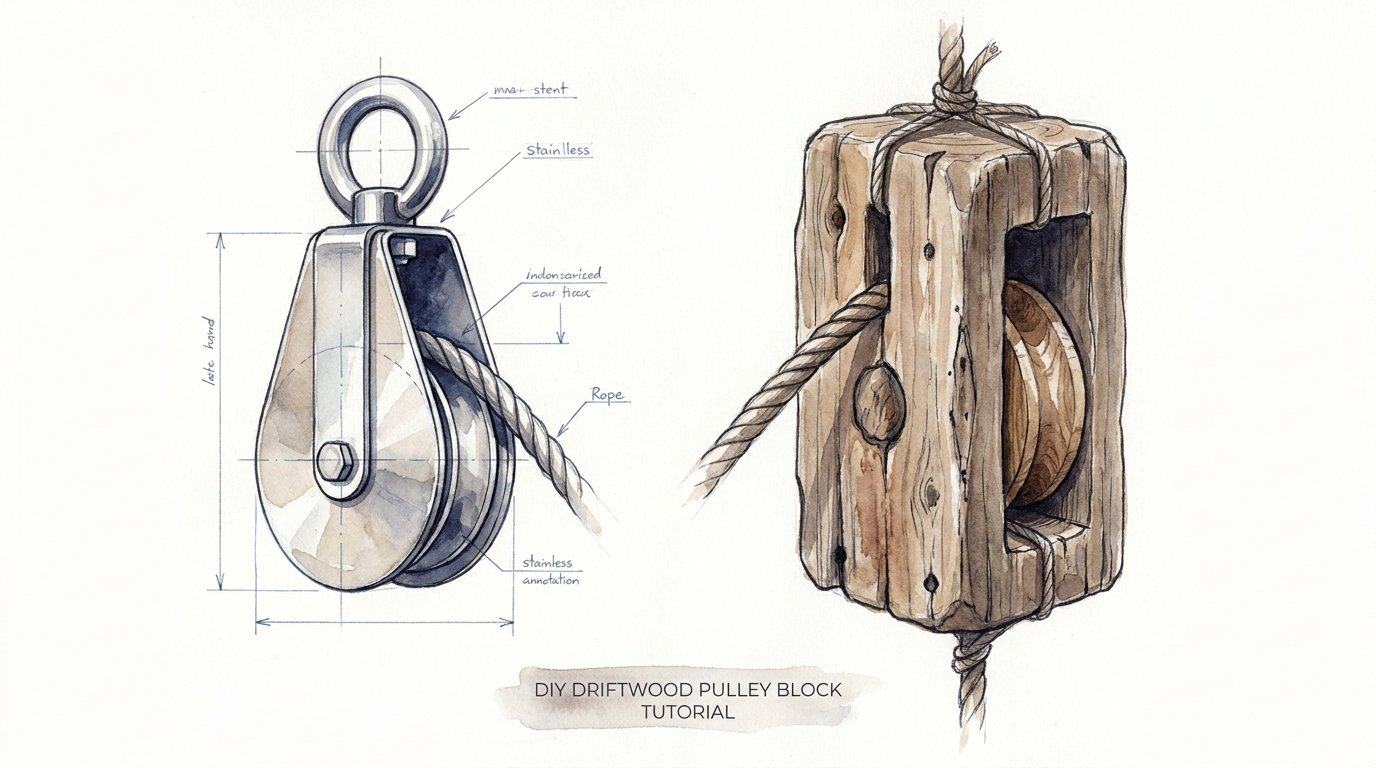
Anatomy is the first thing to master. The block consists of the shell (the body), the sheave (the wheel), the pin (the axle), and the strop (the rope loop that holds it all together). The opening where the rope enters is called the swallow, while the sides of the block are the cheeks. Understanding these parts allows you to scale your design from a tiny 3-inch block for a clothesline to a massive 12-inch double-purchase block for heavy timber framing.
Step 1: Selecting Your Driftwood
Success starts on the beach. You are looking for a piece of hardwood driftwood—typically oak, elm, or locust—that feels unnaturally heavy for its size. Avoid “punky” wood that feels soft or light, as this indicates internal rot. Look for timber with a tight grain and no large cracks (checks) running through the center where your pin will go. A piece of driftwood that has been pounded by surf and sand is often “case-hardened” and provides an ideal shell material.
Step 2: Preparing the Shell
Square up your selected driftwood using a handsaw or drawknife. For a standard single block, your shell should be roughly three times as long as the width of the rope you intend to use. Once squared, mark the center for the mortise—the slot where the sheave will sit. You can remove the bulk of this material with a drill, then clean up the interior walls with a sharp chisel. The interior must be smooth so the rope doesn’t chafe as it passes through the swallow.
Step 3: Creating the Sheave
The sheave is the heart of the block. Historically, these were made from Lignum Vitae, a tropical hardwood so dense it sinks in water and contains natural oils that act as a permanent lubricant. If you don’t have Lignum Vitae, use a dense piece of heartwood oak or even a high-density plastic like Delrin. Use a hole saw to cut a round blank, then mount it on a bolt in your drill or a lathe to carve the “U” shaped groove for the rope. The diameter of the sheave should be at least five to six times the diameter of the rope to prevent internal fiber damage to the cordage.
Step 4: Boring and Fitting the Pin
Drill a hole through the center of the cheeks and the sheave. This hole must be perfectly square to the shell faces. For the pin, a stainless steel bolt is the modern choice, but a traditionalist will use a piece of Greenheart or a brass rod. The pin should be a “snug” fit in the cheeks but allow the sheave to spin with zero resistance. If the sheave wobbles, the block will eventually “eat” itself under load.
Mechanical Advantage: How It Actually Works
Designing a block and tackle system isn’t just about making one block; it is about understanding how to “rove” them together to multiply your strength. This is the principle of Mechanical Advantage (MA). A single block fixed to a ceiling only changes the direction of the pull. You pull down to lift up. This is a 1:1 ratio. To actually gain power, you need a movable block attached to the load.
Every time the rope passes from one block to the other, it creates a “part” of the tackle. If you have two blocks and the rope goes back and forth twice, you have a 2:1 or 3:1 advantage depending on where the rope starts. In simple terms, if you have a 4:1 system, you can lift 400 pounds using only 100 pounds of force. The trade-off is distance. To lift that 400-pound load one foot, you must pull four feet of rope through your hands.
Friction is the enemy of wood-on-wood systems. While modern ball bearings reduce friction to nearly zero, they fail instantly if sand or salt gets inside. A wooden sheave on a wooden or brass pin has higher initial friction, but it is “dumb” technology—it doesn’t care about grit. To optimize performance, you must ensure the swallow is wide enough that the rope never touches the cheeks of the shell. The rope should only touch the sheave itself.
Benefits of Traditional Wood Blocks
Choosing hand-carved wood over modern galvanized steel offers several practical advantages that often surprise modern mechanics. The most immediate is weight-to-strength ratio. While a massive steel crane block is incredibly strong, it is also a lethal weight hanging over your head. A wooden block is much lighter, making it easier to rig alone in the woods or on a mast.
Corrosion resistance is another major factor. Steel blocks, even galvanized ones, will eventually pit and rust, creating sharp edges that shred rope. A driftwood block, especially one treated with oil, becomes smoother with use. The salt air that destroys metal only serves to keep the timber of a driftwood block hard and stable. Furthermore, a wooden block is “quiet.” There is no metallic clanking or grinding, which is why they are still preferred in theater rigging and traditional sailing.
Field repairability is perhaps the most “pioneer-grit” benefit. If a modern pulley breaks, you throw it away. If the pin in your wooden block snaps, you can carve a new one from a hardwood branch in twenty minutes. If the shell cracks, you can lash it back together with a “strop” of rope. This makes wooden blocks the ultimate choice for long-term survival or remote work where there is no hardware store for fifty miles.
Challenges and Common Mistakes
Building your own lifting gear carries a heavy responsibility. The most common mistake beginners make is choosing the wrong grain orientation for the shell. The grain should always run parallel to the direction of the pull. If you carve a block where the grain runs across the cheeks, the tension of the pin will simply split the wood in half like a piece of kindling the moment you apply a heavy load.
Another frequent error is making the sheave groove too shallow. If the rope can jump out of the sheave and get wedged between the wheel and the shell, it will jam the system instantly—a situation known as being “chock-a-block.” The groove should be deep enough that at least half the rope’s diameter is “buried” in the wheel. This ensures the rope stays centered even if the block starts to twist under load.
Neglecting the score is a final pitfall. The score is the groove carved around the outside of the shell to hold the “strop” or rope lashing. Without a deep, well-carved score, the rope holding the block to the anchor point can slip off the smooth wood. This lashing is what actually carries the weight; the wooden shell is just a housing for the wheel. If the lashing fails, the whole system collapses.
Limitations and Trade-offs
Despite their resilience, driftwood blocks have realistic constraints. They are not intended for high-speed applications. If you try to run a wooden pulley at 1,000 RPM with a motor, the friction between the sheave and the pin will generate enough heat to smoke the wood and eventually cause a fire. These are “slow and heavy” tools meant for manual hauling or slow-winch operations.
Size is another trade-off. To get the same strength as a 2-inch steel pulley, a wooden block might need to be 6 inches long. This increased bulk means you need more space for your rigging. Environmental factors also play a role; while they handle salt and water well, they can eventually fall prey to wood-boring insects if left sitting in the dirt for years without maintenance. You must treat them like any other high-quality wooden tool—keep them out of the mud and give them an occasional coat of oil.
Comparison: Hand-Hewn Timber vs. Modern Steel
When deciding between building a driftwood block or buying a modern steel equivalent, consider the following factors. This comparison focuses on the realities of long-term use in outdoor or maritime environments.
| Factor | Hand-Hewn Driftwood | Modern Stainless/Galvanized Steel |
|---|---|---|
| Maintenance | Low (Occasional oiling) | High (Greasing bearings, rust prevention) |
| Repairability | Excellent (Field-carvable parts) | Poor (Requires replacement) |
| Weight | Lightweight | Heavy |
| Longevity | Decades (If maintained) | Years (Prone to seizing/pitting) |
| Initial Cost | Free (Materials found in nature) | $20 – $200+ |
Practical Tips and Best Practices
For those ready to start their first project, always begin with a prototype. Don’t try to lift your truck with the first block you carve. Use a smaller piece of driftwood to understand how the mortise and sheave fit together. A “loose” block is a dangerous block, so aim for tolerances that allow movement but prevent slop.
Always use synthetic-clad or high-quality natural fiber rope. Modern “poly-steel” or “Dacron” ropes work exceptionally well with wooden blocks because they are slightly self-lubricating. If you use cheap, abrasive yellow polypropylene, it will act like sandpaper on your wooden sheaves. High-quality rope protects your investment in the wood.
Master the rope strop. Instead of using a metal hook, learn to create a “grommet”—a continuous loop of rope made by unlaying a single strand and re-weaving it into itself. This grommet is then “seized” around the block in the scores you carved. This creates a flexible, incredibly strong attachment point that won’t scratch your mast or clatter against your workshop walls.
Advanced Considerations: The Lignum Vitae Secret
Serious practitioners eventually go looking for Lignum Vitae for their sheaves. This wood is so unique that it was used for the propeller shaft bearings of the first nuclear submarine, the USS Nautilus. Its density is roughly 80 lbs per cubic foot, meaning it is one of the few woods that will sink in water. The reason it is the “holy grail” for pulley blocks is its resin content—up to 30% of its weight is natural oils.
When a sheave is made of Lignum Vitae, the friction of the spinning pin actually draws a small amount of oil to the surface, providing a self-replenishing lubricant that never washes away in the rain. If you can’t find genuine Lignum Vitae (which is now protected in many regions), look for Verawood (Argentine Lignum Vitae) or Ipe. These “ironwoods” offer similar, albeit slightly less oily, performance and will ensure your blocks remain effortless to turn for a lifetime.
Scaling your block systems is another advanced skill. For truly massive loads, you shouldn’t just make a bigger single block. You should move to double or triple blocks. Carving a “double block” requires a shell with two separate mortises and two sheaves. This allows you to “reeve” the rope through more parts, increasing your mechanical advantage without needing a 20-foot long block.
Example Scenario: The Timber-Frame Lift
Imagine you are building a small off-grid cabin. You have a 400-pound oak beam that needs to be lifted 8 feet into the air to set the header. Doing this by hand is a recipe for a hospital visit. Using a modern 1:1 pulley, you would still have to pull with 400 pounds of force—impossible for most people.
Instead, you carve two double-blocks from a piece of shore-found locust. You reeve them together to create a 4:1 purchase system (a “double tackle”). Now, to lift that 400-pound beam, you only need to apply 100 pounds of downward force. This is well within the capability of an average person. You can take your time, “sweating” the rope inch by inch, and because the blocks are made of wood, you don’t have to worry about them rusting if the construction project takes all winter.
Measurements matter in this scenario. For a 4:1 lift with a half-inch rope, your blocks should be about 9 inches long with 4-inch diameter sheaves. This size ensures the rope has enough “tread” to grip the sheave without slipping and the shell has enough “meat” to resist the 500-pound total tension (400-pound load plus 100-pound pull) on the anchor point.
Final Thoughts
Reclaiming the art of the driftwood pulley block is more than a woodworking project; it is a shift in perspective. It challenges the idea that we are helpless without industrial manufacturing. By finding a piece of timber that the ocean has already tested and carving it into a tool of mechanical advantage, you are participating in a tradition that spans thousands of years of human ingenuity.
Practical value is the ultimate measure of any tool. A hand-carved block is lighter, quieter, and more resilient to the ravages of nature than almost anything you can buy. It teaches you about grain, friction, and the elegant simplicity of physics. As you use these blocks, you’ll find they develop a “patina of utility”—a smooth, polished finish that only comes from years of honest work.
Start small and keep your eyes on the tide line. The next time you find a piece of silvered, heavy timber on the sand, don’t see it as debris. See it as the crown of a new block, waiting to be brought back to life. Experiment with different woods, master the rope strop, and soon you’ll have a workshop filled with tools that have as much soul as they do strength.
Sources
1 wikipedia.org (https://en.wikipedia.org/wiki/Block_(sailing)) | 2 lamitopsail.org (https://lamitopsail.org/wp-content/uploads/2015/05/Nautical-Terminology-and-Commands.pdf) | 3 rolandsmodelshipbuilding.com (https://rolandsmodelshipbuilding.com/2019/05/06/block-and-tackle/) | 4 4thgillingham.co.uk (http://www.4thgillingham.co.uk/tutorials/sailing-tips/blocks/) | 5 duckworksmagazine.com (https://www.duckworksmagazine.com/02/articles/woodenblocks/woodenblocks.htm) | 6 maritimesa.org (https://maritimesa.org/nautical-science-grade-11/2020/10/23/blocks-and-tackles/) | 7 timbersol.co.uk (https://timbersol.co.uk/blog/strongest-types-of-wood/) | 8 maritime.org (https://maritime.org/doc/steel/part5.php) | 9 maritimesa.org (https://maritimesa.org/nautical-science-grade-11/2020/10/23/purchases-and-tackles/) | 10 syrenshipmodelcompany.com (https://syrenshipmodelcompany.com/resources/Stropping%20Blocks%20(one%20method).pdf) | 11 firgelliauto.com (https://www.firgelliauto.com/blogs/mechanisms/block-and-tackle) | 12 treelineusa.com (https://treelineusa.com/blog/best-carving-wood/)