reduce screen time kids
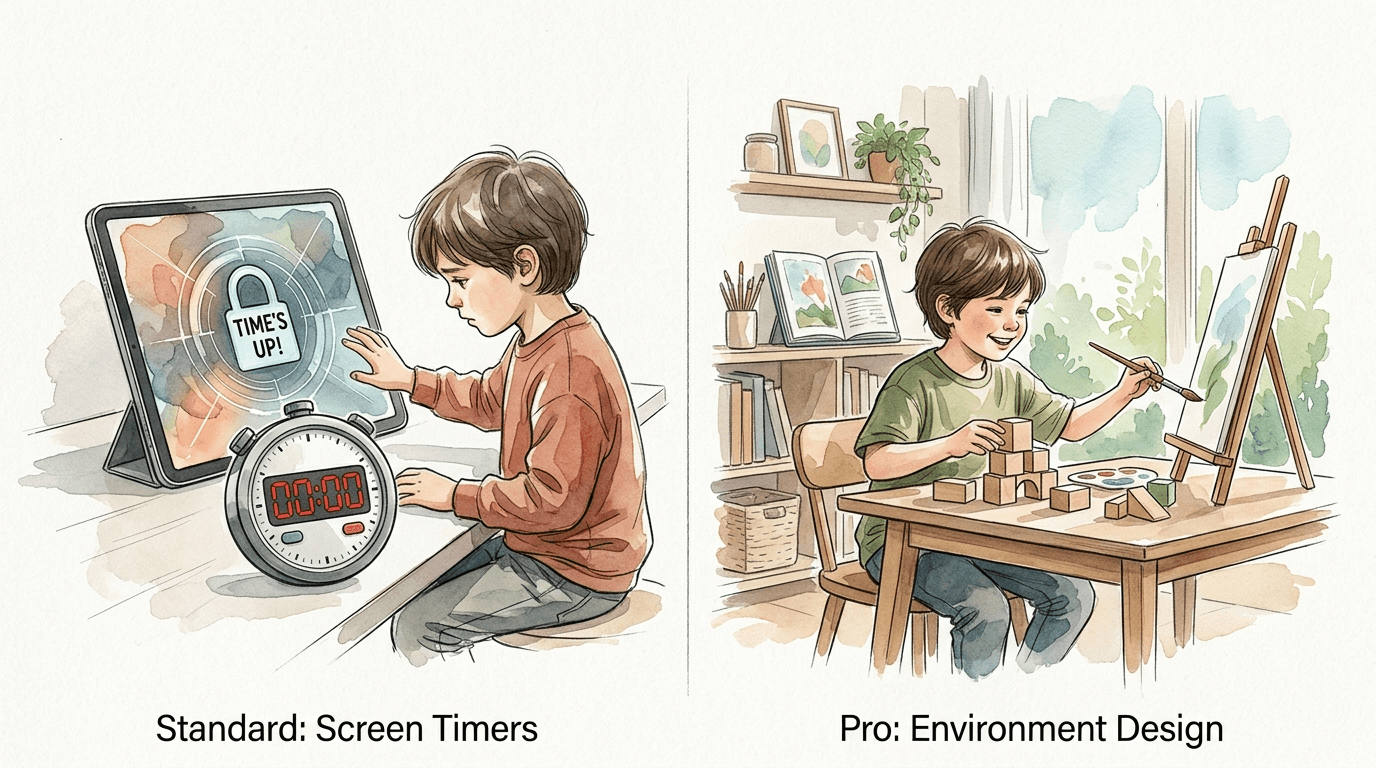
Amateurs use timers; pros use architecture. Change the room, change the habit. Stop being the ‘Screen Police’. Move from standard timers to Pro-level environmental design. If they can’t see the screen, they won’t ask for it. Try these 3 home layout shifts.
[affiai]Negotiating with a toddler over “five more minutes” is a losing battle. You are fighting against a dopamine loop designed by some of the smartest engineers in the world. When you use a timer, you remain the villain, the one who takes the fun away. But when you change the environment, the house becomes the teacher. The “architecture of the home” does the work for you, removing the constant visual cues that trigger screen cravings.
Environmental design is about friction. If a screen is the first thing your child sees when they walk into a room, they will want to use it. If the screen is hidden behind a cabinet or a piece of art, the craving never starts. You are moving from reactive parenting to proactive design. This guide will show you how to stop managing minutes and start managing your space.
reduce screen time kids
To reduce screen time kids need more than just rules; they need a physical environment that supports different types of play. Currently, the average child aged 8 to 18 spends approximately 7.5 hours daily on screens for entertainment, while only spending four to seven minutes in unstructured outdoor play. This massive imbalance has significant consequences for brain development, including potential thinning of the brain’s cortex, which is responsible for critical thinking and reasoning.
When we talk about reducing screen time, we are really talking about replacing a high-dopamine, low-effort activity with something that requires more engagement. Research from the American Academy of Pediatrics suggests that children under 18 months should avoid screens entirely (except for video chatting), and those aged 2 to 5 should be limited to one hour of high-quality programming per day. However, enforcing these limits with a stopwatch often leads to power struggles and “screen hangovers”—the irritability children face when the digital flow is suddenly interrupted.
In the real world, screens are used as “digital pacifiers” because they are convenient. They occupy a child while a parent cooks dinner or takes a phone call. Environmental design acknowledges this reality but seeks to lower the visual “noise” of screens. By making screens harder to access and non-screen activities easier to start, you change the default behavior of the household without saying a word.
How Environmental Design Works
The core principle of environmental design is Choice Architecture. This concept suggests that the way options are presented to us determines what we choose. If your living room furniture is all pointed at a 65-inch black rectangle, the room is shouting, “Watch TV!” If the furniture is arranged in a circle around a coffee table with books and art supplies, the room says, “Talk or Create.”
You are using “friction” to guide behavior. High friction means an activity is hard to start (e.g., the TV is unplugged in a closet). Low friction means an activity is easy to start (e.g., a bin of Legos is open on the floor). To reduce screen use, you must increase the friction for digital devices and decrease the friction for physical play. Habits follow a three-step loop: cue, routine, and reward. By removing the visual cue (the screen), you prevent the routine from ever starting.
Visual cues are powerful triggers. A study on habit formation found that visual indicators lose their effect after 3-5 days through habituation, so it is important to rotate or reposition your environment regularly to keep non-screen options fresh. The goal is to make the “good” behavior the path of least resistance. You aren’t taking away the TV; you are just making it a less obvious choice.
Benefits of an Architecture-First Approach
Moving away from timers toward environmental design offers measurable benefits for both children and parents. Studies show that when screen time is reduced through healthy boundaries, children experience improved sleep hygiene and better emotional regulation. Because blue light-emitting devices can suppress melatonin secretion, removing screens from sight before bedtime ensures a more natural sleep cycle and better REM sleep, which is essential for memory and learning.
Cognitive development also sees a significant boost. High amounts of screen time in children aged 3 to 5 have been linked to differences in brain structure, specifically in areas responsible for visual processing, empathy, and attention. By designing an environment that encourages “three-dimensional play”—where children interact with height, weight, and depth through touch—you are supporting the neural pathways that screens simply cannot stimulate.
Parental stress levels often drop when the environment does the “parenting.” You no longer have to be the person who says “no” every ten minutes. When the TV isn’t the focal point of the room, kids are more likely to engage in “boredom,” which is the space where creativity and imagination actually happen. Instead of waiting for a timer to beep, children learn to look around their environment for things to do, fostering independence and problem-solving skills.
Challenges and Common Mistakes
The biggest challenge is the “inconvenience factor.” Many parents keep screens front and center because they are a reliable way to keep kids occupied. Hiding a TV or putting tablets in a locked drawer means you also lose that easy escape when you need a break. It requires a commitment to the initial transition period, which can be messy and loud as kids adjust to a new layout.
A common mistake is thinking that just “hiding” the screen is enough without providing an alternative. If you remove the TV but leave the room empty, your child will just follow you around asking for the TV. You must “flood the zone” with low-friction alternatives. If the screen goes into a cabinet, the art supplies must come out onto the table. If the tablet is put away, a basket of books should take its place.
Another pitfall is inconsistent messaging between caregivers. If one parent enforces the “hidden screen” rule while the other leaves the remote on the couch, the child becomes confused and frustrated. Everyone in the house must be on board with the architecture of the space. It is also a mistake to ignore your own habits; if you are constantly on your phone while the kids are “screen-free,” they will quickly sense the hypocrisy and resist the boundaries.
Limitations of Environmental Design
Environmental design is not a magic wand for every situation. In small apartments or studio spaces, you may not have the luxury of “hiding” a TV or creating separate zones for play. Spatial constraints can make it difficult to move furniture away from the screen. In these cases, you have to get creative with covers, screens, or decorative cloths to break the visual cue.
Budget can also be a barrier. Buying hidden TV cabinets or custom joinery is expensive. However, you can achieve similar results with DIY solutions like painting the wall behind the TV a dark color to help the screen “recede” or using a simple folding screen to block the view. The principle of friction still applies even if the solution is a $20 cloth rather than a $2,000 armoire.
Finally, environmental design cannot replace active parenting. While a better layout helps, you still need to engage with your children and model healthy digital habits. If the environment is perfect but the social interaction is missing, the child will still crave the high-stimulation reward of a screen. It is a tool to support your parenting, not a replacement for it.
Standard vs. Pro: How They Compare
| Feature | Standard: Screen Timers | Pro: Environment Design |
|---|---|---|
| Primary Focus | Duration of use | Ease of access |
| Parental Role | Enforcer/Police | Architect/Guide |
| Friction Level | Low (Screen is always ready) | High (Screen is tucked away) |
| Mental Load | High (Constant monitoring) | Low (Set it and forget it) |
| Child Reaction | Negotiation and begging | Forgetfulness/Natural play |
Practical Tips for Your Home Layout
You can start shifting your home’s architecture today with zero budget. The first step is to turn your furniture away from the screen. Instead of having every seat in the living room face the TV, arrange your couch and chairs to face each other or a window. This simple shift signals that the room is for conversation and connection, not just consumption.
Next, use visual “camouflaging” techniques. If you cannot hide the TV in a cabinet, paint the wall behind it a dark, matte color like charcoal or navy. This reduces the contrast between the black screen and the wall, making the TV “disappear” when it is off. You can also hang a gallery wall of art around the TV to draw the eye away from the screen and toward the physical decor.
Create a centralized charging station in a drawer or a basket away from common areas. Instead of having tablets and phones charging on the kitchen counter or by the bed, they should have a “home” that is out of sight. When the devices are charging in a closed cabinet, they are no longer an active visual prompt for your child to ask for them. If they can’t see it, the craving is significantly reduced.
- Hide the remote: Keep the TV remote in a drawer or high shelf so the child cannot turn it on themselves.
- The “Lego Table” trick: Keep a half-finished project (puzzle, blocks, art) in the most prominent spot in the room.
- Outdoor Gear visibility: Keep shoes, balls, and outdoor toys right by the door to make going outside the easiest choice.
Advanced Considerations for Long-Term Success
For serious practitioners of environmental design, consider the “Digital Minimalism” philosophy for the whole house. This involves evaluating every piece of technology based on its value and cost to your family’s focus. It might mean replacing a large TV with a projector that you only pull out for “movie nights,” effectively making the screen 100% invisible 90% of the time.
Lighting also plays a role in environmental cues. Bright, cool lighting is associated with screen-based activities and alertness. By using warm, dimmable lights in the evening, you signal to the body that it is time for quiet, screen-free play. This “temporal design” aligns your home’s atmosphere with your family’s biological needs, making it easier for kids to transition away from screens as the sun goes down.
Think about the “Social Architecture” of your home. If you want your kids to read, they need to see you reading. If you want them to play outside, the backyard needs to be an inviting, safe space that they can access independently. The environment should not just “block” screens but “invite” the life you want your family to lead. Your role is to be the lead architect of these experiences.
Example: The Living Room Transformation
Consider the “Before” and “After” of a typical family room. In the “Before” scenario, a 55-inch TV is the centerpiece of the main wall, with a large sectional couch facing it directly. A tablet is charging on the side table, and a pile of remotes sits on the coffee table. The kids walk in, see the screen, and immediately ask to watch a show. The parent says “not yet,” leading to a 20-minute argument.
In the “After” scenario, the parent installs a simple set of sliding “barn doors” or a large piece of hinged art over the TV. The sectional is broken up into a couch and two chairs facing each other over a rug. The tablet is moved to a charging station in the hallway closet. On the coffee table, there is a basket of library books and a tray of drawing materials. When the kids walk in, they don’t see a screen. They see the books and the art supplies. Instead of asking for the TV, they naturally pick up a book or start a drawing. The architecture has won the battle before it even started.
Final Thoughts
Reducing screen time doesn’t have to be a daily war of wills. By shifting from the “Screen Police” role to the “Home Architect” role, you create a space that naturally guides your children toward healthier habits. Screens are powerful, but they are also just objects in a room. When you control how those objects are presented, you control the influence they have over your family’s life.
Start small. Choose one room and make one layout shift this weekend. Hide the remotes, turn a chair, or move the tablet charger. You will be surprised at how quickly children adapt to the “new normal” when the visual cues are removed. Your home is a tool—make sure it is designed to work for you, not against you.
Experiment with different setups and observe how your children’s play patterns change. The goal isn’t to eliminate technology forever, but to ensure that it serves your family on your terms. Change the room, and the habits will follow.
Sources
1 biglifejournal.com (https://biglifejournal.com/blogs/blog/benefits-of-outdoor-play-less-screen-time) | 2 nyp.org (https://www.nyp.org/healthmatters/what-does-too-much-screen-time-do-to-childrens-brains) | 3 extendedframes.com (https://extendedframes.com/design-your-environment-how-space-shapes-habits-focus-and-results/) | 4 jamesclear.com (https://jamesclear.com/environment-design-organ-donation) | 5 cool-timer.com (https://cool-timer.com/blog-pages/building-sustainable-daily-routines-with-timer-tools) | 6 medium.com (https://medium.com/discover-elevate-mastering-work-life-productivity/what-are-the-visual-indicators-in-building-habits-3f08a64e9b33) | 7 goalsandprogress.com (https://goalsandprogress.com/home-environment-design-for-better-habits/) | 8 harvard.edu (https://hms.harvard.edu/news-events/publications-archive/brain/screen-time-brain) | 9 harvard.edu (https://hms.harvard.edu/news-events/publications-archive/brain/screen-time-brain) | 10 compasschildcare.com (https://www.compasschildcare.com/child-care-near-me/nature-vs-screens-how-outdoor-learning-environments-shape-child-development) | 11 cincinnatichildrens.org (https://scienceblog.cincinnatichildrens.org/screen-usage-linked-to-differences-in-brain-structure-in-young-children/) | 12 cincinnatichildrens.org (https://scienceblog.cincinnatichildrens.org/screen-usage-linked-to-differences-in-brain-structure-in-young-children/) | 13 ballarddesigns.com (https://www.ballarddesigns.com/howtodecorate/2018/01/8-ways-to-hide-your-tv-in-plain-sight/) | 14 reddit.com (https://www.reddit.com/r/HomeDecorating/comments/132qw2g/350_degree_glass_room_no_walls_so_tv_in_centre_of/)