Urban Driftwood Shelf Design Ideas
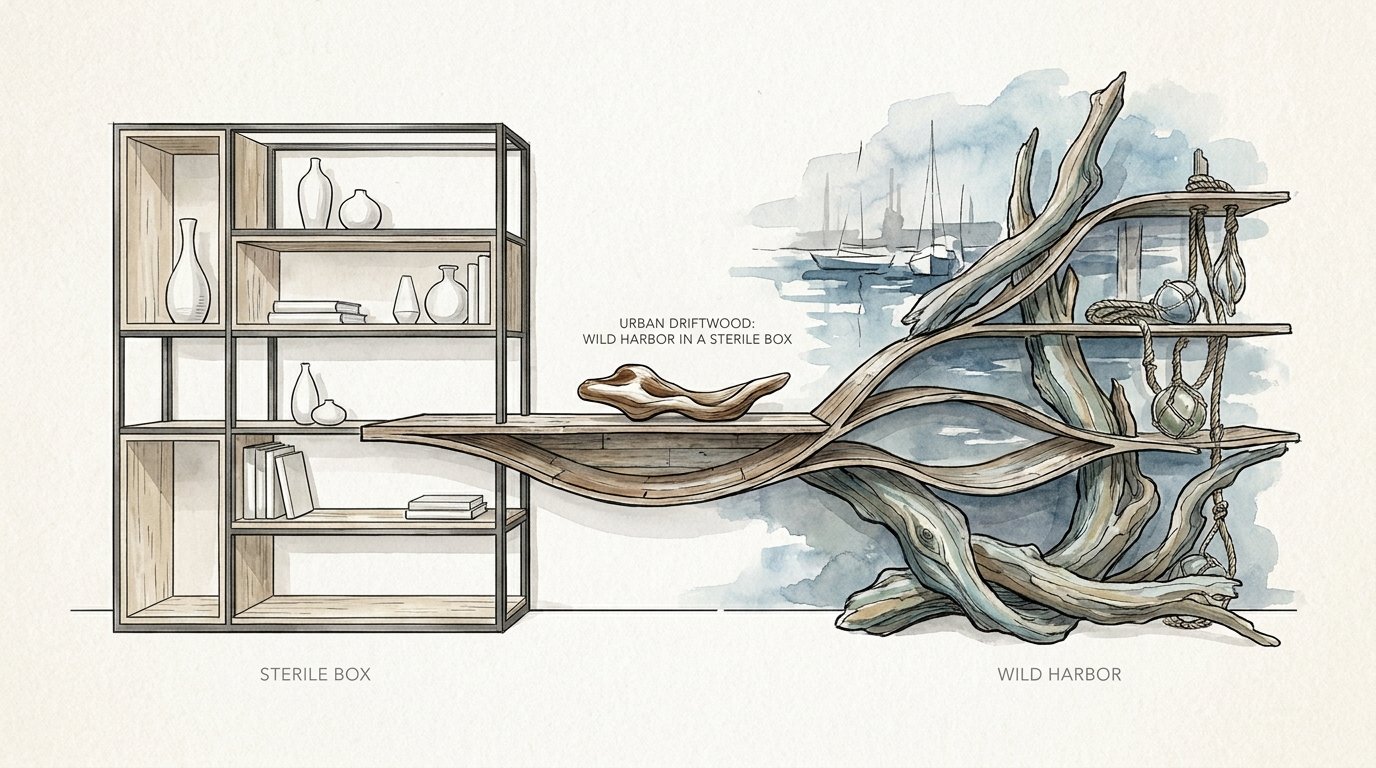
Why live in a sterile concrete box when the ocean is giving away the blueprints for a wild sanctuary? Urban living can feel like living in a cage of straight lines. A driftwood shelf isn’t just a place to put your keys; it’s a piece of the wild world breaking through the concrete. It’s time to bring the texture of the Pacific into the heart of the city.
[affiai]Establishing a home in a modern city often requires a compromise between convenience and soul. High-rise apartments and industrial lofts offer sleek surfaces, but they frequently lack the grounding presence of the natural world. Driftwood serves as a bridge between these two realities. This material has been forged by salt, sun, and the relentless churning of the tides, resulting in a density and character that no kiln-dried lumber from a big-box store can replicate.
Mounting a weathered plank of cedar or fir onto a drywall surface is an act of defiance. It rejects the mass-produced aesthetic in favor of something unique and unyielding. Every knot in the wood tells a story of survival against the elements, and bringing that story indoors changes the energy of a room. It turns a functional storage space into a focal point of rugged, biophilic design.
Practitioners of this craft know that working with driftwood is a test of patience. You cannot rush the ocean, and you certainly cannot rush the preparation of its gifts. From the legalities of the shoreline to the grit of the final mounting, this guide will walk you through the process of creating an urban driftwood shelf that stands the test of time.
Urban Driftwood Shelf Design Ideas
Urban driftwood shelf design is the art of integrating raw, salt-beaten timber into modern interior environments. It sits at the intersection of coastal heritage and industrial utility. While a traditional shelf is a flat, predictable surface, a driftwood shelf embraces irregularity, using the wood’s natural “live edge” to create visual tension against the flat walls of a city apartment.
One popular approach is the Industrial Shoreline style. This design pairs heavy, sun-bleached planks with black iron pipe fittings or raw steel brackets. The contrast between the organic, eroded wood and the rigid, man-made metal creates a balanced aesthetic that works perfectly in lofts or converted warehouses. It suggests a history of maritime labor brought into a residential space.
Another refined option is the Invisible Floating Mount. In this design, the hardware is completely hidden within the wood and the wall studs. This creates the illusion that a massive piece of the coast is simply hovering against your wall. It emphasizes the silhouette of the wood, highlighting the “silvering” effect caused by years of UV exposure and salt saturation. This style is ideal for minimalist homes where the goal is to reduce clutter and focus on a single, powerful texture.
For smaller spaces, consider the Suspended Rope Shelf. Using thick manila or sisal rope to hang a driftwood plank adds a vertical element to the design. This method mimics the rigging of old sailing vessels and provides a sense of movement. It is particularly effective for lighter pieces used to display plants or small ceramics, adding a “wild harbor” vibe to a bathroom or kitchen corner.
How to Process and Prepare Driftwood
Turning a piece of beach debris into a permanent interior fixture requires a systematic approach to cleaning and stabilizing the material. You are bringing a biological object into a controlled environment; failure to treat it properly can lead to pests, mold, or structural failure.
The first step is Desalination and Sanitization. Driftwood is often saturated with sea salt and microscopic organisms. Submerge the wood in a large trough of fresh water for at least 48 to 72 hours. This process leaches out the salt, which could otherwise corrode your mounting hardware over time. After the initial soak, add a mild bleach solution (roughly one cup of bleach per gallon of water) and let it sit for another 24 hours. This kills any hidden “critters” like sand gnats or wood-boring larvae that may be dormant in the crevices.
Once sanitized, the wood must undergo Solar Drying. Never attempt to build with damp driftwood. Place the wood in a well-ventilated area, preferably in direct sunlight, for one to two weeks. The wood is ready when it feels light for its size and produces a sharp “clack” when tapped with a hammer. If you are in a humid urban environment, using a dehumidifier in a closed room can accelerate this process, but avoid high-heat ovens which can cause the wood to check or crack violently.
The final stage of preparation is Structural Sanding. Use a stiff wire brush to remove any loose bark, soft rot, or calcified salt deposits. Then, transition to 120-grit sandpaper to smooth out the “working surface” of the shelf while leaving the front and sides raw. You want to preserve the silvered patina that only nature can provide, so sand sparingly. A light touch ensures the wood remains a piece of art rather than a piece of lumber.
The Mechanics of Mounting Irregular Wood
Mounting a piece of driftwood is more complex than hanging a standard shelf because the back surface is rarely flat. Achieving a level, secure fit against a flat wall requires mechanical ingenuity and a few specific techniques.
Scribing the Back Edge is a fundamental skill for the serious practitioner. To get the wood flush against the wall, you may need to “scribe” the irregularities of the wood onto a piece of paper, transfer it to the wood, and use a chisel or a power sander to create a flat contact point. Alternatively, for very heavy pieces, you can use Lag Bolts and Stud Mounting. Locate your wall studs and drill deep pilot holes into the thickest parts of the driftwood. Use long lag screws that penetrate at least two inches into the wooden studs behind the drywall.
If you prefer a floating look, Internal Steel Rods are the gold standard. This involves drilling deep, perfectly straight holes into the back of the driftwood plank and inserting heavy-duty steel rods that are anchored into the wall studs. Because driftwood can be surprisingly dense in the center while being soft on the outside, ensure your drill bit is sharp and your torque is set high. Use a spirit level on the front face of the wood as you tighten the hardware, as the irregular top surface can easily fool the eye.
For lighter applications or hollow walls where studs aren’t available at the desired location, Heavy-Duty Toggle Bolts (like Snaptoggles) are necessary. These anchors provide significant pull-out resistance by spreading the load behind the drywall. However, always aim for at least one stud for any driftwood shelf intended to hold more than a few pounds. The torque exerted by a deep shelf can easily rip through gypsum board if not properly anchored.
Benefits of Driftwood Shelving in Urban Environments
The primary benefit of a driftwood shelf is its Biophilic Impact. Research in environmental psychology suggests that the presence of natural materials—specifically those with organic, non-linear forms—can lower cortisol levels and reduce heart rates in occupants of urban spaces. In a city of “straight lines,” the curved, eroded edges of driftwood provide a much-needed visual rest for the brain.
Sustainability is another significant advantage. Using driftwood is the ultimate form of Material Salvage. You are reclaiming wood that has been discarded by the ecosystem, requiring no new trees to be harvested and no industrial processing. It is a zero-carbon material choice that carries a story of environmental resilience. Each piece is a “one-of-one,” ensuring that your home remains distinct from the cookie-cutter interiors of modern developments.
From a practical standpoint, driftwood is Naturally Hardened. The combination of salt saturation and sun-baking often results in wood that is more resistant to rot and impact than standard pine shelving. Once properly dried and sealed, a driftwood shelf is incredibly durable, capable of supporting heavy loads if the mounting system is engineered correctly. It brings a “pioneer-grit” durability to the delicate interior of a city apartment.
Challenges and Common Pitfalls
The most common mistake beginners make is Underestimating the Salt. If wood is not properly leached in fresh water, the residual salt will eventually pull moisture from the air. This leads to a “weeping” effect where the wood stays perpetually damp, eventually rusting brackets and ruining the paint on your walls. Always take the time to soak your finds before they enter the workshop.
Another challenge is Pest Infiltration. Coastal wood is a prime habitat for various insects. If you skip the bleach or vinegar soak, you might find yourself dealing with an infestation months after the shelf is mounted. Some practitioners use a heat-treatment method in a homemade kiln to ensure total sterilization, but for most urban DIYers, a thorough chemical soak is the most reliable path.
Structural integrity can also be a hidden issue. Driftwood often looks solid but can have Internal Decay or “punky” spots. Always test the density of the wood by trying to press a fingernail or a screwdriver into it. If it sinks in easily, the wood is too soft to hold a screw. You can sometimes save these pieces by injecting them with wood-hardening resin, but it’s often better to keep hunting for a more “bone-hard” specimen.
Limitations and Environmental Constraints
Not every piece of wood found on the beach is suitable for shelving. Weight and Balance are significant constraints. Very thick, water-logged logs may be too heavy for standard residential drywall even with the best anchors. You must be realistic about the load-bearing capacity of your walls. If you are renting a modern apartment with thin metal studs, you may be limited to smaller, decorative driftwood accents rather than heavy consoles.
There are also Legal Limitations to consider. In many regions, such as parts of the Pacific Northwest, driftwood is considered critical habitat for shoreline ecosystems. Taking massive logs or wood embedded in sand dunes is often illegal and subject to heavy fines. Most jurisdictions allow the “hand-carry” removal of small quantities for personal use, but always check local DNR (Department of Natural Resources) or State Park regulations before you start loading your truck.
Furthermore, driftwood is sensitive to Humidity Fluctuations. Urban apartments often have very dry air in the winter due to central heating. This can cause the wood to shrink or develop new cracks. While this often adds to the “rugged” look, it can loosen mounting hardware. It is wise to check the tightness of your shelf brackets once a year to ensure the wood hasn’t shifted as it acclimates to your home’s microclimate.
Comparing Driftwood to Other Materials
When deciding on a shelving material, it helps to understand how driftwood stacks up against common alternatives like reclaimed barn wood or new commercial lumber.
| Feature | Driftwood | Reclaimed Barn Wood | Commercial Pine/Oak |
|---|---|---|---|
| Visual Texture | High; eroded, silvered patina | Medium; saw marks, nail holes | Low; uniform grain |
| Ease of Prep | Low; requires soaking/drying | Medium; requires de-nailing | High; ready to sand |
| Cost | Free (if self-collected) | Moderate to High | Moderate |
| Durability | High (if dense species) | High | Medium |
| Uniqueness | Absolute; no two are alike | High | None; mass-produced |
While commercial lumber is easier to work with, it lacks the history and tactile soul of salvaged wood. Reclaimed barn wood offers a similar “old world” feel but often lacks the specific sun-bleached, salt-worn aesthetic that defines the coastal look. Driftwood remains the choice for those who value the “wild” over the “vintage.”
Practical Tips and Best Practices
If you want your driftwood shelf to look professional rather than like a piece of washed-up trash, attention to detail is paramount. Use a Matte Polyurethane Finish. High-gloss finishes make driftwood look like plastic and ruin the natural light-diffusing properties of the silvered grain. A matte or “ultra-flat” sealer protects the wood from dust and moisture without changing its appearance.
When it comes to leveling, do not rely on the top surface of the wood. Driftwood is almost always tapered or bowed. Instead, use a Level on the Brackets themselves. If the wood sits at a slight angle, you can use small wooden shims or even dabs of clear epoxy on the underside of the shelf to “true” the surface where items will sit. This ensures your coffee mug doesn’t slide off a shelf that looks perfectly straight to the eye.
Another pro tip is to use Beeswax for Small Crevices. If your piece has deep cracks that might collect dust, filling them with a dark-tinted beeswax can stabilize the wood and make cleaning much easier. It preserves the “honesty” of the material while making it more functional for daily life in a busy city apartment.
Advanced Considerations for Serious Practitioners
For those who want to push the boundaries of urban driftwood design, consider Integrated Lighting. Routing a small groove into the underside of a thick driftwood plank allows you to install a recessed LED strip. This creates a “wash” of light that highlights the textures of the wall below and the grain of the wood above. It’s an effective way to turn a functional shelf into a piece of high-end architectural lighting.
If you find a piece of wood that is structurally sound but has a large “check” or split, you can use Resin Stabilization. Pouring a clear or sea-blue epoxy into the crack not only reinforces the wood but also creates a “river” effect that nods back to the wood’s aquatic origins. This requires careful damming of the wood and a slow-cure resin to prevent bubbles, but the results are stunning in a modern setting.
Consider the Species of Wood you are sourcing. Western Red Cedar is common on many beaches and offers incredible rot resistance and a sweet, lingering scent. However, it is a soft wood and can be easily dented. If you find “Old Growth” fir or hemlock, these pieces are often as hard as stone after years in the salt. Identifying your wood species helps you choose the right drill bits and fasteners for the job.
Example Scenarios for the Urban Home
Imagine a narrow Entryway in a Brooklyn Brownstone. The walls are white, the floor is dark wood. A single, six-foot-long piece of silvered driftwood is mounted at waist height using hidden steel rods. It serves as a “landing strip” for mail and keys. The organic shape breaks up the long, narrow corridor, making the space feel expansive and grounded rather than cramped.
In a Modern Bathroom with Slate Tiles, a series of three small, thick driftwood blocks are used as staggered shelving for towels and apothecary jars. The warmth of the wood balances the coldness of the stone tiles. Because the wood has been properly sealed with a moisture-resistant finish, it thrives in the humid environment, reminiscent of a high-end coastal spa.
Finally, consider a Living Room Feature Wall. Instead of a single shelf, multiple pieces of driftwood are arranged in a “gallery” style, some holding trailing plants like Pothos, others holding vintage maritime instruments. The varying textures of the wood—some smooth and water-worn, others rugged and knotted—create a vertical forest effect that completely transforms the “sterile concrete box” into a living sanctuary.
Final Thoughts
Building an urban driftwood shelf is more than a weekend project; it is a way of reclaiming a sense of the wild within the confines of city life. It requires you to slow down, to respect the cycles of the ocean, and to apply the “pioneer-grit” necessary to turn raw nature into a functional home. By following the proper steps of sanitization, drying, and structural mounting, you ensure that your piece of the Pacific remains a durable and beautiful part of your environment for decades.
The practical value of this approach lies in the unique combination of sustainability, biophilic health benefits, and rugged durability. There is a deep satisfaction in knowing that the shelf on your wall wasn’t purchased from a catalog, but was instead “won” from the shoreline and finished by your own hands. It reminds us that even in the heart of the concrete jungle, the textures of the natural world are never far away.
As you begin your hunt for the perfect plank, remember to work with the wood, not against it. Let the knots and the cracks guide your design. Whether you choose the industrial look of pipe brackets or the magic of a floating mount, you are doing more than just adding storage. You are bringing the soul of the harbor home. Experiment with different oils, play with lighting, and most importantly, listen to what the wood is telling you about the journey it took to get to your wall.
Sources
1 diydriftwood.com (https://diydriftwood.com/driftwood-refinishing-techniques/) | 2 youtube.com (https://www.youtube.com/watch?v=c3j9o7yTMss) | 3 youtube.com (https://www.youtube.com/watch?v=irzKw9lhEtU) | 4 dksstores.com (https://dksstores.com/blog-post49) | 5 lakewedoweelife.com (https://www.lakewedoweelife.com/lake-life/driftwood-art-and-treasures-by-tammy-lovvorn) | 6 wikihow.com (https://www.wikihow.com/Preserve-Driftwood) | 7 anchorco.com (https://anchorco.com/blogs/pro-tips-and-tricks/how-to-hang-shelves-in-drywall) | 8 woodsnap.com (https://www.woodsnap.com/blogs/news/how-to-hang-wall-shelves-on-drywall-secure-and-stylish-solutions) | 9 rmcad.edu (https://www.rmcad.edu/blog/biophilic-design-integrating-nature-into-modern-interiors/) | 10 homedepot.com (https://www.homedepot.com/c/ah/how-to-hang-shelves/9ba683603be9fa5395fab90a500e3e8) | 11 reddit.com (https://www.reddit.com/r/SeattleWA/comments/gmcsi2/any_recommendations_for_good_driftwood_beaches/) | 12 snazzylittlethings.com (https://www.snazzylittlethings.com/3-step-durable-driftwood-finish/)