Structural Integrity Of Driftwood For Shelves
Are you burning your best building materials for ten minutes of heat when they could be supporting your library for decades? Most people see a driftwood log and think ‘bonfire.’ But that wood has been salt-cured and sun-dried into a material stronger than anything you’ll find at a lumber yard. Stop burning the ‘fuel’ and start building the ‘legacy.’ Your future shelves are hidden in the woodpile.
[affiai]Finding a massive piece of silvered timber on the shoreline feels like discovering a lost treasure. This wood has survived the crushing weight of the ocean, the abrasive grit of the sand, and the relentless bleaching of the sun. It has endured more than any kiln-dried plank from a big-box store. Choosing to build with it is an act of respect for the journey that wood has taken.
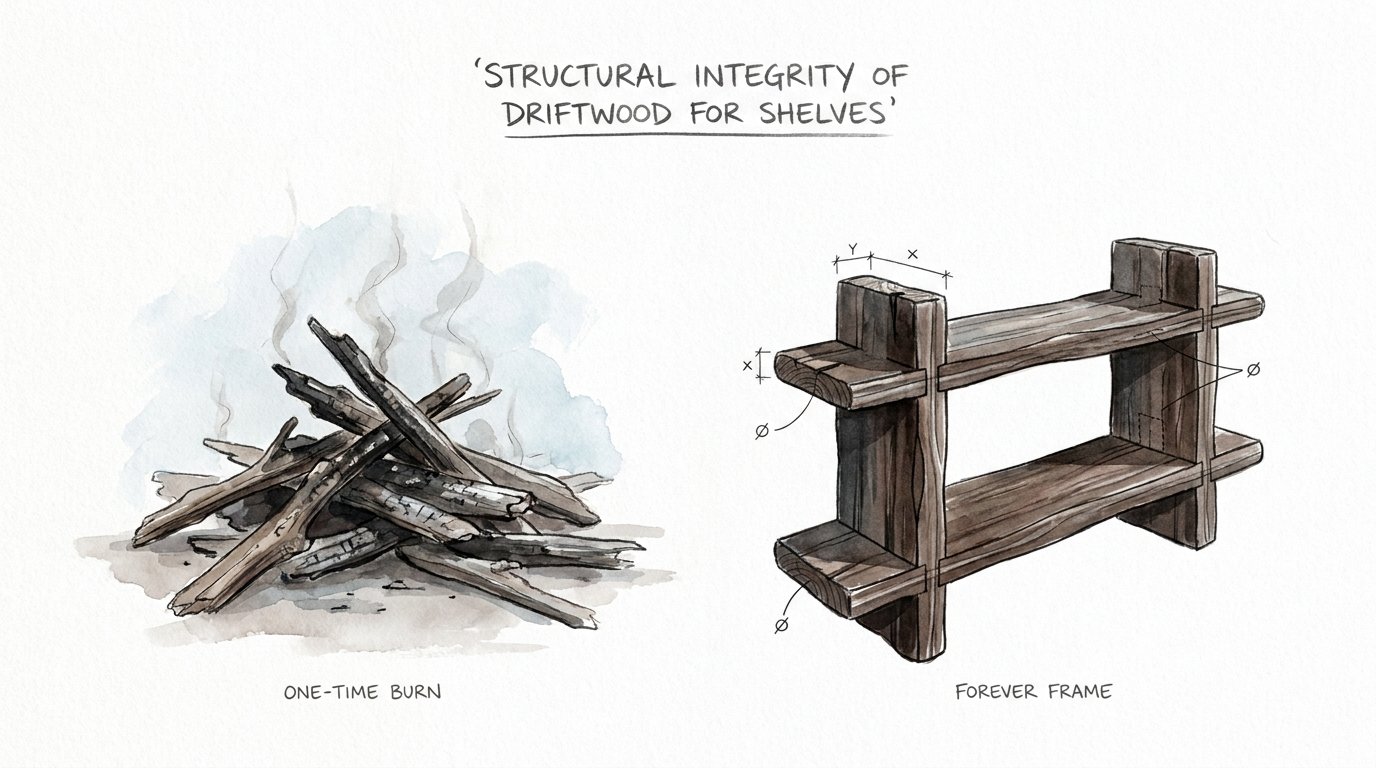
Traditional lumber is grown for speed and harvested for profit. Driftwood, however, is seasoned by the elements over years or even decades. This natural processing creates a character and a resilience that modern manufacturing cannot replicate. When you transition from a ONE-TIME BURN mindset to a FOREVER FRAME philosophy, you stop seeing waste and start seeing potential.
Structural Integrity Of Driftwood For Shelves
Structural integrity is the foundation of any shelving project. In the world of driftwood, this integrity is forged through a process of natural selection. Only the densest, most resilient heartwood survives the abrasive environment of the sea. While the soft sapwood often rots away or is eaten by marine organisms, the core remains, becoming harder and more stable over time.
Saltwater acts as a natural preservative, penetrating deep into the wood fibers and displacing moisture. This “salt-curing” process helps prevent future rot and discourages many common terrestrial pests from making a home in your furniture. Historical records show that settlers in medieval Iceland relied on driftwood to build houses, churches, and ships because it was often more durable than the local scrub timber.
When we talk about density, driftwood is often deceptive. A piece of sun-bleached sycamore or poplar driftwood can maintain a density nearly identical to its fresh-cut counterpart, but with significantly lower moisture content. This makes it lighter to handle while maintaining its compressive strength parallel to the grain. However, you must inspect for “checking”—those deep cracks that occur as wood dries—to ensure the piece can still support the weight of heavy books or tools.
Think of driftwood as a pre-stressed material. It has already warped, twisted, and cracked as much as it likely ever will. Unlike new lumber that might “bow” or “cup” six months after you install it in your climate-controlled home, a properly dried piece of driftwood is remarkably stable. It has finished its movement, making it a reliable choice for structural applications like floating shelves or heavy-duty mantels.
The Preparation Process: From Shoreline to Shelf
Harvesting your own lumber requires a different set of skills than walking through a warehouse. First, you must identify pieces that are truly sound. Give the wood a sharp rap with a hammer; a solid “thunk” indicates a dense core, while a hollow or dull sound suggests internal rot. If your fingernail easily sinks into the wood, it is likely a softwood that has begun to degrade.
Once you have brought your prize home, the cleaning phase begins. Use a stiff-bristled brush or a pressure washer to remove mud, sand, and loose bark. If the wood was pulled from the ocean, it is saturated with salt. You must soak the wood in fresh water for several days, changing the water daily, to leach out the chlorides. This prevents the salt from attracting moisture later and keeps it from corroding your metal fasteners.
Sanitization is the next critical step. A solution of one part bleach to nine parts water is effective for killing bacteria and any remaining larvae. Submerge the wood for at least six to twelve hours. This soak not only cleans the wood but can also help lighten the color if you prefer that ghostly white “beach” look. After the soak, the wood must be dried slowly in a shaded, well-ventilated area.
Drying is where patience becomes your best tool. Rushing this stage with high heat can cause the wood to shatter or develop massive structural cracks. Professional builders often use a moisture meter to ensure the core of the wood has reached a stable level, typically below 12% for indoor use. Depending on the thickness of the log, this air-drying process can take several weeks or even months.
Benefits of Building with Driftwood
One of the greatest advantages is the environmental sustainability of the practice. By salvaging wood that has already been displaced by nature, you are bypassing the industrial logging and transportation cycle. This is “found” material that requires no new trees to be felled. You are essentially cleaning the environment while sourcing premium building materials.
The aesthetic appeal of driftwood is unmatched. Each piece is a unique sculpture shaped by random events—the way a specific branch broke during a storm or how it tumbled over a particular rocky reef. No two shelves will ever look the same. The silver-gray patina of sun-bleached wood provides a neutral, sophisticated backdrop that fits both rustic cabins and modern minimalist lofts.
Durability is another significant factor. Because the sea has already stripped away the weaker parts of the wood, what remains is the “survivalist” portion of the tree. This wood is naturally resistant to the warping and shrinking that plagues new construction. When you build a shelf from high-quality driftwood, you are creating a piece that can literally last for generations without losing its shape.
Economically, driftwood offers a high-value return for a low-cost investment. While you may spend more time in the preparation and cleaning phases, the raw material itself is free. Compared to the soaring prices of reclaimed barn wood or live-edge slabs from a boutique sawmill, driftwood allows you to create high-end, custom furniture on a pioneer’s budget.
Challenges and Common Mistakes
The most frequent error is failing to properly leach the salt from the wood. Salt is hygroscopic, meaning it pulls moisture out of the air. If you skip the freshwater soak, your shelf might “sweat” on humid days, leading to damp books or rusted brackets. Furthermore, salt residue can ruin high-end finishes, causing them to peel or turn cloudy within a few months of application.
Working with irregular shapes presents a significant mechanical challenge. Standard woodworking tools like table saws and jointers are designed for flat, square boards. Attempting to run a gnarled log through a table saw is dangerous and often impossible. You must learn to use “scribed” joinery or custom-fitted brackets to ensure your shelf sits level against a flat wall while maintaining its organic front edge.
Another pitfall is ignoring the “smell test.” Wood that has spent too much time in stagnant or brackish water can harbor anaerobic bacteria that produce a foul odor when the wood warms up indoors. If a piece smells like sulfur or rot even after cleaning, it is best left for the beach. No amount of sealant can completely mask the scent of a wood that has “turned.”
Many beginners also forget to account for the “hidden” weight of driftwood. Because it is often denser than standard pine or cedar, a large driftwood mantel can weigh significantly more than it looks. Using standard drywall anchors is a recipe for disaster. You must secure these pieces directly into the wall studs using heavy-duty lag bolts or specialized floating shelf hardware.
Limitations and Environmental Constraints
Not every piece of wood on the beach is a candidate for a shelf. Softwoods like pine, fir, and spruce degrade much faster in water than hardwoods like oak, maple, or walnut. If you find a piece that is light as a feather and feels “punky” to the touch, it lacks the structural integrity for load-bearing use. These pieces are better suited for decorative wall hangings or light art projects.
Environmental regulations are a serious consideration for any modern pioneer. In many regions, driftwood plays a vital role in coastal ecosystems, providing habitat for birds and stabilizing sand dunes. Some state parks and national shorelines strictly prohibit the removal of driftwood. Always check local laws before loading your truck; the “free” wood becomes very expensive if it comes with a heavy fine.
Load-bearing spans are another limitation. Because driftwood isn’t milled to a uniform thickness, you cannot rely on standard span tables used in home construction. A driftwood plank might be two inches thick in one spot and only half an inch thick near a knot. You must over-engineer your supports and carefully test the shelf’s deflection under weight before loading it with your prized possessions.
Comparing Driftwood to Commercial Lumber
| Factor | Driftwood | Commercial Pine | MDF / Particle Board |
|---|---|---|---|
| Material Cost | Free (Labor intensive) | Moderate | Low |
| Durability | Very High (Salt-cured) | Low to Moderate | Very Low |
| Moisture Stability | Excellent (Pre-shrunk) | Prone to warping | Fails when wet |
| Aesthetic | Unique, Organic | Uniform, Common | Requires veneer/paint |
| Ease of Use | Difficult (Irregular) | Easy (Standard sizes) | Very Easy |
Practical Tips and Best Practices
When you are ready to start building, your tool kit should include more than just a hammer and nails. An orbital sander is essential for smoothing the surface without losing the wood’s natural contours. Start with a coarse 80-grit paper to remove any remaining stubborn debris, then work your way up to a 220-grit for a finish that is soft to the touch but still looks wild.
For the final finish, avoid thick, plastic-looking varnishes. These often trap moisture and hide the beautiful texture of the wood. Instead, use a natural oil like boiled linseed oil or a high-quality beeswax. These finishes penetrate the fibers, highlighting the grain while allowing the wood to “breathe.” If you are concerned about salt residue, a base coat of shellac acts as an excellent sealer that prevents “bloom” from ruining your topcoat.
If you are mounting a particularly heavy or oddly shaped piece, consider the “blind shelf” method. This involves drilling deep holes into the back of the wood and sliding it onto steel rods that are anchored into the wall studs. This provides a clean, floating look that makes the wood appear as though it simply washed up onto your wall. Use a level and a template to ensure your holes are perfectly aligned.
Advanced Considerations for the Serious Builder
For those looking to take their driftwood projects to the next level, epoxy stabilization is a game-changer. If you find a piece with incredible character but a few soft spots or deep cracks, you can use a clear, penetrating epoxy to consolidate the fibers. This turns a beautiful but fragile piece into a rock-hard structural component. You can even use tinted resins to fill large voids, creating a “river” effect within the driftwood.
Joinery in driftwood requires a departure from standard dovetails or mortise-and-tenon joints. Because the wood is rarely square, you must often use “cope and stick” techniques or hand-carved sockets. Using a rotary tool with carving bits allows you to fit pieces together with surgical precision, even when the surfaces are gnarled and twisted. This level of craftsmanship distinguishes a “craft project” from a piece of fine furniture.
Think about the orientation of the wood. The “top” of the shelf doesn’t have to be the side that faced the sun on the beach. Sometimes the most interesting grain patterns are hidden on the underside that was buried in the sand. Spend time rotating the piece and viewing it under different lighting conditions before you make your first cut. The wood has spent years forming its character; take a few days to discover it.
Example Scenario: The Floating Entryway Shelf
Imagine finding a four-foot length of weathered oak driftwood on a rocky inlet. It is roughly six inches wide and three inches thick, with a deep silver patina. After a week of freshwater soaking and two weeks of air-drying in your workshop, the moisture meter reads a perfect 10%. You decide to turn this into a floating shelf for your entryway to hold keys and mail.
First, you use a jointer or a hand plane to create one perfectly flat edge—the side that will sit against the wall. Because the wood is so dense, you pre-drill three half-inch holes into this flat back edge, spaced sixteen inches apart to match your wall studs. You then mount three ten-inch steel rods into the studs of your entryway wall using a heavy-duty mounting bracket.
The driftwood slides onto the rods with a snug fit. Because the wood is salt-cured oak, it is incredibly stiff; even with several heavy books and a ceramic vase, the shelf shows zero deflection. You finish the piece with a light coat of matte wax, which deepens the color slightly but preserves the “bone-white” highlights. The result is a piece of furniture that feels like it has always been part of your home’s story.
Final Thoughts
Building with driftwood is a journey that begins with a walk on the beach and ends with a legacy in your home. It requires you to slow down, to listen to the material, and to work with the shapes nature has provided. By choosing to build rather than burn, you are participating in a tradition as old as the first coastal settlers.
This process teaches us that value isn’t always found in a store-bought price tag. True value is often hidden in the “waste” that others overlook. When you take a piece of wood that has been hardened by the sea and transform it into a functional piece of art, you aren’t just making a shelf. You are preserving a story of survival and resilience.
Don’t be afraid to experiment with different species and shapes. Each trip to the water is an opportunity to find your next structural masterpiece. As you gain experience, you will find that the irregular, gnarled pieces you once thought were impossible to work with are actually the ones that provide the most reward. Stop seeing the woodpile as fuel and start seeing it as your future library.
Sources
1 laredoute.co.uk (https://www.laredoute.co.uk/content/driftwood-decoration-why-adopt-it-for-an-organic-and-chic-winter/) | 2 reddit.com (https://www.reddit.com/r/Aquariums/comments/q312cf/how_to_find_good_pieces_of_driftwood/) | 3 cuttingedgefirewood.com (https://www.cuttingedgefirewood.com/blogs/blog/7-types-of-wood-you-shouldnt-burn-in-your-fireplace) | 4 wikihow.com (https://www.wikihow.com/Preserve-Driftwood) | 5 wordpress.com (https://mikesdriftwood.wordpress.com/why-driftwood/) | 6 quora.com (https://www.quora.com/How-is-furniture-made-from-driftwood-different-from-other-wooden-furniture) | 7 briansbenham.com (https://www.briansbenham.com/shelf-material-guide-mdf-plywood-or-solid-wood/) | 8 wallpanelsworld.co.uk (https://wallpanelsworld.co.uk/blog/mdf-shelves-shelf-boards-structural-integrity-suitability/) | 9 dtwooddecor.com (https://www.dtwooddecor.com/driftwood-coffee-table-care-and-maintenance/)