Diy Driftwood Wind Sound Sensors
Listen closely: your decor is trying to tell you that a storm is coming. Static decor is just clutter. Dynamic decor is data. We’re building bio-acoustic sensors out of beach-combed timber that change pitch as the wind shifts. It’s not just a sculpture; it’s the voice of the atmosphere.
[affiai]The wind is a chaotic force, but it carries information. Every gust tells a story about pressure changes, approaching fronts, and thermal shifts. Most of us ignore this until we see a digital notification on a screen. Integrating nature-based sensors into your living space allows you to “hear” the weather before you feel it.
Diy Driftwood Wind Sound Sensors
A driftwood wind sound sensor is a precision-built Aeolian harp made from salvaged marine timber. Unlike traditional wind chimes that rely on physical impact to create noise, these sensors use the physics of fluid dynamics to vibrate strings. As air flows over a taut string, it creates a repeating pattern of swirling vortices known as a von Kármán vortex street. These alternating eddies of air push and pull the string, causing it to sing.
In the real world, this is the same phenomenon that makes telephone wires hum or car antennas whistle at highway speeds. By using driftwood as a natural resonator, we turn a piece of ocean debris into a bio-acoustic instrument. These sensors act as an early warning system for local wind velocity. Because the frequency of the vibration is directly proportional to the wind speed, a rising pitch tells you exactly when the atmosphere is tightening its grip.
How the Bio-Acoustic System Works
Building one of these requires an understanding of how tension, wood density, and wind interact. You aren’t just tying strings to a stick; you are creating a resonant cavity that amplifies microscopic vibrations into audible data.
1. Selecting the Resonant Timber
Finding the right piece of driftwood is the most critical step. Look for “hard” driftwood—wood that has been bleached by the sun and stripped of its soft outer bark. Harder woods like oak or mahogany remnants have higher density and better acoustic wave velocity along the grain. If the wood sounds hollow or “musical” when you tap it with a stone, it has the potential to act as a soundboard.
2. The Physics of Vortex Shedding
The “sensor” part of this build relies on the diameter of your strings. Thinner strings vibrate at higher frequencies in lower winds, while thicker strings require a more powerful gust to activate. The frequency (f) is calculated based on the Strouhal number, the wind velocity, and the string diameter. By varying string thicknesses on a single piece of driftwood, you create a multi-tonal sensor that “activates” different notes as the wind speed increases.
3. Designing the Sound Cavity
Solid wood alone is a poor amplifier. To make the wind audible, you must create or find a natural hollow. Many pieces of driftwood have been bored out by marine life or rot. If yours is solid, you can use a chisel to create a shallow trench under where the strings will sit. This “well” allows sound waves to bounce and reinforce one another, creating the haunting, “unearthly” drone characteristic of Aeolian instruments.
Benefits of Kinetic Feedback
Choosing an acoustic sensor over a digital weather station offers a deeper connection to your environment. Digital apps provide data, but bio-acoustic sensors provide an experience.
- Passive Monitoring: You don’t need to check an app to know the wind has shifted. The change in the “song” from your porch provides an immediate, subconscious update on local conditions.
- Biophilic Harmony: These sensors use natural materials that have already survived the elements. They look and sound like they belong in the landscape.
- Educational Value: Watching the relationship between a gust of wind and a specific musical note is a masterclass in fluid dynamics for anyone in the home.
- No Power Required: While digital sensors fail when the battery dies or the Wi-Fi drops, a timber sensor is always “on” as long as the air is moving.
Challenges and Common Mistakes
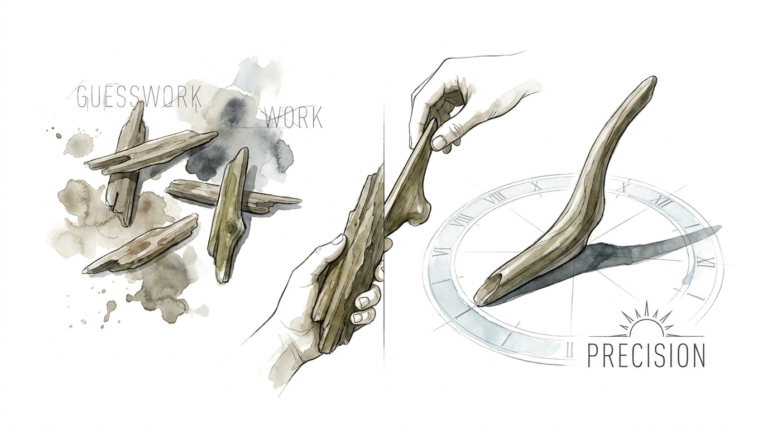
Building a functional wind sensor is harder than making a simple chime. Precision is the difference between a musical instrument and a rattling piece of wood.
Using “Soft” or Decayed Wood: If the driftwood is too “punky” or soft, it will absorb the vibrations rather than reflecting them. This leads to a muffled sound or no sound at all. Always test for hardness by attempting to dent the wood with your thumbnail; if it leaves a deep mark, the wood isn’t dense enough for acoustic sensing.
Improper String Tension: Many beginners over-tighten the strings, fearing they will be too quiet. However, driftwood is often brittle. Changes in humidity can cause the wood to expand or contract, which can snap the timber under high tension. Using adjustable tuning pegs—the kind found on zithers or harps—is essential for fine-tuning the sensor to the local climate.
Ignoring Airflow Geometry: The wind must hit the strings at a near-perpendicular angle to trigger the von Kármán vortices. If you place the sensor in a “dead zone” behind a wall or thick vegetation, it will remain silent even during a gale.
Limitations of Timber Sensors
While these devices are powerful tools for atmospheric awareness, they have realistic constraints. A bio-acoustic sensor is a supplement to weather data, not a replacement for a barometer.
Driftwood is inherently unstable. It has been soaked in salt water and dried in the sun, meaning it will continue to weather. This affects the tuning over time. Unlike a metal-frame wind harp, a driftwood sensor may need seasonal recalibration as the wood settles into its new environment.
Furthermore, these sensors have a “threshold of activation.” Most require a steady wind of at least 8 to 12 miles per hour to begin singing. In very calm inland areas, the sensor might remain a silent sculpture for weeks at a time. This makes them ideal for coastal or ridge-line locations where air movement is consistent.
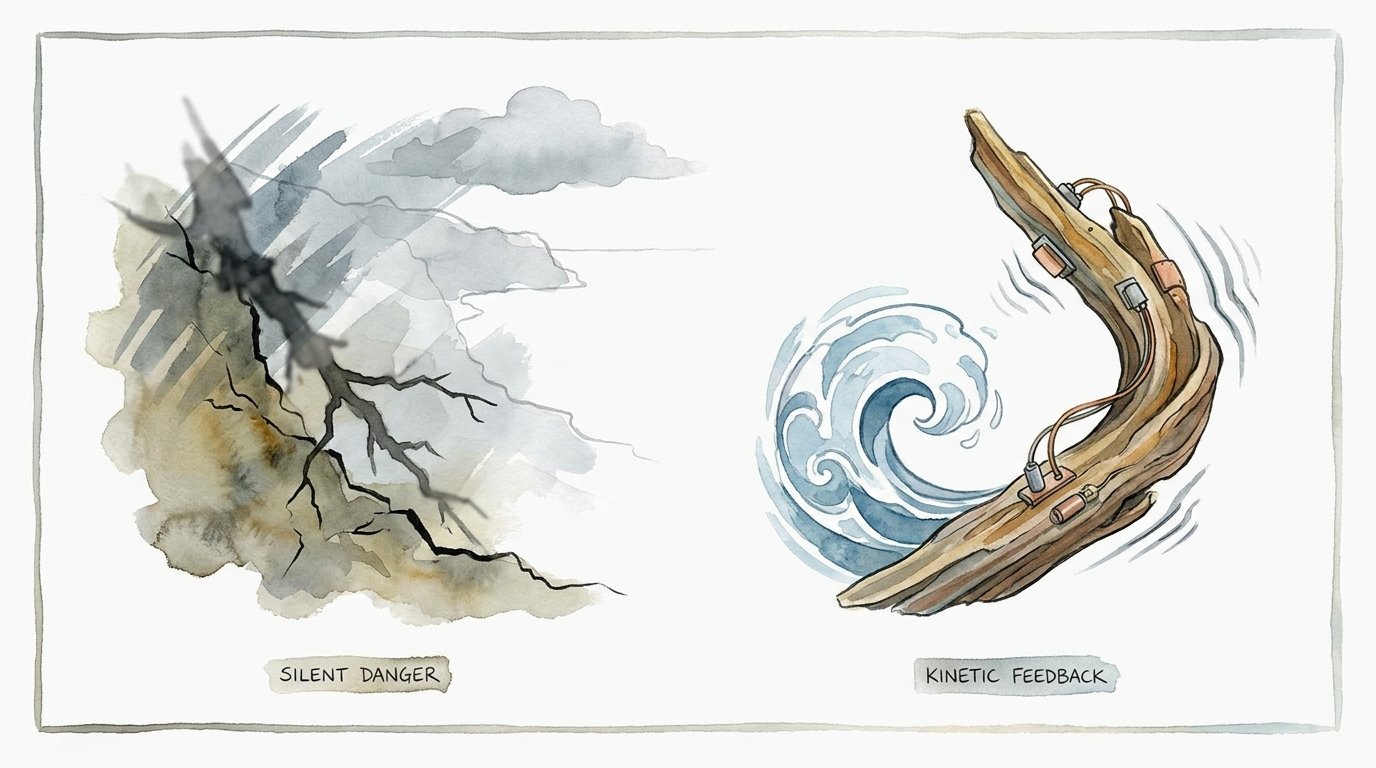
Comparison: SILENT DANGER vs KINETIC FEEDBACK
Modern weather safety often relies on “Silent Danger”—digital alerts that arrive via text or app. While precise, these notifications are easy to ignore or miss if your phone is in another room. “Kinetic Feedback” systems, like the driftwood wind sensor, utilize your primary senses to keep you informed.
| Feature | Digital Alerts (Silent) | Bio-Acoustic Sensors (Kinetic) |
|---|---|---|
| Notification Style | Screen/Visual | Auditory/Resonant |
| Contextual Speed | High (Exact MPH) | Medium (Pitch Shifts) |
| Reliability | Grid-dependent | Environment-dependent |
| Installation | Plug & Play | Craft-intensive |
Practical Tips for Success
Follow these best practices to ensure your sensor sings even in light breezes.
- Use Nylon Strings: While steel strings are louder, nylon (high-tension guitar strings) is more resistant to the salt spray and humidity that driftwood often encounters.
- Angled Wind Deflectors: If your sensor is quiet, try adding a “wind vane” or a slanted piece of wood near the strings. This concentrates the airflow, increasing the velocity right as it passes the strings.
- Seal the Wood: Use a natural beeswax or a clear matte outdoor sealant. This preserves the “pioneer-grit” look while preventing the wood from soaking up rain, which would deaden the sound.
- Consistent Tuning: Tune all your strings to the same fundamental note (e.g., a low G). The wind won’t play chords; it plays harmonics. Having the same base pitch creates a more haunting, ethereal drone as the overtones shift.
Advanced Considerations
For those who want to push the “sensor” aspect further, you can integrate modern tech into the ancient timber. Serious practitioners often install **piezoelectric pickups** inside the sound cavity. These small sensors convert the mechanical vibrations of the wood into an electrical signal.
With a piezo pickup, you can run a line from your driftwood sensor to an indoor amplifier or a recording device. This allows you to monitor the “voice of the atmosphere” from inside a soundproofed home. You can even use software to map the pitch of the wood to actual wind speed data, creating a hybrid low-tech/high-tech weather station.
Another advanced technique involves **resonant hollowing**. Instead of a simple trench, you can drill a series of holes of varying depths along the back of the driftwood. Each hole acts as a Helmholtz resonator, amplifying specific frequencies. This allows you to “pre-program” your sensor to scream at a certain frequency only when the wind hits dangerous speeds.
Example: The “Storm Watcher” Configuration
Imagine a 4-foot piece of cedar driftwood mounted vertically on a coastal deck. The builder has used three different string gauges: a 0.010″ steel string for light breezes, a 0.024″ nylon string for moderate winds, and a 0.045″ wound string for heavy gusts.
During a calm afternoon (5 MPH), the sensor is silent. As a front approaches and winds hit 12 MPH, the thin steel string begins a high-pitched, shimmering whistle. This is your first data point: a shift is happening. If the 0.024″ string starts a deep, resonant hum, you know the wind has breached 20 MPH. When the thickest string begins to growl, the sensor is telling you to secure your outdoor gear and head inside. This isn’t just art; it’s a functioning, multi-stage alert system.
Final Thoughts
Building a DIY driftwood wind sound sensor is a journey back to a more intuitive way of living. It requires you to look at a piece of beach-combed timber not as trash, but as a vessel for atmospheric data. By combining the ancient art of the Aeolian harp with the principles of kinetic feedback, you create a piece of decor that actually earns its keep.
The beauty of this project lies in its unpredictability. No two pieces of driftwood are the same, meaning no two sensors will ever sound identical. Each one develops its own personality, its own “language” for describing the weather. You start to recognize the specific “warning tone” that precedes a summer thunderstorm or the “melancholy drone” of a winter gale.
Start small with a single string and a solid branch. As you begin to hear the voice of the atmosphere, you’ll find yourself searching the shoreline for bigger, denser, and more resonant timber. The wind is always talking; it’s time you gave it a way to be heard.
Sources
1 wunderground.com (https://www.wunderground.com/cat6/Whirls-Curls-and-Little-Swirls-Science-Behind-Von-Karman-Vortices) | 2 salfordacoustics.co.uk (http://salfordacoustics.co.uk/make-an-aeolian-harp)