How To Capture Sea Spray Minerals With Driftwood
The salt that kills your garden is actually the hidden fertilizer you’ve been ignoring. Most coastal gardeners see sea spray as a curse. We see it as a free mineral delivery system. Positioning driftwood strategically allows you to trap the ocean’s micro-nutrients and feed your soil for $0. Turn a nuisance into your greatest asset.
[affiai]Coastal life demands a certain level of grit. You learn to live with the wind, the damp, and the relentless salt. Standard gardening advice tells you to wash that salt away or build high walls to keep it out. That approach ignores the wealth of the deep. Every gust of ocean wind carries a microscopic mist of every element on the periodic table.
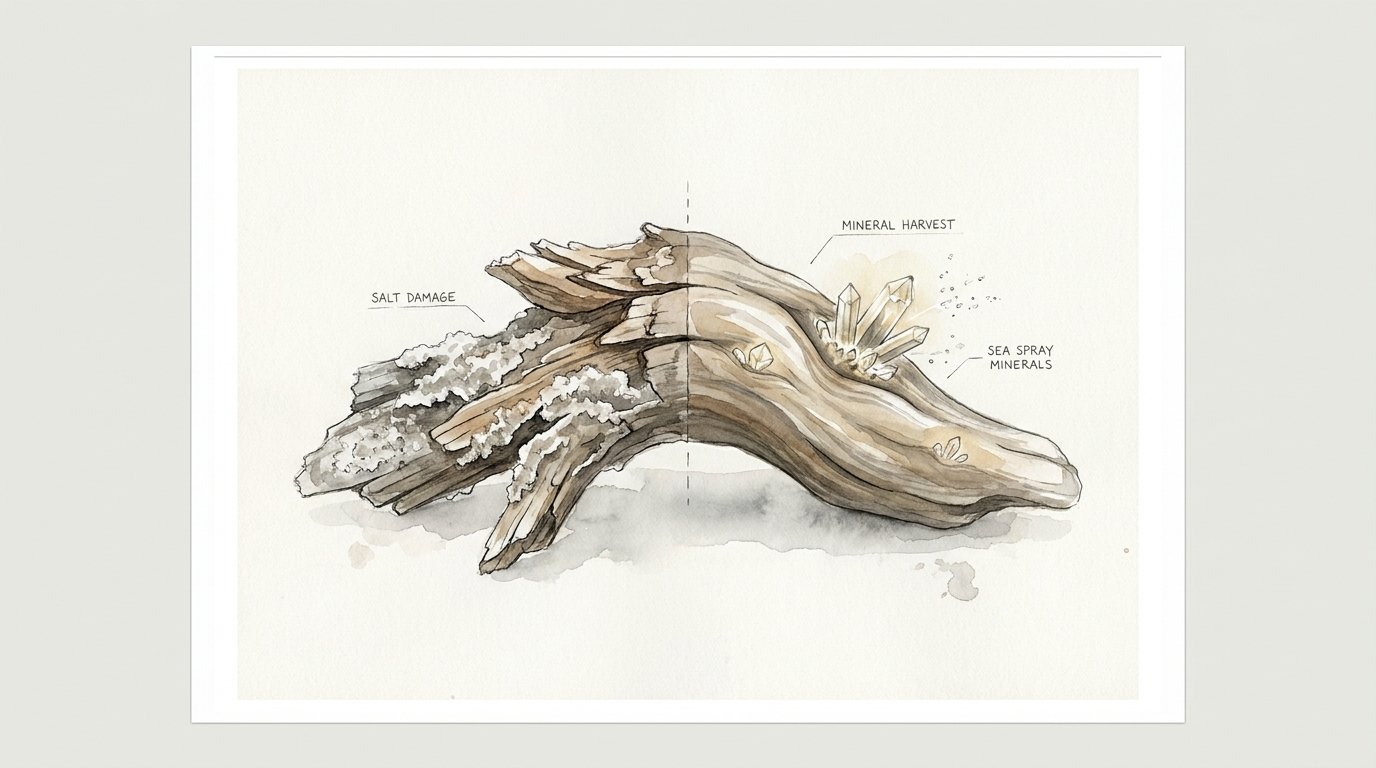
Natural sea spray is not just sodium chloride. It is a complex aerosol containing over 90 different minerals, organic proteins, and living microbes from the sea surface microlayer. Capturing these nutrients requires a physical structure that breathes with the wind. Driftwood serves as the perfect, weathered net for this mineral harvest.
How To Capture Sea Spray Minerals With Driftwood
Sea spray travels as a fine mist, often invisible to the naked eye until it settles on a windowpane. These aerosols are formed by the bursting of air bubbles in whitecaps and the mechanical tearing of drops from wave tops. Scientists estimate that trillions of kilograms of sea salt flux into the atmosphere every year. Your coastal garden is sitting in the middle of a massive, airborne nutrient flow.
Driftwood acts as a mechanical filter in this environment. Unlike a solid brick wall that creates turbulent air pockets, a pile of driftwood is porous. It allows the wind to move through it while slowing the velocity just enough for the heavy mineral droplets to drop out of suspension. The wood itself is often hygroscopic, meaning it pulls moisture directly from the humid sea air.
Think of driftwood as a biological sponge. It has spent years, sometimes decades, being tumbled in the surf and soaking in a mineral bath. When it lands on your shore, it is already saturated with ocean wealth. Once placed in your garden, it continues to gather fresh deposits from every storm. Over time, rain washes these concentrated minerals off the wood and into the root zone of your plants.
This method emulates the natural formation of coastal dunes. In the wild, driftwood provides the “anchor” that allows sand and organic matter to accumulate. This creates a micro-habitat where specialized plants can thrive despite the harsh conditions. Bringing this system into a managed garden space provides a slow-release source of trace elements that most land-based fertilizers lack.
Strategic Placement for Maximum Mineral Trapping
Success depends entirely on where and how you stack your wood. You are building a “mineral reef” on dry land. The primary goal is to intersect the prevailing onshore winds that carry the heaviest load of spray. Observation is your best tool here; look at where the morning mist lingers or where the fence posts show the most salt crust.
Position your driftwood barriers perpendicular to the wind flow. Large, heavy logs should form the base of your structure to provide stability against coastal gales. Smaller, more branched pieces should be tucked into the gaps. These intricate branches increase the surface area of your “net,” catching smaller droplets that would otherwise sail right over a flat surface.
Depth matters more than height for mineral capture. A wide, low stack of wood creates more contact points for the wind than a single tall wall. Aim for a structure that is two to three feet deep. This depth creates a “baffling” effect where the air is forced to take a winding path through the wood, leaving its mineral cargo behind on every surface.
Avoid placing your driftwood traps directly against the stems of sensitive plants. The salt concentration immediately under the wood can be high after a heavy spray event. Instead, place the driftwood “up-drift” from your planting beds. Allow the rain to leach the minerals into the soil and move them toward the root systems in a diluted, safe form.
Benefits of the Driftwood Mineral Harvest
The primary advantage is the sheer diversity of the nutrient profile. Modern agriculture focuses on Nitrogen, Phosphorus, and Potassium, but plants require a long list of trace elements like boron, iodine, molybdenum, and selenium for peak health. Seawater contains these in a balanced ratio that nearly mirrors the composition of human blood.
Trace minerals act as catalysts for plant enzymes. They improve the plant’s ability to photosynthesize and resist disease. Many coastal gardeners report that their vegetables have a higher “Brix” level—a measurement of sugar and mineral content—when they integrate sea minerals. This results in produce that tastes better and stays fresh longer on the shelf.
Fungal activity is another hidden benefit. Driftwood is a prime host for marine and terrestrial fungi. As these fungi break down the wood, they create a “mycelial bridge” between the wood and your garden soil. These fungal networks are experts at transporting minerals and water directly to plant roots in exchange for sugars.
Beyond nutrition, driftwood provides a functional windbreak. It shelters young seedlings from the physical battering of the wind without completely cutting off airflow. Stagnant air leads to mold and mildew; the porous nature of driftwood keeps the air moving while taking the “sting” out of the gust.
Challenges and Common Mistakes
The biggest danger is the “sodium spike.” While sea minerals are beneficial, an over-accumulation of sodium chloride can lead to soil salinity issues. This usually happens in areas with very low rainfall. Without regular rain to wash the salt off the wood and into the deeper soil layers, the salt can reach toxic levels for non-halophytic (salt-intolerant) plants.
Collecting driftwood is subject to local laws. Many beaches are protected, and removing wood can disrupt natural erosion control systems. Always check your local regulations before harvesting. In many areas, taking small amounts for personal use is permitted, but large-scale hauling may require a permit or be strictly forbidden.
Pests can sometimes hitch a ride on untreated wood. Termites or wood-boring beetles may be present in logs that have sat on the upper beach for a long time. Inspect your wood before bringing it near your home or wooden garden structures. A simple way to mitigate this is to let the wood sit in a “quarantine” area for a few weeks to watch for signs of activity.
Aesthetics can be a hurdle for some. A pile of gray, weathered wood looks like “trash” to a neighbor who prefers manicured lawns and plastic edging. Explaining the function of your mineral reef can help, but careful arrangement is key. Aim for an intentional, sculptural look rather than a haphazard heap.
Limitations of the Driftwood Method
This system is most effective within the first half-mile of the coastline. The concentration of sea spray aerosols drops significantly as you move inland. While high-altitude winds can carry sea salts hundreds of miles, the mechanical trapping method of driftwood requires the heavy, low-level mist found near the breaking surf.
Soil type dictates how well this works. Sandy soils are excellent for sea mineral harvesting because they drain quickly. This drainage prevents salt from building up to dangerous levels. Heavy clay soils, however, can trap the sodium, leading to a breakdown of soil structure and poor water infiltration.
Distance from the water also changes the chemistry. The “coarsest” and heaviest spray particles fall out first. These are the most mineral-rich but also the saltiest. If you live right on the dunes, you must be much more careful with sodium levels than someone living three blocks back.
Environmental conditions play a role in the “wash-off.” In extremely dry years, you may need to manually spray down your driftwood with a garden hose to simulate rain. This ensures the minerals move into the soil rather than just sitting on the surface of the wood as a dry crust.
Comparing Mineral Delivery Systems
| Feature | Driftwood Trapping | Commercial Sea Solids | Diluted Seawater Spray |
|---|---|---|---|
| Cost | Free / $0 | Moderate to High | Low (Labor only) |
| Effort | High Initial / Low Ongoing | Low | Moderate (Repeat apps) |
| Risk Level | Low (Natural leaching) | Low (Controlled dosage) | Moderate (Foliar burn risk) |
| Longevity | Years (Perennial) | Short (Seasonal) | Immediate / Short |
Practical Tips for Success
Start by selecting the right plants for your mineral-rich zone. Asparagus, beets, kale, and chard are all descendants of coastal plants and can handle higher levels of sea minerals. They will thrive in the “spray zone” behind your driftwood barriers. Sensitive plants like strawberries or beans should be placed further away.
Integrate organic matter into the soil around your driftwood. Compost and mulch act as a buffer for the minerals. The humic acids in compost can help “chelate” or wrap around the minerals, making them more bioavailable to the plants and preventing the sodium from damaging the soil biology.
Monitor your soil pH. Seawater is slightly alkaline (pH 7.5 to 8.4). Over several years, a heavy mineral harvest can nudge your soil pH upward. If you are growing acid-loving plants like blueberries, you may need to balance the area with elemental sulfur or pine needle mulch.
Use the driftwood as a support structure. Sturdy logs make excellent natural trellises for climbing peas or flowers. This gives the plants direct access to the micro-environment created by the wood while utilizing the vertical space. The rough texture of the wood is easy for tendrils to grip.
Advanced Considerations for Serious Practitioners
Serious gardeners can look into “Biochar Integration.” If you have permission to burn small amounts of beach-cast wood, the resulting charcoal is infused with sea minerals. Adding this “sea-char” to your garden beds provides a permanent home for microbes and a long-term reservoir for trace elements.
Fungal inoculation can accelerate the benefits. You can buy mushroom spawn (like Wine Cap or Oyster) and “seed” your driftwood stacks. The fungi will break down the lignins in the wood more quickly, releasing the stored ocean minerals into the soil and creating a rich, spongy humus layer at the base of your barrier.
Consider the “Estuary Effect.” In nature, the most productive areas are where fresh and salt water mix. You can replicate this by placing your driftwood traps near a rain barrel overflow or a garden pond. The constant presence of freshwater helps dilute the salts into a perfect “isotonic” solution that plants can absorb with zero stress.
Study the seasonal wind patterns. In many coastal regions, the “salts” are most prevalent during winter storms. You might choose to build your driftwood reefs in the fall to capture these winter deposits, then dismantle or move them in the spring if you want to lower the mineral input during the primary growing season.
Example: The “Pacific Hedge” Scenario
Imagine a small coastal plot in the Pacific Northwest. The garden faces the southwest, where winter storms bring heavy spray. The gardener spends a weekend collecting large fir and cedar driftwood logs from a nearby legal collection point.
The logs are stacked in a three-tiered “stadium” arrangement on the windward edge of the vegetable patch. Behind this barrier, the gardener plants a row of sea kale and salt-tolerant roses. During the first winter, the driftwood turns white with salt crust after a major gale.
When the spring rains arrive, they wash this crust into the soil. Soil tests the following year show a significant increase in magnesium and sulfur—elements often lacking in the local acidic soils. The kale grows twice as thick as the previous year, and the roses show no signs of the black spot fungus that usually plagues the neighborhood.
Final Thoughts
The ocean is the world’s greatest reservoir of life-sustaining elements. For the coastal gardener, these minerals are literally floating in the air, waiting to be claimed. Driftwood is the traditional, resilient tool that allows us to step into that cycle and bring the wealth of the tide into our soil.
Building a mineral trap is more than just a gardening hack; it is an act of working with the environment rather than against it. You stop fighting the salt and start harvesting the minerals. This shift in perspective turns a “harsh” climate into a landscape of abundance and hidden potential.
Experiment with your placement and watch how your plants respond. Nature doesn’t waste anything, and a weathered log on the beach is not just dead wood—it is a promise of a better harvest. Take the grit of the coast and turn it into the green of your garden. Strong roots are built on the elements of the deep.
Sources
1 wikipedia.org (https://en.wikipedia.org/wiki/Sea_salt_aerosol) | 2 gaspepurplaisir.ca (https://gaspepurplaisir.ca/en/driftwood-a-valuable-ally-against-shoreline-erosion/) | 3 ebsco.com (https://www.ebsco.com/research-starters/oceanography/seawater-composition) | 4 youtube.com (https://www.youtube.com/watch?v=MtsieDz8xgo) | 5 jerseyshorescene.com (https://jerseyshorescene.com/tips-on-using-driftwood-in-the-garden/) | 6 youtube.com (https://www.youtube.com/watch?v=MPSx6buv3N8) | 7 tnnursery.net (https://tnnursery.net/blogs/garden-blog/driftwood-has-many-uses) | 8 wikipedia.org (https://en.wikipedia.org/wiki/Seawater) | 9 remineralize.org (https://remineralize.org/2023/04/ag-usa-the-power-of-sea-minerals-and-microbes-to-restore-soils/) | 10 pithandvigor.com (https://pithandvigor.com/2024/08/driftwood-in-landscape-6-great-garden-uses/)