Diy Driftwood Fishing Lures Vs Plastic
Fish have seen a million plastic toys, but they have never seen a piece of the ocean move with this much ‘soul’. Factory-made lures are designed to catch fishermen, not fish. They are sterile, uniform, and move with a predictable mechanical rhythm that smart predators avoid. A driftwood lure carries the density of the deep and the irregular ‘panic’ of real life. It doesn’t just look like a fish; it vibrates with the frequency of the ocean’s own history.
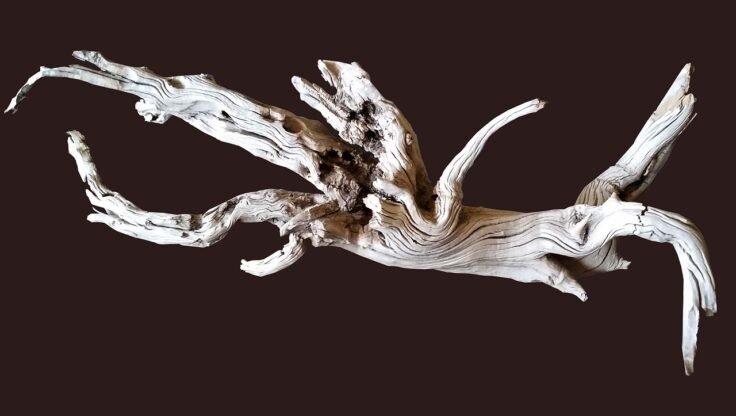
[affiai]Imagine walking along a shoreline where the tide has left behind a graveyard of timber. Most people see debris, but a seasoned angler sees potential. That grayed, salt-crusted branch has spent months or years being cured by the sun and compressed by the weight of the water. It has already survived the elements, making it the perfect candidate for a tool that needs to withstand the violent strike of a predatory fish.
Making your own gear is a return to the roots of the sport. It shifts the focus from consumerism back to craftsmanship. When you catch a fish on a lure you whittled from a piece of wood you found, the victory belongs entirely to you. You aren’t just using a tool; you are participating in a tradition that stretches back to the first humans who realized a carved bone or a shaped stick could fool a hungry mouth.
This guide will walk you through the grit and the glory of turning scavenged timber into high-performance tackle. We will explore the physics of buoyancy, the art of the ballast, and the secret to creating that erratic “living action” that plastic simply cannot replicate.
Diy Driftwood Fishing Lures Vs Plastic
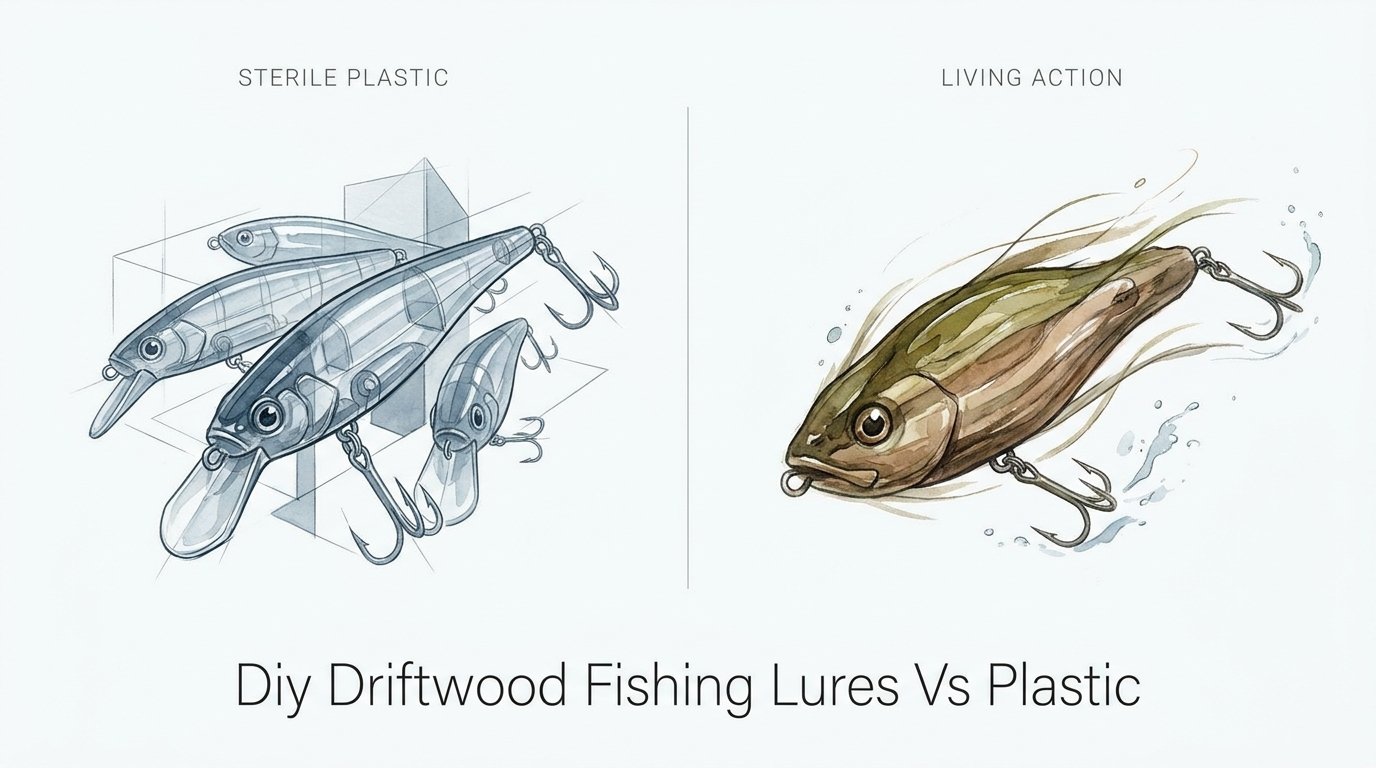
DIY driftwood fishing lures are handcrafted tools carved from natural, scavenged timber, designed to mimic the movement and vibration of live prey. Unlike mass-produced plastic lures, which are often hollow and injection-molded, driftwood lures are solid-bodied. This difference in construction fundamentally changes how the lure interacts with the water. A plastic lure moves with a “sterile” precision—every shimmy and rattle is the same as the million units that came before it.
Driftwood lures exist because serious anglers recognize that nature is rarely perfect. Real baitfish don’t swim in perfect sine waves; they dart, stumble, and vibrate with an irregular frequency. Because every piece of driftwood has a slightly different density and grain structure, no two lures will ever move exactly the same way. This inherent “soul” is what makes them so effective for pressured fish that have learned to ignore the mechanical hum of factory lures.
In the real world, these lures are used by surfcasters targeting striped bass, backcountry anglers chasing snook, and freshwater hunters looking for that trophy musky. They thrive in environments where durability and unique action are paramount. While a hollow plastic lure might crack against a rock or a bridge piling, a solid wood plug carries the “pioneer-grit” required to bounce off hard cover and keep on swimming.
Think of it like the difference between a digital metronome and a heartbeat. One is technically perfect, but the other is alive. That irregular “panic” built into the grain of the wood is what triggers the predatory instinct in a fish. When you cast a driftwood lure, you are offering something the fish hasn’t seen in a catalog—you are offering something that feels real.
The Anatomy of a Driftwood Lure
Before you put a knife to wood, you need to understand what is happening under the surface. A lure is more than just a shaped stick; it is a balanced machine that must fight against its own buoyancy to achieve a specific action.
The Role of Density and Buoyancy
Driftwood is unique because it has been “seasoned” by the environment. Saltwater-cured wood often has a higher density than fresh timber, which affects how it sits in the water. Wood with a lower specific gravity, like cedar or balsa, provides a “lively” action that is hard to replicate. These materials want to pop back to the surface quickly, creating a high-frequency vibration during the retrieve.
Grain Orientation
Always look at how the grain runs through your piece of wood. For a durable lure, you want the grain to run lengthwise. If the grain runs crosswise, the lure is prone to splitting when a heavy fish puts pressure on the hook hangers. The natural curves in a piece of driftwood can often be used to your advantage, creating a built-in “offset” that aids in an erratic swimming motion.
Internal Ballast
Because wood is naturally buoyant, you must add weight to “ballast” the lure. This isn’t just about making it sink; it’s about lowering the center of gravity so the lure remains stable during a fast retrieve. Proper ballasting ensures the lure stays upright and doesn’t “blow out” or spin uncontrollably when you pick up the pace.
How to Make a Driftwood Lure: Step-by-Step
Creating a lure from scratch requires patience and a bit of trial and error. You don’t need a professional workshop to get started, but you do need a clear plan and a few essential tools.
Phase 1: Selecting and Preparing the Wood
Not every stick on the beach is a winner. Look for wood that is solid and free of significant rot or “punky” spots. Harder woods like oak or maple will be more durable but harder to carve. Softer woods like cedar or pine are excellent for beginners because they shape easily and have fantastic natural buoyancy.
Once you find your piece, make sure it is completely dry. If you carve wet wood, it will shrink and crack as it dries, ruining your paint and hardware alignment. Leave your scavenged wood in a warm, dry place for at least a week before you start working on it.
Phase 2: Shaping the Profile
Start by sketching your desired profile onto the wood. If you are a beginner, a simple “cigar” shape for a topwater walker or a “poppet” shape with a flat face is a great place to start. Use a coping saw or a sharp whittling knife to remove the bulk of the material.
Shaping Tips:
- Work slowly and always carve away from your body.
- Keep your knife sharp; a dull blade is more dangerous and results in jagged cuts.
- Use 80-grit sandpaper to refine the rough shape once the carving is done.
Phase 3: Drilling and Hardware Installation
This is where the lure becomes a tool. You will need to drill pilot holes for your screw eyes and a larger hole for your ballast weight. Most builders use stainless steel screw eyes for hook hangers. For the ballast, lead BBs or small sections of lead wire work well.
Position your main ballast weight in the belly of the lure, usually just forward of the center point. This creates a “keel” effect. If you want a topwater lure that sits tail-down (like a “spook” style bait), place the weight further toward the rear.
Phase 4: Sealing the “Soul”
Raw wood will absorb water, expand, and eventually rot. You must seal the wood before you even think about paint. A common mistake is skipping this step or using a sealer that isn’t waterproof. A deep-penetrating epoxy or a mixture of boiled linseed oil and mineral spirits (diluted 60/40) are classic choices. Submerging the lure in the sealer ensures that every pore is filled, protecting the “living action” from being dampened by water intrusion.
Benefits of Choosing Driftwood Over Plastic
The most measurable benefit of a driftwood lure is its buoyancy-to-weight ratio. Because wood is solid, it carries more mass than a hollow plastic lure of the same size. This allows for significantly longer casts, especially into a stiff headwind.
Another major advantage is vibration frequency. Plastic has a sharp, metallic “click” when it hits the water or when internal rattles move. Wood has a low-frequency “thud.” In many fishing scenarios, especially in clear or shallow water, the subtle, organic vibration of wood is far more convincing to a wary predator.
Durability is often overlooked. While plastic lures can crack or have their lips snapped off by a single bad cast against a rock, a solid cedar or oak plug can take a beating and keep on fishing. Even if the paint chips away, the lure still works. Many old-timers believe that a “scarred” wooden lure actually catches more fish because the exposed wood grain adds even more irregular texture to the movement.
Finally, there is the environmental factor. Every year, thousands of plastic lures are lost in our waterways, contributing to microplastic pollution. A wooden lure, if lost, will eventually biodegrade back into the system it came from. The hooks are the only part that remains, making it a much cleaner choice for the conscious angler.
Challenges and Common Mistakes
The biggest challenge in making driftwood lures is tracking. If your screw eyes are even a fraction of a millimeter off-center, or if your shaping is slightly asymmetrical, the lure may want to roll onto its side or spin. This is why “tuning” is essential. You may need to bend the front screw eye slightly left or right to get the lure to swim straight.
Another common pitfall is over-weighting. It is tempting to add a lot of lead to make the lure cast like a bullet. However, too much weight kills the action. A lure that is too heavy will sit too deep in the water and lose that “panic” vibration. It becomes a “wet log” instead of a “living action” lure.
Common Mistakes to Avoid:
- Using wood with internal rot that hides under the surface.
- Not pre-drilling pilot holes, which leads to the wood splitting when you insert the screw eyes.
- Rushing the drying time for sealers and clear coats.
- Using non-stainless hardware that will rust and fail in saltwater.
Limitations of the Driftwood Approach
While driftwood lures are superior in many ways, they are not a “magic bullet” for every situation. Their primary limitation is consistency. If you find a specific shape and weight that works perfectly, it is very difficult to replicate that exact lure a second time. The wood’s density varies from branch to branch, and your hand-carving will never be as precise as an injection mold.
These lures also require more maintenance. You should inspect them regularly for cracks in the clear coat. If water gets into the wood, it will cause the lure to swell, which can crack the finish or pop the screw eyes out. Unlike plastic, which you can throw in a box and forget, wooden lures benefit from being rinsed in fresh water and allowed to dry after a day on the salt.
Depth control can also be a challenge. Plastic lures can be engineered with internal chambers to sit at an exact buoyancy. Driftwood lures often require “field testing” to find their true running depth. If you need a lure that stays exactly at 4 feet on every cast, a calibrated plastic crankbait might be a safer bet.
Comparing Driftwood and Plastic Lures
| Factor | Driftwood Lures | Plastic Lures |
|---|---|---|
| Movement | Erratic, “Living Action” | Predictable, Mechanical |
| Casting Distance | Excellent (High Density) | Moderate (Hollow Body) |
| Maintenance | High (Requires Sealing) | Low (Set and Forget) |
| Cost | Low (Scavenged Materials) | Moderate to High |
| Eco-Friendliness | High (Biodegradable) | Low (Microplastics) |
Practical Tips for Best Performance
To get the most out of your handmade lures, you need to understand how to “tune” them on the water. When you first finish a lure, take it to a pool or a clear patch of water. Observe how it sits. If it leans to one side, you may need to add a small lead “sticker” or shave a tiny bit of wood off the opposite side.
Tuning and Efficiency:
- Eye Placement: Bending the line-tie eye down will usually make a lure dive deeper. Bending it up will make it run shallower and with more wobble.
- Hook Selection: Don’t just put the biggest hooks possible on the lure. Heavy hooks can dampen the action of a small wooden plug. Use thin-wire, high-strength hooks to maintain the “panic” vibration.
- The “Salt” Factor: Remember that saltwater is denser than freshwater. A lure that sinks slowly in a lake might become a floating lure in the ocean. Always test your lures in the environment where you plan to use them.
Another trick is to use natural pigments. If you want to keep the “soul” of the driftwood, try staining the wood rather than painting it with thick acrylics. This keeps the lure’s profile slim and allows the natural texture of the wood to “vibrate” in the water.
Advanced Considerations: Through-Wire Construction
For those who are targeting truly massive fish—like giant trevally, tuna, or trophy muskies—standard screw eyes may not be enough. In these cases, through-wire construction is the gold standard. This involves drilling a hole all the way through the length of the lure and running a single piece of heavy-gauge stainless steel wire from the nose to the tail.
The hooks are then attached to loops in this central wire. This ensures that even if the wood body of the lure were to split in half during a fight, you would still be connected to the fish. It is a more complex process that requires a long drill bit and precise alignment, but it provides the ultimate level of “pioneer-grit” security.
Example Scenario: The “Salt-Cured” Popper
Imagine you find a 6-inch piece of sun-bleached cedar on a North Carolina beach. It’s light, but solid. You decide to make a “chugger” style popper. You carve a deep, concave mouth into the front and taper the tail. You add a 1/2-ounce lead weight into the belly, just behind the front hook hanger.
When you take it to the surf, you notice that it sits with its nose just above the waterline. When you snap the rod tip, the concave mouth “gulps” air and creates a massive splash, followed by a trail of bubbles. Because it’s made of cedar, the lure has a “sharp” snap-back motion that a plastic popper can’t match. After three casts, a 30-pound striped bass explodes on it. The wood absorbs the impact, the screw eyes hold firm, and you land the fish of a season on a piece of trash you found yesterday.
Final Thoughts
The transition from using sterile plastic to crafting your own driftwood lures is more than just a hobby; it is an evolution of your identity as an angler. It forces you to look at the water differently, to understand the physics of movement, and to appreciate the raw materials that nature provides. There is a profound satisfaction in knowing that the piece of wood you whittled by the campfire is the same one that eventually fools a cagey predator.
While the process has its challenges—from tracking issues to the demands of proper sealing—the rewards far outweigh the effort. A driftwood lure offers a “living action” that is uniquely yours. It carries the weight of the ocean’s history and the grit of the person who shaped it.
Start small. Find a stick, sharpen your knife, and see what kind of “soul” you can carve out of it. Experiment with different shapes, play with your ballast placement, and don’t be afraid of a few failures. Every “wet log” you produce is just a stepping stone toward a masterpiece that will one day hang from the jaw of a trophy fish.
Sources
1 reddit.com (https://www.reddit.com/r/lurebuilding/comments/11xwppn/what_is_the_the_most_ideal_wood_to_use_when/) | 2 youtube.com (https://www.youtube.com/watch?v=fg3NkVeyoV8) | 3 cavyfishing.com (https://cavyfishing.com/blogs/posts/handmade-vs-mass-produced-lures-why-custom-wood-baits-catch-more-cavy-fishing) | 4 youtube.com (https://www.youtube.com/watch?v=rFYjRKGKFwY) | 5 wikihow.com (https://www.wikihow.com/Make-Wooden-Fishing-Lures) | 6 battlbox.com (https://www.battlbox.com/blogs/fishing/how-to-make-fishing-lures-out-of-wood-a-comprehensive-guide) | 7 youtube.com (https://www.youtube.com/watch?v=mfLVYOVnJSk) | 8 louisianasportsman.com (https://www.louisianasportsman.com/fishing/top-ways-to-get-the-most-out-of-hand-carved-lures/) | 9 outdoorsfirst.com (https://muskie.outdoorsfirst.com/board/forums/thread-view.asp?tid=80649) | 10 sportfishingmag.com (https://www.sportfishingmag.com/wooden-or-plastic-fishing-lures/)