Driftwood Sailboat Hull Guide
Why spend hours fighting the wood when the ocean has already done the heavy lifting for you? Most crafters spend days trying to chisel a ‘boat’ out of a flat board. The pro knows that the Pacific is the world’s most talented sculptor. Here is how to find the timber that was already born to be a vessel.
[affiai]Working with driftwood is about partnership rather than mastery. Instead of forcing a design onto a stubborn piece of kiln-dried lumber, you are searching for a form that has been tumbled, smoothed, and curated by the currents. This approach saves time and results in a piece of art that carries the history of the sea in its grain.
Practical crafting begins at the high tide line. Understanding how to identify these natural shapes is a skill that blends beachcombing with naval architecture. It is about seeing the “sheer line” in a weathered branch or the “keel” in a root ball.
## Driftwood Sailboat Hull Guide
A driftwood sailboat hull is a found object that possesses the inherent geometry of a nautical vessel. Unlike traditional model making, where you start with a block and remove material to find the ship, here the ship is already present. Your job is simply to recognize it and refine it.
These hulls exist because wood is a resilient, buoyant material that naturally weathers into streamlined shapes when subjected to the abrasive forces of sand and surf. In the real world, these shapes often mimic “displacement hulls,” which are rounded and designed to move through the water rather than on top of it.
You can find these natural hulls on shorelines worldwide, but they are particularly abundant in regions with significant tidal action and dense forests, such as the Pacific Northwest or the rugged coastlines of the Northeast. Identifying a potential hull requires looking for a piece with a relatively flat “deck” side and a curved or “V-shaped” bottom that can provide stability.
## How to Find and Prep Your Hull
The process of creating a driftwood sailboat is less about carpentry and more about curation. Following a systematic approach ensures your found timber remains stable and beautiful for years to come.
Step 1: The Shoreline Search
Search for “linear” pieces of wood that have been debarked by the ocean. Look for wood that sits naturally on its side without rolling over completely; this indicates a low center of gravity. Pieces with a natural “bow” or pointed end are highly prized, as they require less carving.
Step 2: Cleaning and Desalination
Freshly found driftwood is saturated with salt and often harbors microorganisms. Rinse your find thoroughly with fresh water. Some crafters recommend a light solution of vinegar or a very diluted bleach spray to kill any remaining fungi or pests before letting the wood dry completely in a shaded, well-ventilated area.
Step 3: Seasoning the Timber
Wait for the wood to reach its “equilibrium moisture content.” If you work the wood while it is still damp from the sea, it will likely crack (check) as it dries in your home. This process can take anywhere from a few days to several weeks depending on the thickness of the hull.
Step 4: Refinement
Use a 220-grit sandpaper to smooth out any “fuzz” or rough patches. If the wood has a natural hole or soft spot, this is often the perfect place to step your mast. Drill a shallow hole for the mast, being careful not to go all the way through the hull.
Benefits of Strategic Selection
Choosing a natural shape over a manufactured one offers several distinct advantages for the hobbyist and the artist alike.
- Reduced Labor: The sea has already handled the bulk of the shaping, reducing the need for heavy chiseling or power tools.
- Unique Aesthetics: No two pieces of driftwood are identical. Every hull has a unique “character” and story that cannot be replicated with store-bought lumber.
- Sustainability: Utilizing found materials is the ultimate form of upcycling. You are removing debris from the shoreline and turning it into a legacy piece.
- Natural Durability: Wood that has survived months at sea is often the heartwood of the tree—the densest and most rot-resistant part.
Challenges and Common Mistakes
Working with natural timber is not without its hurdles. Understanding the biological nature of your material will help you avoid common pitfalls.
The most frequent mistake is ignoring the “salt factor.” Salt is hygroscopic, meaning it attracts moisture. If you don’t rinse your driftwood well, it may feel “clammy” or damp even years later when the humidity rises. This can eventually lead to rot or the failure of glues and finishes.
Another challenge is internal voids. Driftwood can look solid on the outside but be riddled with “shipworm” holes or rot on the inside. Always tap the wood with a small hammer; a dull, thudding sound often indicates internal decay, while a sharp “clack” suggests a solid, healthy hull.
Limitations of Driftwood Hulls
While driftwood is excellent for artistic models and small decorative sloops, it has realistic constraints.
Structural integrity is the primary limitation. Because you are not choosing the grain direction yourself, driftwood is prone to splitting along natural fault lines if you attempt to screw heavy hardware into it. It is generally not ideal for functional, large-scale remote-controlled boats that require perfect waterproofing and balanced weight distribution.
Environmental limitations also play a role. Driftwood is often “punky” (soft) compared to kiln-dried cedar or mahogany. This makes it difficult to achieve the razor-sharp lines required for high-performance racing models. It is a material for the soul, not the stopwatch.
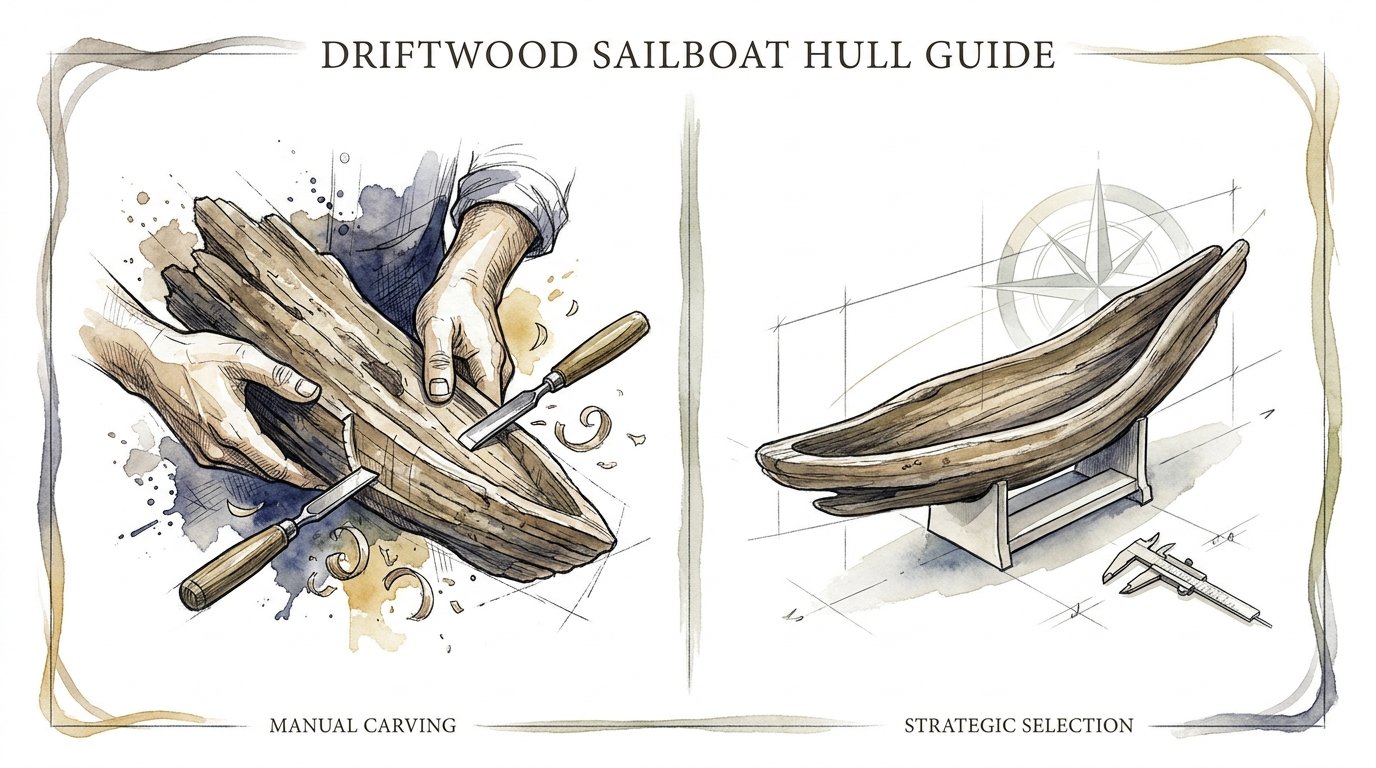
Strategic Selection vs. Manual Carving
How does finding a hull compare to the traditional method of carving one from a block of wood?
| Feature | Strategic Selection (Driftwood) | Manual Carving (Block) |
|---|---|---|
| Skill Level | Beginner to Intermediate | Advanced |
| Time Investment | Low (Focus on assembly) | High (Focus on shaping) |
| Tool Requirements | Minimal (Drill, Sandpaper) | Extensive (Chisels, Planes, Saws) |
| Design Consistency | Variable / Organic | Highly Predictable / Scale-accurate |
Practical Tips for the Modern Pioneer
Apply these best practices to ensure your driftwood vessel stands the test of time.
Use the right sealant. While many suggest polyurethane, it often looks “plastic” on driftwood. A better choice is a matte acrylic spray or a natural oil like Tung oil or Linseed oil. These penetrate the fibers and enhance the silver-gray patina without adding an artificial shine.
Stabilize with a “Keel.” If your found hull is too light and tips over, you can discreetly add weight. Drilling a small hole in the bottom and inserting a lead fishing weight, then sealing it with wood filler, will give your boat the “pendulum” effect found in real sailing vessels.
Mast placement is key. Traditionally, the mast should be placed about one-third of the way back from the bow. For irregular driftwood shapes, finding the “center of lateral resistance” is a trial-and-error process. Use a temporary mast held by a rubber band to find the balance point before drilling your permanent hole.
Advanced Considerations for Practitioners
For those who want to move beyond simple decor, consider the botany of your find. In the Pacific Northwest, finding a piece of Western Red Cedar or Douglas Fir is a jackpot. These woods are naturally resistant to decay and have a high strength-to-weight ratio.
If you find a piece that is too soft to hold a screw, you can “harden” the wood using a clear penetrating epoxy sealer (CPES). This liquid resin soaks into the soft fibers and hardens them, essentially turning the driftwood into a wood-plastic composite that is incredibly durable and easy to machine.
Scaling is another factor. If you find a massive stump that resembles a hull, you aren’t limited to a mantelpiece model. Large-scale “driftwood sculpture” boats can serve as garden features or even functional seating, provided you treat the base with a marine-grade varnish to prevent ground-contact rot.
Scenario: The “Beach-Found Sloop”
Imagine you are walking a shoreline after a heavy storm. You find a 12-inch piece of weathered cedar. It is curved on one side with a natural point at the front.
To turn this into a vessel, you first clean it with a stiff brush to remove sand and salt. After drying for a week, you notice a small crack forming near the “stern.” You embrace this—it is part of the wood’s story. You drill a 1/4-inch hole for a simple dowel mast. For the sail, you use a scrap of canvas from an old drop cloth, securing it with tiny eye screws. The result is a piece that feels “born” from the sea rather than forced by a machine.
Final Thoughts
Embracing the natural forms of driftwood allows you to bypass the most tedious parts of woodworking and go straight to the creative heart of the craft. By letting the ocean act as your primary sculptor, you create pieces that possess an organic grace and a historical depth that new lumber simply cannot match.
The transition from a “woodworker” to a “strategic selector” requires a shift in mindset. You are no longer fighting the timber; you are listening to it. This approach rewards patience and a keen eye, making every trip to the beach a potential visit to the world’s most diverse lumber yard.
Experiment with different wood types and finishing techniques. Whether you are building a fleet of tiny sloops for a windowsill or a single, imposing galley for a study, the principles of selection and preservation remain the same. The Pacific has done the work—all you have to do is find it.
Sources
1 snakemountainboatworks.com (https://snakemountainboatworks.com/materials-sources-for-vintage-wooden-boat-preservation/) | 2 driveaboatusa.com (https://driveaboatusa.com/blog/boat-hull-types-and-shapes/) | 3 woodenboat.com (https://skills.woodenboat.com/guides/small-boat-shapes-an-overview-of-types-and-terms/) | 4 ez-dock.com (https://www.ez-dock.com/blog/a-quick-guide-to-boat-hull-shapes/) | 5 yachtway.com (https://yachtway.com/news/a-visual-guide-to-hull-types-with-real-examples/) | 6 driveaboatcanada.ca (https://driveaboatcanada.ca/types-of-hulls/) | 7 wordpress.com (https://woodandrope.wordpress.com/2012/05/20/driftwood-sailboat-tutorial-sail-away/) | 8 boatdesign.net (https://www.boatdesign.net/threads/woods-to-choose-from.12621/) | 9 hometalk.com (https://www.hometalk.com/diy/decorate/rooms/make-a-driftwood-sailboat-29311631) | 10 sandypointboatworks.com (https://sandypointboatworks.com/boat-building-articles-journals/boat-building-articles/wood-types-and-uses) | 11 building-model-boats.com (https://www.building-model-boats.com/wood-ship-models.html) | 12 ybw.com (https://forums.ybw.com/threads/cause-of-rot.399758/) | 13 k-timbers.com (https://k-timbers.com/6-best-types-of-wood-for-boat-building/)