How To Identify High-density Driftwood For Wall Art
The difference between a permanent heirloom and a wall-damaging disaster is five seconds of expert inspection. If you’re picking up every stick you see on the tide line, you’re likely bringing pests and rot into your home. A ‘Pro’ selection process looks for the wood the ocean has already ‘forged’—the high-density cores that have survived decades of salt and sun. Here is how to find the timber that can actually hold its own weight on your wall.
[affiai]Bringing the raw, untamed beauty of the coast into your living space requires more than just an eye for aesthetics. It demands the discipline of a pioneer who knows that a weak foundation leads to collapse. Most coastal debris is exactly that—debris. It is soft, salt-saturated, and often a Trojan horse for wood-boring insects. True high-density driftwood, however, is a biological marvel that has outlasted its softer components through a brutal process of natural selection.
How To Identify High-density Driftwood For Wall Art
High-density driftwood refers to the heartwood or structural cores of trees that have been stripped of their sapwood and bark by years of wave action and sun exposure. While standard wood often rots when left in the elements, certain species and specific parts of the tree possess enough lignin and natural resins to resist total decay. These pieces are often referred to as “forged” because the ocean has effectively hammered away everything weak, leaving behind only the most resilient fibers.
In the world of interior design and structural art, high-density driftwood is the gold standard. It is heavy, structurally sound, and capable of being drilled, sanded, and mounted without crumbling. You can find these specimens on rocky shorelines or at the mouths of rivers where hardwoods like oak, walnut, or manzanita have been deposited. Identifying them is a sensory experience that combines weight, sound, and a simple physical test.
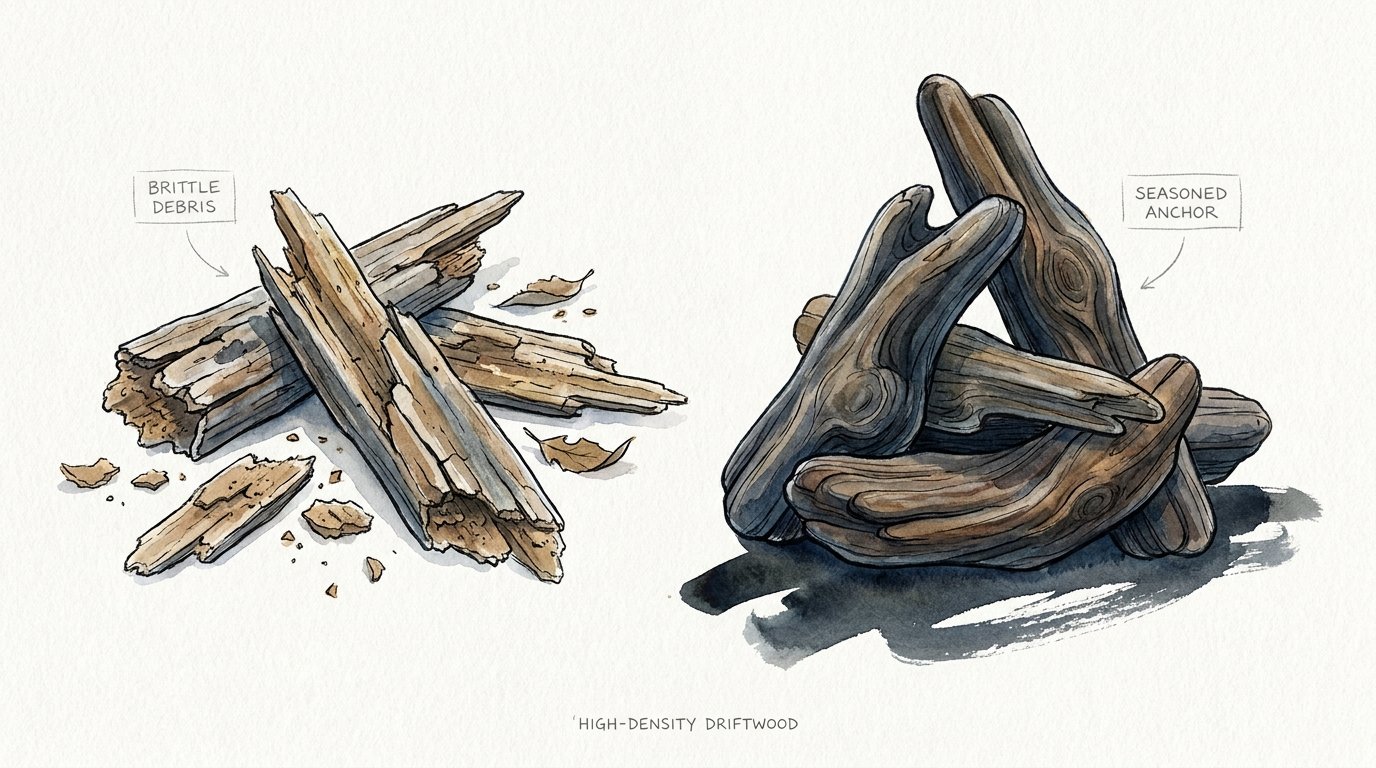
A seasoned anchor feels like stone. When you lift a piece of high-density timber, the weight should surprise you. If a three-foot limb feels light enough to toss with one hand, it is likely “punky”—a term for wood that has been hollowed out by fungal rot or is a low-density softwood like pine. High-density pieces have a tight grain and often a smooth, almost polished texture where the salt and sand have acted as natural abrasives over many years.
The Selection Process: Searching for the Seasoned Anchor
Finding the right timber begins with a mental shift from “collecting” to “prospecting.” You are looking for the Seasoned Anchor, a piece of wood that has been stripped of its vulnerabilities. This wood has already survived the worst the environment can throw at it.
The first step in the field is the Screwdriver Test. Carry a small flathead screwdriver or a pocket knife. Press the tip firmly into the surface of the wood. If the metal sinks in more than a sixteenth of an inch with minimal pressure, the wood is soft and likely rotting from the inside. A high-density specimen will resist the blade, feeling more like cured lumber or even hard plastic.
Next, observe the color and grain. High-density hardwoods often turn a silvery-grey or deep charcoal. Look for the presence of “checking”—small, clean cracks that run with the grain. These are a sign of the wood drying and shrinking over decades. If the cracks are jagged or if the wood is flaking off in “cubical” chunks, you are looking at brown rot, a deal-breaker for any indoor project.
Listen to the wood. Tap the timber with a stone or another piece of wood. A solid, high-density piece will produce a sharp, higher-pitched “clack.” A piece of brittle debris will produce a dull, muffled thud, indicating that the internal structure is porous and air-filled. This simple acoustic test can save you from hauling a twenty-pound log back to your vehicle only to find it is a hollow shell.
Processing Your Find: From Beach to Board
Once you have secured a high-density candidate, the real work begins. You cannot simply nail a piece of beach wood to a wall and call it art. Salt is hygroscopic, meaning it pulls moisture from the air. If you leave salt in the wood, it will “sweat” in humid weather, potentially ruining your drywall and rusting your mounting hardware.
Sterilization is non-negotiable. Pests like the Teredo navalis (shipworms) or standard wood borers can lay eggs deep within the grain. A thorough soak in a 1:9 bleach-to-water solution for 24 hours is the industry standard for sanitizing the surface. For larger pieces that cannot be submerged, a garden sprayer can be used to saturate the wood repeatedly over several days.
Drying is the longest phase. Even if the wood felt dry on the beach, its core is likely holding moisture. Large pieces should be kept in a low-humidity environment with plenty of airflow. Some practitioners use a low-temperature oven (under 200°F) for smaller pieces, but for a massive wall anchor, patience is the only tool. Expect a large timber to take several months to fully stabilize before you apply a finish.
Scrubbing and sanding come next. Use a stiff nylon brush to remove sand and loose fibers. Avoid wire brushes if you want to keep the natural “weathered” look, as they can leave dark metallic streaks. If you must sand, do so by hand. Power sanders often erase the very textures—the “Hogarth curves” and natural voids—that make driftwood valuable as art.
Benefits of High-Density Selection
Choosing high-density timber over common beach sticks provides a list of practical advantages that directly impact the longevity of your home decor.
- Structural Integrity: High-density wood can support its own weight and the weight of additional elements like hanging lanterns or air plants.
- Hardness for Hardware: Dense wood holds screws and anchors firmly. Soft wood will “strip” under the weight of a heavy piece, leading to a fall.
- Longevity: These pieces are effectively “pre-aged.” They are unlikely to warp, twist, or continue to rot once they are indoors and dry.
- Aesthetic Depth: Hardwoods develop a richer patina. The way light hits a dense, polished grain is vastly superior to the flat, dull look of rotted pine.
Serious practitioners prefer high-density wood because it allows for Advanced Mounting Techniques. You can drill “blind holes” for French cleats or toggle bolts without fear of the wood splitting. This creates a floating effect on the wall that is both modern and clean, showcasing the timber’s natural silhouette.
Common Pitfalls and the Wall-Damaging Disaster
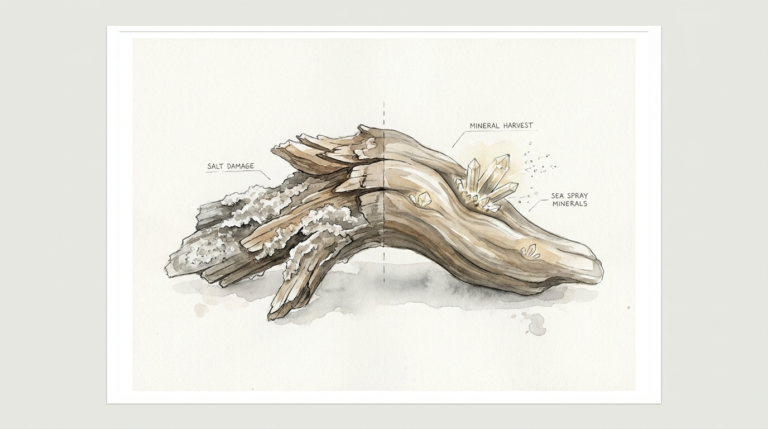
The most common mistake is failing to account for Salt Leaching. A beautiful piece of wood that hasn’t been leached of its salt will eventually cause the paint on your wall to bubble and peel. The salt interacts with the minerals in the drywall, creating a permanent damp spot that can lead to mold growth behind the art.
Another pitfall is the Weight Miscalculation. High-density driftwood is significantly heavier than people expect. A five-foot branch of dense oak driftwood can weigh forty pounds or more. Relying on simple picture wire or adhesive strips is an invitation for a “wall-damaging disaster.” You must hit the studs.
Pests are the silent killer. Termites and carpenter ants often seek out driftwood as a moisture-rich nesting ground. If you skip the sterilization step, you aren’t just bringing in a piece of art; you are bringing in an infestation. Inspect the wood for small, perfectly round holes—these are exit holes for borers. If you see “frass” (sawdust-like powder) falling from the wood, it is currently inhabited and must be treated or discarded.
Limitations and Legal Realities
While searching for the perfect anchor, you must respect the boundaries of the law and the environment. Many state and national parks prohibit the removal of driftwood. This wood plays a vital role in coastal ecosystems, providing habitat for insects and small animals, and helping to prevent beach erosion.
Always check local regulations before you begin your hunt. In areas where collection is legal, there are often limits on the size or quantity of wood you can take. Respecting these rules ensures that the coastline remains intact for the next generation of pioneers and ensures that your hobby doesn’t result in a hefty fine.
Furthermore, recognize that not every piece of wood can be saved. If a piece is so saturated with oil or chemicals (indicated by a rainbow sheen or a chemical smell), it should never be brought indoors. Marine timber that has been treated with creosote—a common preservative for old pier pilings—is toxic and gives off harmful fumes in a confined space.
Comparison: Brittle Debris vs. Seasoned Anchor
To help you distinguish between a treasure and a liability, refer to this comparison of characteristics.
| Feature | Brittle Debris | Seasoned Anchor |
|---|---|---|
| Weight | Light, airy, feels “empty” | Heavy, dense, feels like stone |
| Surface Test | Porous, crumbly under pressure | Hard, resists blade penetration |
| Acoustic | Dull “thud” when tapped | Sharp “clack” or ring |
| Risk Level | High (Pests, Rot, Structural Failure) | Low (Stable, Durable, Safe) |
| Best Use | Firewood or temporary garden decor | Permanent wall art and furniture |
Practical Tips for Mounting and Display
Once your wood is clean and dry, mounting it correctly is the final hurdle. High-density wood doesn’t behave like softwood. It requires pre-drilling. If you try to drive a screw directly into a dense piece of oak driftwood, you will likely snap the screw head or split the timber.
Use French Cleats for heavy, horizontal pieces. This hardware distributes the weight across a larger surface area on the wall. For vertical, branch-like structures, consider using Molly Bolts or heavy-duty toggle anchors if a stud isn’t perfectly positioned. Always ensure that at least one primary mounting point is anchored into a solid wood stud.
For a truly professional look, use a Countersink Bit. This allows the screw head to sit below the surface of the wood. You can then fill the hole with a mixture of wood glue and the sawdust you saved from your drilling. Once dry, this creates a nearly invisible mount, making it look as though the wood is growing directly from the wall.
Advanced Finishing for the Serious Practitioner
A raw piece of driftwood is beautiful, but a finished piece is a masterpiece. To protect the wood and enhance its character, you have several options depending on the desired look.
For a natural, “pioneer-grit” finish, use Raw Linseed Oil or Mineral Oil. These oils soak into the fibers, darkening the wood slightly and highlighting the intricate grain patterns without adding a synthetic shine. Apply the oil in thin layers with a lint-free cloth, allowing 24 hours between coats.
If you want to preserve the sun-bleached, silver look, avoid oils entirely. Instead, use a Matte Acrylic Sealer or a spray-on lacquer. This provides a protective barrier against dust and moisture while keeping the wood’s appearance unchanged. Always test the finish on a small, inconspicuous area first.
For pieces with deep cracks or voids, some artists use Clear Epoxy Resin. This can stabilize a piece that is visually stunning but structurally complex. By filling the “checks” with resin, you reinforce the timber while creating a window into the wood’s internal history.
Scenarios: Choosing the Right Wood for Your Space
Consider a scenario where you want to mount a large focal piece above a fireplace. In this case, you need a high-density “root ball” or a heavy limb. The heat from the fireplace will further dry the wood, so it must be fully seasoned before installation to prevent new cracks from forming. A piece of Manzanita or Oak is ideal here for its resistance to temperature shifts.
In a bathroom, where humidity is high, the choice of wood is even more critical. You must use a high-density wood that has been thoroughly leached of salt and sealed with a moisture-resistant finish. A Cedar core, while technically a softwood, is naturally rot-resistant and can handle the damp environment better than most, provided it is high-density heartwood.
For small, delicate wall hangings, you might be tempted to use lighter sticks. However, even for a “garland” style piece, using small fragments of high-density wood ensures they won’t snap when you drill holes for the twine. Consistency in density ensures that the art piece ages uniformly over the years.
Final Thoughts
The art of finding and mounting high-density driftwood is a testament to the idea that nature’s best work takes time. By selecting a Seasoned Anchor, you are choosing a piece of history that has been refined by the ocean’s relentless power. This is not mere debris; it is a structural remnant that deserves a place on your wall.
The investment of five seconds for a proper inspection saves you years of structural and environmental headache. Take the time to clean, dry, and mount your finds with the same grit and determination that allowed the wood to survive the sea. Your home will be safer for it, and your art will stand as a permanent tribute to the wild coast.
Experiment with different wood species and finishing techniques. Every beach is a library of different textures and densities waiting to be discovered. Apply what you have learned here to your next hunt, and you will find that the best art is often the timber that was too tough for the ocean to destroy.
Sources
1 hometalk.com (https://www.hometalk.com/diy/decorate/rooms/q-how-to-hang-a-large-heavy-driftwood-piece-42096700) | 2 ratemyfishtank.com (https://www.ratemyfishtank.com/blog/driftwood-in-aquariums-benefits-types-and-how-to-prepare-it-safely) | 3 danslelakehouse.com (https://danslelakehouse.com/2020/12/diy-driftwood-wall-hanging.html) | 4 artmillworkdesign.com (https://artmillworkdesign.com/blogs/news/selecting-the-right-wood-for-your-wood-wall-art-project) | 5 youtube.com (https://www.youtube.com/watch?v=aFWLyAPowMA) | 6 instructables.com (https://www.instructables.com/Large-Driftwood-Wall-Feature/) | 7 specialeditionart.com (https://specialeditionart.com/blogs/theoracle/how-to-hang-driftwood-on-your-wall-a-comprehensive-guide) | 8 northwestdriftwoodartists.org (https://www.northwestdriftwoodartists.org/lesson-center/about-the-art/art-and-driftwood/) | 9 wikihow.com (https://www.wikihow.com/Preserve-Driftwood) | 10 homify.co.uk (https://www.homify.co.uk/diy/12998/5-things-used-to-preserve-driftwood-and-make-it-home-decor) | 11 hawk-hill.com (https://www.hawk-hill.com/how-to-clean-driftwood/)