Best Wood For Bathroom Shelves
If it survived a decade in the Pacific, your morning shower won’t even leave a mark. Most ‘wet-area’ furniture is just cheap wood with a thin coat of plastic paint. Once that seal breaks, the shelf is doomed. Driftwood is different. It has been pressure-cured by the ocean and seasoned by the sun for years. Its fibers are packed with salt and minerals that act as a natural preservative. When you build with driftwood, you’re building with a material that has already passed the ultimate durability test. It doesn’t just survive humidity—it thrives in it.
[affiai]Choosing materials for a bathroom is often a race against rot. You want the warmth of natural timber, but you fear the inevitable warping and black mold that claim most household woods. The secret isn’t just in the species you choose, but in the history of the timber itself. Nature has its own way of preparing wood for the worst environments on earth, and the results are far superior to any factory-made board.
Best Wood For Bathroom Shelves
The best wood for bathroom shelves is timber that can handle constant moisture cycles without losing its structural integrity. In a world of mass production, many people reach for pine or particle board, only to see them swell like a sponge after three months of steam. True resilience comes from woods that are either naturally oily, incredibly dense, or have been cured by the elements.
Teak is often cited as the gold standard for maritime and bathroom use. It contains a high concentration of natural oils and rubber that repel water from the inside out. However, it is expensive and often sourced from environments that are hard to verify. Cedar and redwood are the traditional American alternatives, prized for their natural tannins which act as a built-in pesticide and fungicide.
White Oak is another heavy hitter in this category. Unlike its cousin, Red Oak, White Oak possesses a unique cellular structure called tyloses. These are essentially tiny bubble-like growths that plug the wood’s pores, making it nearly impossible for water to penetrate deep into the grain. This is why White Oak has been used for centuries in whiskey barrels and ship hulls.
Driftwood and reclaimed maritime timber sit in a category of their own. These woods have undergone a process of “sea-curing.” This isn’t just about species; it’s about a chemical transformation. Years spent in salt water have replaced much of the wood’s sap and starch with salt crystals and minerals. This makes the wood less attractive to the fungi that cause rot and more dimensionally stable when faced with the steam of a modern bathroom.
How the Ocean Forges Unbreakable Fibers
Understanding why sea-cured wood lasts starts with the chemistry of the ocean. When a log falls into the sea, it is immediately subjected to massive osmotic pressure. Salt water moves into the wood, flushing out the volatile sugars and starches that usually serve as “food” for mold and rot-causing bacteria.
As the wood tumbles in the surf, the sun bleaches the surface, and the salt penetrates deep into the heartwood. This salt acts as a desiccant, regulating how much moisture the wood can hold. In a bathroom, where the humidity swings from 40% to 90% in a matter of minutes, this stability is crucial. Regular wood expands and contracts violently with these swings, leading to cracks. Sea-cured wood remains calm.
Sunlight also plays a massive role in this forging process. UV rays break down the lignin on the surface of the wood, leaving behind the tough, silvery cellulose. This “graying” isn’t just an aesthetic; it is a shield. This weathered layer is remarkably resistant to further degradation. When you bring this wood into your home, you are bringing in a material that has already reached its final, most stable state.
The physical tumbling against sand and rock also acts as a natural sandblasting. It removes the softer “early-wood” and leaves behind the hard, dense “late-wood” ridges. This creates a texture that is both beautiful and incredibly durable. It is wood that has been stripped of its weaknesses and reinforced by the minerals of the sea.
From Shoreline to Shower: A Step-by-Step Restoration
Finding a piece of driftwood is only the first half of the journey. To turn a raw find into a functional bathroom shelf, you must follow a disciplined preparation process. Skipping steps here can lead to unwanted smells or hitchhiking pests in your home.
Start by cleaning the timber thoroughly. Use a stiff nylon brush to remove loose sand, dried salt crusts, and any clinging sea life. A pressure washer can be helpful for large pieces, but be careful not to gouge the wood. You want to preserve the natural textures carved by the water, not erase them with a high-pressure jet.
Sterilization is the next mandatory step. Even if the wood looks clean, it can harbor bacteria or salt-loving organisms. Submerge the wood in a large tub of fresh water mixed with a small amount of bleach or a strong vinegar solution. Let it soak for at least 24 to 48 hours. This process, known as “leaching,” helps remove excess surface salt that might otherwise draw too much moisture from the air and make the wood feel perpetually damp.
Drying the wood is where most people lose their patience. You cannot rush this. If you seal wood that still has a high internal moisture content, you are essentially trapping rot inside. Place the wood in a dry, shaded area with plenty of airflow. A moisture meter is a worthy investment for any serious builder; you want the internal moisture to drop below 10% before you even think about applying a finish.
The final stage is the seal. While the salt provides natural protection, a bathroom environment still requires a barrier against soaps and oils. A matte, water-based polyurethane is often the best choice for preserving the “raw” look of driftwood while providing a wipeable surface. Alternatively, a high-quality tung oil or hemp oil can be used for a more natural feel, though these will require reapplication every year or two.
The Unrivaled Benefits of Salvaged Wood
Choosing sea-cured or reclaimed wood over store-bought pine offers advantages that go far beyond the look. The primary benefit is dimensional stability. Because the wood has already spent years expanding and contracting in the harshest conditions, it is much less likely to warp, twist, or cup once mounted on your bathroom wall.
Maintenance is another area where these woods shine. A traditional wooden shelf requires a perfect, unbroken seal to survive. If a single drop of water gets under the lacquer, the wood begins to rot from the inside out. Driftwood, however, is much more forgiving. Even if the surface finish is compromised, the salt-packed fibers underneath are naturally hostile to fungal growth.
There is also the matter of character. No two pieces of driftwood are identical. Every knot, grain line, and silvered ridge tells a story of the tides and the wind. In a room often filled with cold tiles and sterile porcelain, the organic warmth of a sea-cured shelf provides a necessary human connection to the natural world.
From a cost perspective, driftwood is essentially a free resource if you live near the coast. Even if you purchase reclaimed maritime timber from a specialty dealer, the longevity of the material often makes it a better long-term investment than cheap, disposable furniture. You are building something that can be passed down, rather than something that ends up in a landfill in five years.
Why Your Pine Shelves Will Fail (And How to Avoid It)
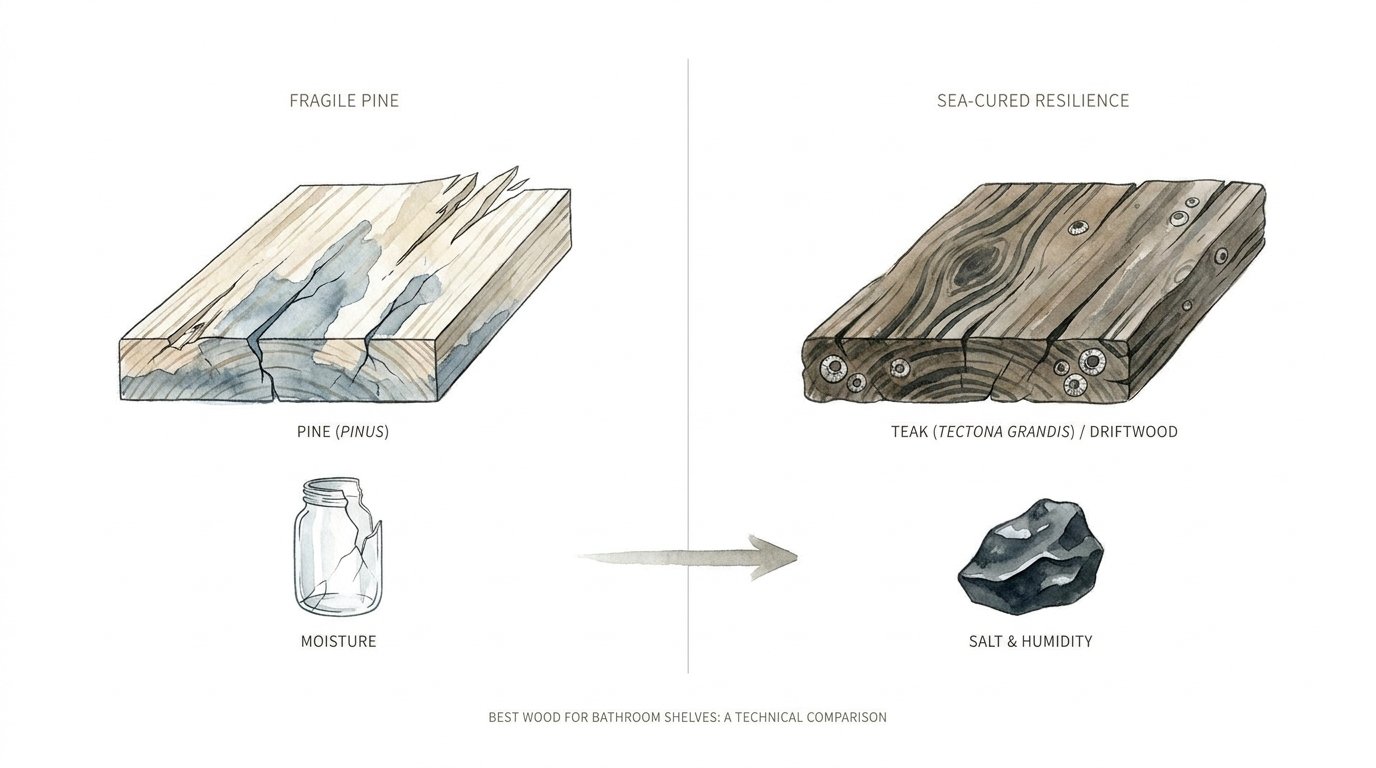
Pine is the most common wood sold at big-box hardware stores, and it is the worst possible choice for a bathroom. It is a “fragile” wood—soft, porous, and filled with sugary sap that acts as a buffet for mold. When the humidity rises, pine absorbs water like a sponge. This causes the wood to expand unevenly, which is why your pine shelves always seem to tilt or wobble after a few months.
Standard construction lumber is also kiln-dried in a way that leaves internal stresses in the wood. When you move that wood into a humid environment, those stresses release, causing the boards to “potato chip” or twist. Unless you are willing to encase pine in multiple layers of heavy-duty marine epoxy, it has no business being near a shower.
If you must use more common hardwoods like Maple or Birch, you must be extremely diligent with your finish. These woods do not have the natural oils of Teak or the tyloses of White Oak. They rely entirely on their topcoat for survival. Every screw hole and every end-grain cut must be saturated with sealant, or the moisture will find its way in.
Most people fail because they forget about the “hidden” faces of the wood. They seal the top and the front of the shelf but leave the back and the bottom raw. In a bathroom, steam rises and settles on every surface. An unsealed bottom face will absorb moisture, while the sealed top face remains dry. This imbalance is exactly what causes wood to cup and pull away from the wall.
Constraints of the Coast: When Reclaimed Wood Is Not Ideal
While driftwood is incredibly resilient, it is not a “magic” material. There are certain scenarios where it may not be the best choice. The most obvious constraint is structural consistency. If you are building a shelf that needs to hold heavy gallon-sized bottles of shampoo and heavy stone decor, you need wood with a flat, reliable surface and predictable strength.
Driftwood is often twisted, knotted, and uneven. This makes it difficult to mount using standard floating shelf brackets. You may need to spend significant time flattening one side with a planer or a drawknife to ensure it sits flush against the wall. If you prefer the look of clean, sharp edges and perfect right angles, raw driftwood will likely frustrate you.
Another consideration is the potential for “salt leaching.” If you do not properly leach and seal the wood, the salt within the fibers can occasionally migrate to the surface in very high humidity. This can create a white, powdery residue or even damage delicate items sitting on the shelf. This is why thorough preparation is not optional.
Finally, there is the matter of weight. High-density maritime woods like Ipe or heavy, water-logged oak are significantly heavier than the pine or plywood most wall anchors are designed for. You must ensure you are mounting these shelves directly into studs or using heavy-duty toggle bolts. If you aren’t prepared to do the structural work, a heavy reclaimed timber shelf could become a safety hazard.
Fragile Pine vs. Sea-Cured Resilience: The Breakdown
To understand the gap between standard lumber and the superior options, we have to look at the numbers. The following table compares common choices based on their performance in high-humidity environments.
| Wood Type | Durability | Moisture Resistance | Maintenance | Cost |
|---|---|---|---|---|
| Store-Bought Pine | Low | Very Low | High (Frequent Resealing) | $ |
| Western Red Cedar | Moderate | High | Low | $$ |
| White Oak | High | High (Tyloses Protection) | Moderate | $$$ |
| Teak | Very High | Excellent (Natural Oils) | Very Low | $$$$ |
| Sea-Cured Driftwood | Extreme | Extreme (Salt-Cured) | Minimal | Free / $$$ |
Practical Tips for a Lifetime of Service
When you are ready to mount your shelves, the hardware you choose is just as important as the wood. Standard steel screws will rust and streak the wood with black stains within months. Always use stainless steel or brass hardware in a bathroom. These metals won’t corrode when exposed to the humidity or the residual salt in reclaimed timber.
Ventilation is your best friend. No matter how resilient the wood is, stagnant, wet air is an enemy. Ensure your bathroom fan is rated for the size of the room and actually runs during and after showers. Good airflow prevents the “condensation dwell time” that allows mold spores to find a foothold in the cracks and crevices of the wood.
If you are using a natural oil finish, keep a small rag and a bottle of the oil in your vanity. Once a year, give the shelves a quick wipe-down. This replenishes the surface barrier and keeps the wood looking vibrant. It only takes five minutes, but it can double the lifespan of your finish.
Think about the “drip line.” If the shelf is located directly under a towel rack or next to a sink, it will see more standing water. Consider adding a very slight pitch to the shelf—just a degree or two—to encourage water to roll off the front rather than pooling against the wall. It’s a small detail that makes a massive difference over a decade of use.
Mastering Wood Movement in High-Steam Environments
Every piece of wood is a bundle of straws. These straws (the fibers) suck up moisture from the air and swell. In a bathroom, this happens every morning and evening. Serious practitioners of woodworking know that you cannot stop wood from moving; you can only manage where it goes.
When mounting a wide shelf, avoid “locking” it in place with tight screws at both ends. This can cause the wood to split as it tries to expand. Instead, use slotted holes in your brackets. This allows the wood to grow and shrink across its width without putting stress on the mounting points.
End grain is the most vulnerable part of any shelf. It is the open end of those “straws.” If you are cutting reclaimed timber to size, pay extra attention to the ends. Apply three or four coats of sealer to the end grain until it stops soaking it up. This prevents moisture from “wicking” deep into the board.
Consider the “vapor drive.” In the winter, the air inside the wood might be more humid than the dry air in your heated house. This creates a pressure that pushes moisture out. In the summer, the reverse happens. By sealing all six sides of the board equally, you slow this exchange down, preventing the rapid changes that lead to internal structural failure.
The Floating Driftwood Vanity: A Case Study
Imagine a small guest bathroom with high ceilings and a single, small window. The owner wanted a “spa” feel but had a limited budget. They found a three-foot section of a Douglas Fir pier piling that had washed up after a winter storm. It was gray, cracked, and smelled faintly of the sea.
After a week of fresh-water soaking and three weeks of drying, the timber was ready. The builder used a hand plane to flatten the top and the back, leaving the rugged, weathered front face untouched. They discovered that the interior of the wood was a deep, rich amber, protected by the silvered exterior.
The shelf was mounted using two 12-inch heavy-duty steel rods drilled deep into the wall studs. Because the wood was so dense, it required a carbide-tipped auger bit and a steady hand. The final result was a massive, floating shelf that looked like it had grown out of the wall.
Five years later, that shelf looks identical to the day it was installed. While the white-painted trim in the same bathroom has begun to peel and show signs of water damage, the sea-cured fir remains rock-solid. It doesn’t just hold the towels; it anchors the entire room with a sense of permanence and history.
Final Thoughts on Building for the Ages
Building for a bathroom is a test of humility. You are working against one of the most persistent forces in nature: water. If you try to fight it with thin veneers and cheap glues, you will lose every time. The only way to win is to use materials that have already made peace with the water.
Whether you source a piece of genuine driftwood or invest in a high-density hardwood like Teak or White Oak, the goal is the same. You are looking for a material that possesses internal resilience. You want fibers that are packed with oils, tannins, or minerals, creating a structure that is more like stone than sponge.
Take the time to prepare your timber correctly. Respect the drying process and choose your hardware wisely. When you put in the effort to build with “sea-cured” grit, you aren’t just making a shelf. You are creating a functional piece of art that will stand as a testament to durability long after the rest of the house has seen its second or third renovation. Experiment with these materials, learn their quirks, and enjoy the peace of mind that comes with knowing your morning shower won’t even leave a mark.
Sources
1 posteakfurniture.com (https://www.posteakfurniture.com/blog/teak-vs-cedar/) | 2 wordpress.com (https://mikesdriftwood.wordpress.com/why-driftwood/) | 3 woodworkersjournal.com (https://www.woodworkersjournal.com/prepare-driftwood-projects/) | 4 groundworks.com (https://www.groundworks.com/resources/dry-rot-wood-rot/) | 5 reddit.com (https://www.reddit.com/r/woodworking/comments/vkrmck/found_this_driftwood_in_the_river_advice_on/) | 6 parklanejewelry.com (https://www2.parklanejewelry.com/how-to-clean-driftwood/) | 7 wikihow.com (https://www.wikihow.com/Preserve-Driftwood) | 8 tnnursery.net (https://tnnursery.net/blogs/garden-blog/driftwood-has-many-uses) | 9 mymumthedreamer.com (https://mymumthedreamer.com/how-to-clean-driftwood-for-crafting/) | 10 shelfgenie.com (https://www.shelfgenie.com/blog/tips-tricks/a-complete-guide-to-the-best-wood-for-bathroom-cabinets/) | 11 duffieldtimber.com (https://duffieldtimber.com/the-workbench/buyers-guides/water-resistant-timber-species-treatments)