reduce screen time for kids calmly
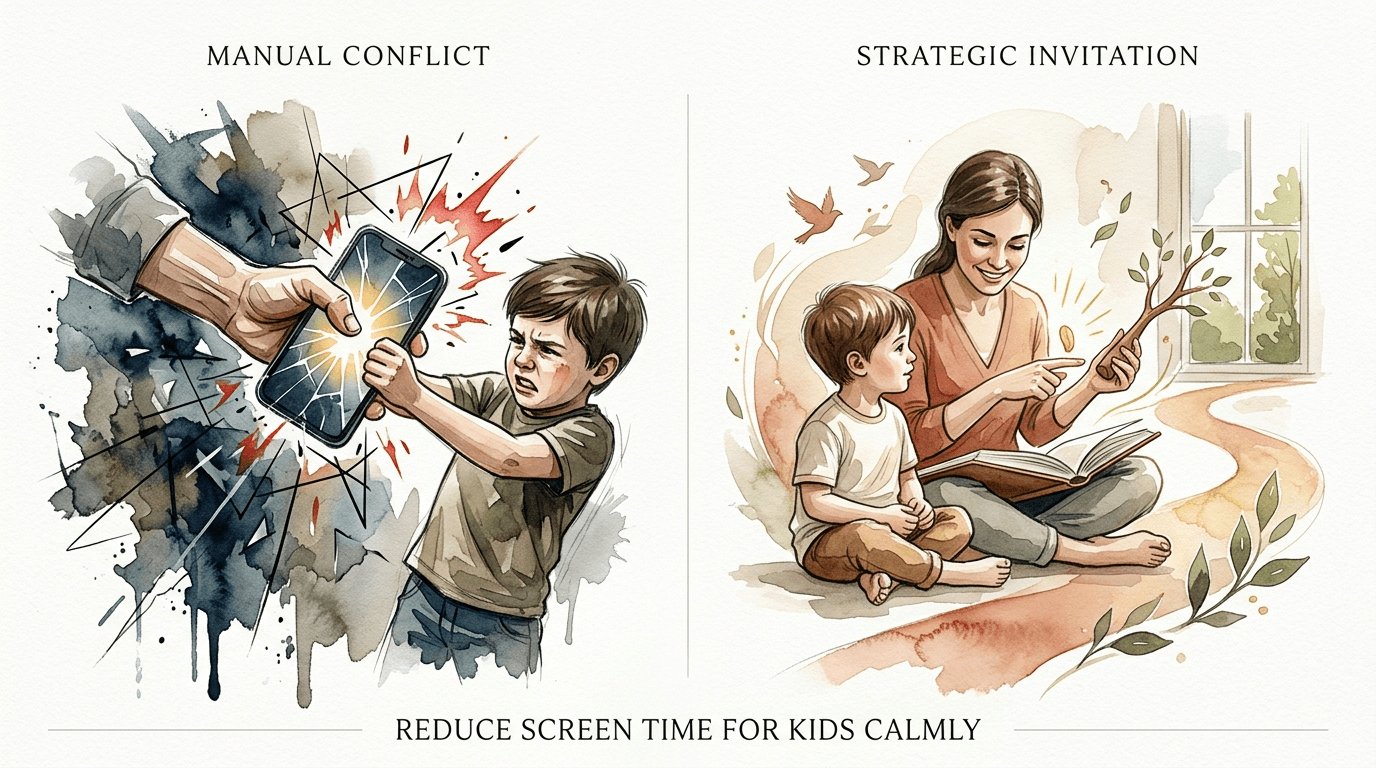
Don’t fight the device; out-design it. Force creates friction; strategy creates flow. Taking a screen away ‘manually’ is a battle you’ll never win. Instead, use the strategic ‘invitation to play.’ When the alternative is more interesting than the app, the screen loses its power.
[affiai]Modern parenting often feels like a constant negotiation with a high-definition slab of glass. We see the glazed-over eyes and the sudden irritability. We feel the tension when we mention the word “bedtime.” But the problem isn’t just the device. It is the design.
Apps are built by thousands of engineers to capture human attention through variable rewards and infinite loops. To compete with that, you cannot just use authority. You have to use strategy. This guide shows you how to move from a state of manual conflict to a state of strategic flow.
reduce screen time for kids calmly
Reducing screen time calmly means shifting your focus from what you are taking away to what you are inviting the child toward. It is a transition from “stop that” to “start this.” This method works because it respects the neurological state of the child rather than fighting against it.
When a child is deep in a game or a video, their brain is in a high-arousal dopamine loop. A sudden, manual removal of the device causes a “dopamine crash.” This crash feels physically painful to a developing nervous system. It triggers the fight-or-flight response, which we see as a meltdown.
The “calm” approach involves “out-designing” the device by creating a physical environment that is just as stimulating, but in a sustainable way. Instead of a power struggle, you create a “bridge” between the digital world and the physical one. This is not about being a “fun” parent every second; it is about being a strategic architect of your home environment.
In real-world terms, this looks like setting up a sensory station before you ask for the iPad to be turned off. It means having a “hook” ready—a puzzle half-finished, a mystery box on the table, or a clear sensory invitation like a tub of kinetic sand. You aren’t just taking a screen; you are offering a new, high-value destination.
The Mechanics of the Strategic Invitation
The goal is to lower the friction of the transition. Digital devices have zero friction; you just swipe. Physical play often has high friction because it requires setup and cleanup. To win, you must pre-load the fun.
Follow these steps to implement a strategic invitation:
Prepare the landing zone. Never ask for a device to be turned off into a vacuum of boredom. Before the time is up, set out a physical activity that is visually appealing and ready to go. This is your “Strategic Invitation.”
Give a physiological warning. Instead of “five more minutes,” use “two more levels” or “one more video.” This helps the child find a natural stopping point in their digital narrative, which reduces the “Zeigarnik effect”—the brain’s tendency to obsess over unfinished tasks.
Execute the Pivot. When the time is up, do not reach for the device. Direct their attention to the invitation. “I just put the new LEGO set on the rug, and I can’t figure out the first step. Can you help?”
Co-regulate the transition. Sit with them for the first three minutes of the new activity. The hardest part of the transition is the first 180 seconds. Once they enter a “flow state” in the physical world, your job is done.
Benefits of Strategic Flow
Choosing strategy over force provides immediate and long-term advantages for both the parent and the child.
Reduced emotional volatility. By avoiding the dopamine crash, you skip the high-intensity meltdowns. This keeps the household’s baseline stress level lower.
Development of self-regulation. When children are invited into a transition rather than forced, they learn to notice their own internal states. They begin to recognize the “foggy” feeling of too much screen time.
Enhanced creative autonomy. Strategic invitations often use open-ended materials. This encourages “active” play rather than “passive” consumption, which strengthens the prefrontal cortex—the part of the brain responsible for executive function.
Strengthened connection. When you “out-design” the device, you are acting as a partner, not an adversary. The child feels supported in their transition rather than controlled.
Challenges and Common Mistakes
The transition to a strategic approach is not without its hurdles. Many parents fall back into old habits when things get busy.
The “Boredom Vacuum” trap. The biggest mistake is expecting a child to transition into a “clean” room with no clear activity. Boredom is healthy, but it is a terrible bridge. Use invitations to get them off the screen, then let boredom take over once they are already “offline.”
Over-explaining. Do not try to lecture a child about the “evils of dopamine” while they are mid-game. Their logical brain is offline. Keep instructions short, punchy, and focused on the new invitation.
Lack of environmental preparation. If the physical toys are buried in a bin at the bottom of a closet, the friction is too high. You cannot out-design a smartphone with a hidden toy. Accessibility is key.
Inconsistency in the “Pivot.” If you sometimes use force and sometimes use strategy, the child will remain on high alert. Predictability reduces the need for the brain to go into a defensive “fight” mode.
Limitations: When Strategic Invitations May Not Work
While powerful, this method has realistic boundaries and constraints.
High-intensity neurodivergence. For some children with ASD or ADHD, transitions are neurologically more difficult. A strategic invitation may need to be paired with more structured visual timers or professional behavioral strategies.
Environmental limitations. If you are in a small apartment or traveling, you may not have the space to set up elaborate “landing zones.” In these cases, the invitation must be portable—like a specific audiobook or a “mystery” drawing prompt.
Parental burnout. Strategy takes more mental energy than simply taking a phone away. On days when you are exhausted, the “manual” approach might feel like the only option. It is okay to be imperfect, but aim for strategy as the default.
The “Higher Stim” problem. If a child has been on a high-octane, competitive gaming marathon for four hours, a “gentle” puzzle might not be enough of a hook. The invitation must be scaled to the level of arousal they are coming from.
Manual Conflict vs Strategic Invitation
Understanding the difference between these two approaches helps you choose the more efficient path.
| Factor | Manual Conflict | Strategic Invitation |
|---|---|---|
| Primary Driver | Authority and Force | Environmental Design |
| Friction Level | High (leads to meltdowns) | Low (leads to flow) |
| Long-term Skill | Compliance or Rebellion | Self-Regulation |
| Parental Role | Enforcer / Police | Architect / Facilitator |
| Brain Impact | Dopamine Crash | Sensory Bridge |
Practical Tips for Immediate Application
You can start out-designing the device today with these simple environmental adjustments.
Create “Toy Rotations.” Keep 70% of toys out of sight. When you bring out a “new” bin as part of an invitation, the novelty factor mimics the “variable reward” of an app.
Use the “Half-Done” Technique. If the invitation is a board game, set the board up and play the first two turns yourself. If it is drawing, start a cool sketch and leave the markers open. A blank page is scary; a half-finished project is an invitation.
Optimize Lighting and Sound. When it is time to transition, dim the lights in the screen area and turn on a calming or rhythmic “work” playlist in the play area. This uses the environment to signal a shift in the nervous system.
Teach the “Why.” For older kids, explain how the apps work. Use terms like “dopamine loops” and “infinite scroll.” When they understand the design, they are more likely to join you in the strategy.
Advanced Considerations: The 2026 Shift
Recent expert frameworks, including the 2026 updates from pediatric organizations, have moved away from strict “hour-based” limits. The focus has shifted to displacement and quality.
The key question is no longer “How many minutes?” but “What is this screen time replacing?” If a screen is replacing sleep, physical activity, or face-to-face connection, it is high-risk. If it is replacing boredom while a parent cooks dinner, and the transition out is managed strategically, the risk is lower.
Serious practitioners of digital wellness also look at the “Arousal Level” of the content. Passive watching (YouTube) is different from active creation (Roblox Studio or Scratch) which is different from addictive scrolling (TikTok). Strategic invitations should be tailored to the intensity of the specific media being used.
Scenario: The Saturday Morning “Screen Slump”
Imagine it is Saturday morning. Your 8-year-old has been on a tablet for 90 minutes. You know if you just grab it, there will be a fight.
Step 1: Preparation. You go to the kitchen table. You pull out a tray of baking soda, vinegar, and food coloring. You put a few “volcano” shapes made of play-dough on the tray.
Step 2: The Pivot. You walk into the living room. You don’t say “Turn that off.” You say, “Hey, the chemistry lab is set up on the table. I’m about to do the first explosion. Do you want to do the red one or the blue one?”
Step 3: The Result. The child’s brain has to make a choice between a passive loop and an active, high-sensory invitation. Because the “friction” of the science project is already handled, they are 80% more likely to set the tablet down and follow the “flow.”
Final Thoughts
The battle against screens is not a moral failing of children; it is a mismatch between biological design and digital engineering. When we rely on manual conflict, we are fighting a war we are ill-equipped to win. We end up exhausted, and our children end up resentful.
By choosing to “out-design” the device, we reclaim our role as the primary influence in our children’s lives. We create a home where the physical world is more vibrant, accessible, and rewarding than the digital one. This doesn’t happen overnight, but every strategic invitation is a step toward a calmer, more connected household.
Experiment with your environment. Focus on the “bridge.” Stop being the screen police and start being the architect of your family’s flow. When the alternative is more interesting than the app, you won’t have to fight the device—the screen will simply lose its power.
Sources
1 peaceathomeparenting.com (https://peaceathomeparenting.com/limit-screen-time-without-conflict/) | 2 screenwiseapp.com (https://screenwiseapp.com/guides/breaking-the-dopamine-loop) | 3 peaceathomeparenting.com (https://peaceathomeparenting.com/dopamine-loop-vs-happiness-screen-time-meltdowns-kids/) | 4 creativesystems.com (https://www.creativesystems.com/designing-play-spaces-for-digital-native-toddlers/) | 5 ffpeds.com (https://ffpeds.com/fostering-genuine-connections-screen-free-strategies-for-kids/) | 6 parental-control.net (https://parental-control.net/en/blog/article/screen-time-how-to-set-boundaries-without-conflict-tips-for-parents) | 7 sparkandstitchinstitute.com (https://sparkandstitchinstitute.com/when-screen-time-rules-fall-apart/) | 8 sbm.org (https://www.sbm.org/healthy-living/how-to-cut-down-screen-time-for-kids) | 9 medium.com (https://medium.com/@a.klimm67/dopamine-and-digital-children-how-screens-shape-the-growing-mind-0fe3d0ee7be9) | 10 usu.edu (https://www.usu.edu/today/story/ask-an-expert–nine-tips-to-help-youth-manage-screen-time) | 11 communityplaythings.com (https://www.communityplaythings.com/resources/articles/designing-environments-that-nurture-the-joy-of-play) | 12 heyotto.app (https://www.heyotto.app/blog/the-complete-guide-to-screen-time-for-kids)