Multi-purpose Driftwood Kitchen Storage
Why buy a rack that only does one job when the ocean provides a multi-dimensional tool that organizes your entire life? Your kitchen doesn’t need more storage; it needs better architecture. A single piece of ‘sea-sculpted’ timber offers infinite mounting points that a factory-made rack can never provide. It’s time to move from single-purpose clutter to the multi-use mastery of the coastline.
[affiai]The modern kitchen often suffers from a sterile rigidity. We buy stainless steel grids and plastic bins, hoping they will solve the chaos of our daily lives. Yet, these mass-produced solutions are often brittle or inflexible. They demand that your tools fit their pre-molded slots. A driftwood storage system flips this script. It is an organic matrix, shaped by the pressure of the tide and the salt of the sea, hardened into a utility that is as rugged as it is beautiful.
Multi-purpose Driftwood Kitchen Storage
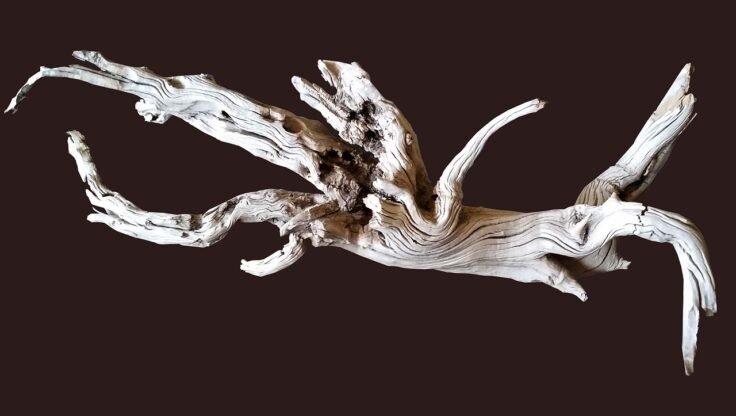
Multi-purpose driftwood kitchen storage is the practice of using weathered, salt-cured timber found along shorelines to create functional mounting and organizational systems. Unlike a standard shelf, driftwood is a three-dimensional sculpture. Its natural knots, bifurcations, and twists act as built-in hooks and ledges. You are not just hanging a board on a wall; you are installing a piece of history that has been cured by the elements.
This approach exists because traditional kitchen cabinetry often wastes vertical and transitional space. A gnarled branch of cedar or oak, properly treated, can span the gap between a window and a stove, providing a place to hang cast iron, dry herbs, and store frequently used knives all on one piece of wood. It is used in real-world situations where space is at a premium or where the “pioneer-grit” aesthetic meets modern functionality. Think of it as the ultimate “all-in-one” tool for the heart of the home.
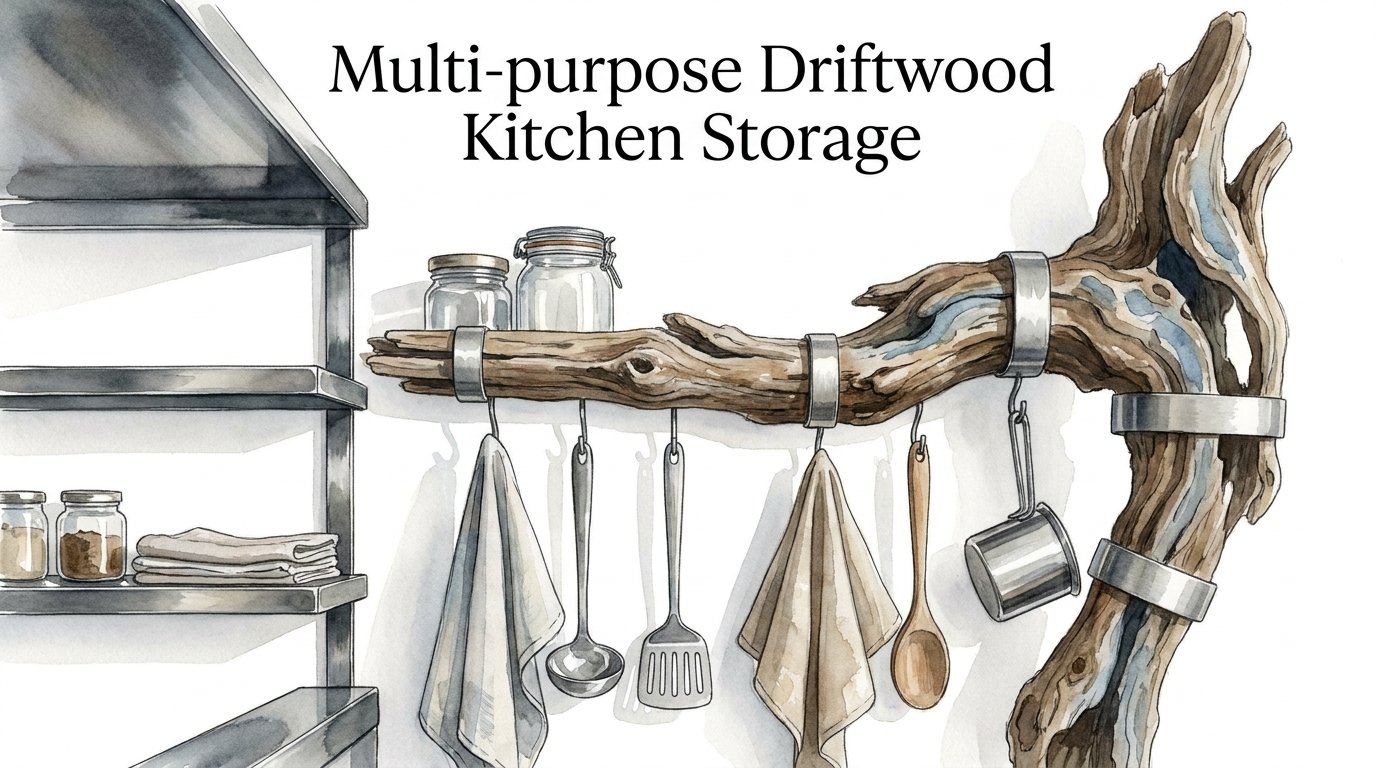
Visualizing this is easy. Imagine a five-foot section of silver-grey wood mounted above your prep station. On its lower protrusions, heavy S-hooks hold your copper pans. Along the top, a flat-sanded edge provides a narrow gallery for spice jars. In the center, where the grain is tight and deep, a magnetic strip is recessed to hold your carbon steel blades. This is the organic matrix at work—a system that adapts to your needs rather than forcing you to adapt to its limitations.
How to Harvest and Prepare Coastal Timber
Preparing driftwood for the kitchen requires more than just picking up a stick from the sand. You must ensure the wood is structurally sound and biologically inert. The salt in the wood is a natural preservative, but it can also attract moisture if not handled correctly.
Step one is the deep clean. Submerge the timber in a large container of fresh water to leach out excess salt and dislodge any hidden sand or silt. For kitchen use, sanitization is non-negotiable. Many artisans use a solution of one part bleach to ten parts water, soaking the wood for at least 30 minutes to kill spores, bacteria, or lingering marine organisms. If the piece is small enough, boiling it for two hours is an even more effective way to sterilize the fibers and release trapped tannins.
Step two involves the drying process. Rushing this stage leads to cracks and warping. Place the wood in a well-ventilated area away from direct sunlight. Depending on the density of the wood, this can take anywhere from a few days to two weeks. Some practitioners use an oven set to 200 degrees Fahrenheit for 2 to 4 hours to ensure the core is bone-dry and any deep-seated pests are neutralized. Keep a close watch to avoid singeing the delicate grey patina.
Step three is the structural refinement. Use a soft-bristled brush or a fine-grit sandpaper to remove loose bark or “soft” spots where the wood has begun to pulp. You want to reach the “heartwood”—the dense, rock-hard center that has survived the ocean’s grind. Once clean, decide on a finish. For a kitchen, a food-safe oil like linseed or a beeswax-based sealant is ideal. It preserves the “bone” look of the wood while making it easy to wipe down.
Benefits of the Organic Matrix
Choosing driftwood over factory-made metal or plastic offers several practical advantages that go beyond simple looks. The most significant benefit is customization. Because every piece of driftwood is unique, you can select a branch that fits the specific dimensions of your kitchen’s odd corners or “dead” zones.
Durability is another factor. Coastal timber has already survived years of UV exposure, saltwater saturation, and physical battering. What remains is often the densest part of the tree. When mounted correctly, a piece of driftwood can support the weight of heavy cast iron skillets that might cause a cheap wire rack to sag or buckle.
Furthermore, wood has superior insulation properties. Unlike metal racks, wood does not conduct heat. If you mount a driftwood rack near a stove or a wood-burning oven, the rack itself won’t become a burn hazard. It remains neutral to the touch, making it a safer choice for high-heat environments. It also acts as a natural acoustic dampener, reducing the “clatter” of metal utensils in a busy kitchen.
Challenges and Common Mistakes
The most frequent error is ignoring the legalities of collection. In many regions, including various state and national parks, removing driftwood is illegal to prevent coastal erosion and protect habitats. Always check local regulations before you go beachcombing. Harvesting from private property without permission can also lead to legal trouble.
Pests are another common pitfall. If you skip the sanitization or “kiln” stage, you risk introducing wood-boring insects into your home. These small hitchhikers can eventually migrate to your kitchen cabinets or structural beams. A thorough soak and a heat-treating session are the only ways to guarantee your storage system isn’t a Trojan horse for termites or beetles.
Structural integrity is often overestimated. Just because a piece of wood looks thick doesn’t mean it hasn’t rotted from the inside out. Always perform a “thump” test—hit the wood with a hammer. A solid piece will ring with a clear, hard sound. A dull, muffled thud suggests internal decay. If you can push a screwdriver into the wood with hand pressure, it is not fit for a kitchen rack.
Limitations of Driftwood Storage
Despite its ruggedness, driftwood has its boundaries. It is not ideal for holding massive, concentrated loads in a single spot unless the wood is exceptionally thick hardwood like oak or madrone. Unlike engineered steel, which has a predictable shear strength, wood has natural grain lines that can split if overloaded with improper hardware.
Environmental limitations also play a role. In extremely humid kitchens without ventilation, driftwood can absorb moisture and develop mold if it wasn’t sealed correctly. While the salt-curing process helps, it isn’t a permanent shield against poor airflow. If your kitchen resembles a steam room more than a workshop, you may need to apply a more aggressive polyurethane sealant, though this will sacrifice some of the wood’s natural texture.
Rigid Metal vs. Organic Matrix
When deciding between a standard industrial rack and a driftwood system, it helps to look at the measurable differences in performance and maintenance.
| Feature | Rigid Metal (Factory) | Organic Matrix (Driftwood) |
|---|---|---|
| Weight Capacity | High; predictable load limits. | Variable; depends on wood density. |
| Installation | Standardized; requires flat walls. | Adaptive; fits irregular spaces. |
| Maintenance | Low; wipe clean, check for rust. | Moderate; occasional oiling required. |
| Cost | Moderate to high for quality steel. | Low (self-harvested) to moderate. |
| Aesthetic | Industrial, sterile, modern. | Warm, nostalgic, authoritative. |
Practical Tips for Mounting
Securing a heavy, irregular piece of wood to a wall requires more than a few nails. You must locate the studs. Use a reliable stud finder and mark your points clearly. Because driftwood is rarely straight, you will often find that only one or two points of the wood naturally touch the wall.
For the most secure mount, use a French Cleat system for larger pieces. You can sand a flat section onto the back of the driftwood and attach one half of the cleat there, while the other goes into the wall studs. This distributes the weight across a wider area and allows the rack to sit flush against the wall. If you prefer a more “floating” look, use heavy-duty toggle bolts or long timber screws driven directly through the thickest knots of the branch.
Incorporate functionality into the mounting process. If you have a particularly deep knot, don’t just fill it—drill it out slightly to create a natural “well” for a small herb pot or a place to tuck a sharpening stone. Use stainless steel S-hooks for hanging items to prevent the metal from reacting with any residual sea salt in the wood.
Advanced Customization Techniques
Serious practitioners often go beyond basic hanging. Consider “inlaying” functional elements directly into the timber. You can use a router to create a channel on the underside of a driftwood branch to install a dimmable LED strip. This provides focused task lighting for your countertop while keeping the source of the light hidden behind the organic curve of the wood.
Another advanced move is the integrated magnetic strip. By recessing powerful neodymium magnets into the back of a thin section of the wood, you can create a “hidden” knife rack. To the casual observer, your knives appear to stick directly to the sea-worn bark. This protects the blades from the scratches often caused by metal-on-metal racks and keeps them within arm’s reach during intensive prep work.
Think about the “flow” of your tools. Place the driftwood at a height where the most-used items—your primary chef’s knife, your favorite iron pan—are at eye level. Use the upper, more irregular branches for items used less frequently, like dried chili bunches or decorative ladles. This creates a hierarchy of utility that makes your kitchen work like a well-oiled machine.
Example Scenario: The Coastal Scullery
Consider a kitchen remodel where a homeowner replaced an entire bank of upper cabinets with two large spans of salt-cured cedar. The lower span was mounted exactly 18 inches above the counter. The homeowner used a Forstner bit to drill three 1-inch holes into a thick bend in the wood, creating a built-in block for their most-used wooden spoons.
The upper span, mounted higher and slightly offset, featured several natural “Y” junctions. These were used to cradle a heavy rolling pin and a collection of artisanal cutting boards. By removing the bulky cabinets and replacing them with the driftwood matrix, the kitchen felt twice as large, yet it held 15% more accessible gear. The “pioneer” approach didn’t just store the tools; it presented them in a way that encouraged more frequent, more efficient cooking.
Final Thoughts
Building a multi-purpose driftwood storage system is an exercise in intentionality. It forces you to look at your kitchen not as a collection of boxes, but as a workspace that can be shaped to your specific rhythm. It honors the grit of the pioneer spirit, using what is available to create something that is both functional and enduring.
The transition from single-purpose clutter to an organic matrix requires patience and a bit of “elbow grease,” but the results are measurable. You gain a kitchen that is quieter, warmer, and infinitely more flexible. You are no longer fighting against the rigid lines of a factory; you are working with the flow of the coastline.
Experiment with different types of wood and mounting heights. Don’t be afraid to let the wood tell you where the tools should go. Every knot and every curve is an opportunity for better architecture. Start with one small branch, and you may find that the ocean has more to offer your home than you ever imagined.
Sources
1 parklanejewelry.com (https://www2.parklanejewelry.com/how-to-wash-driftwood/) | 2 reddit.com (https://www.reddit.com/r/bluetongueskinks/comments/13uqo98/how_to_clean_and_sanitize_driftwood/) | 3 specialeditionart.com (https://specialeditionart.com/blogs/theoracle/how-to-hang-driftwood-on-your-wall-a-comprehensive-guide) | 4 youtube.com (https://www.youtube.com/watch?v=Jb9L0BTwfTY) | 5 awhc.org (https://vertexaisearch.cloud.google.com/grounding-api-redirect/AUZIYQFaGFmtmFVK0XqaPWuh1udXJQfAfGSJOtOCjodP4QK7yL3OwtiaAGMqcMyY9LkRbihm622DJjupBLN448YwvjZhuYWkv8LoeOUHY0KraQzTyxk4HOzKupJEZgrlVG81dsM=) | 6 steelpowershelving.com.au (https://steelpowershelving.com.au/blogs/news/wooden-shelves-vs-metal-shelves-pros-and-cons) | 7 acerackingsystem.com (https://www.acerackingsystem.com/wooden-shelves-vs-metal-shelves/) | 8 melissaknorris.com (https://melissaknorris.com/podcast/kitchen-tools/) | 9 dksstores.com (https://dksstores.com/blog-post67) | 10 ponomasteel.com (https://ponomasteel.com/blogs/stainlesssteelspace/articles-metal-shelves-vs-wood-shelves) | 11 ashdeco.com (https://ashdeco.com/blogs/news/wood-shelf-vs-metal-shelf-comparison) | 12 Source (https://www.google.com/search?q=time+in+Los+Angeles,+CA,+US) | 13 ca.gov (https://www.parks.ca.gov/?page_id=21301) | 14 hawk-hill.com (https://www.hawk-hill.com/how-to-clean-driftwood/) | 15 pgstoragesystems.com (https://pgstoragesystems.com/blogs/news/comparative-guide-metal-vs-wood-racks-for-storeroom-storage) | 16 frenchcreekfarmhouse.com (https://www.frenchcreekfarmhouse.com/2020/01/how-to-safely-hang-heavy-stuff-on-wall.html) | 17 quora.com (https://www.quora.com/Is-it-illegal-to-take-driftwood-from-a-beach) | 18 hometalk.com (https://www.hometalk.com/diy/decorate/rooms/q-how-to-hang-a-large-heavy-driftwood-piece-42096700) | 19 allstate.com (https://www.allstate.com/resources/home-insurance/how-to-hang-something-heavy) | 20 newellpioneervillage.com (https://newellpioneervillage.com/collections/furniture-collection-early-pioneer-families/)