weekly family plan to cut screen time
We’ve traded presence for proximity. It’s time to come back.
[affiai]Remember when the living room was for living? This weekly plan helps you transition from isolated scrolling to shared experiences that actually build a family culture.
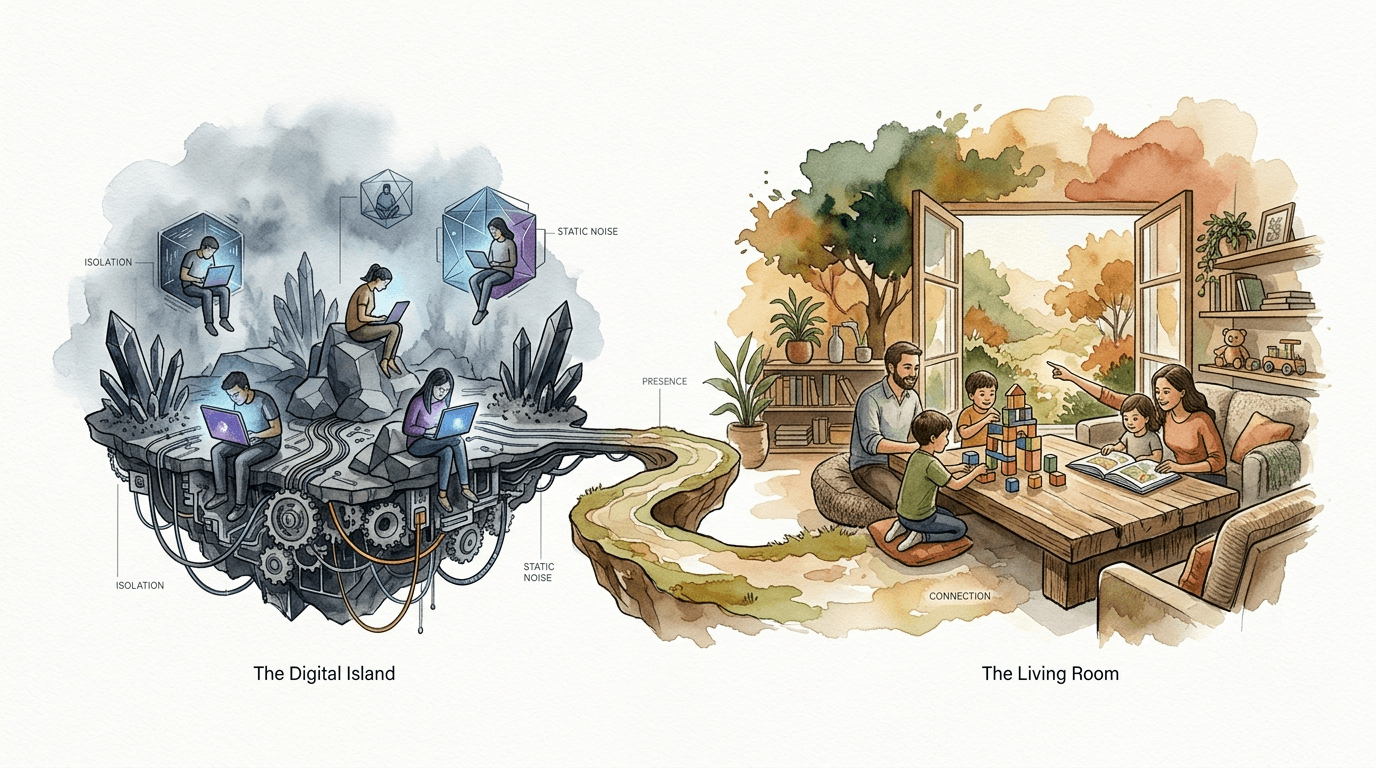
For most modern families, the home has become a collection of individual “digital islands.” Everyone is in the same room, but nobody is together. You are physically close, yet mentally miles apart, tethered to different algorithms that don’t know your children’s names or your spouse’s favorite stories.
Reclaiming your home isn’t about becoming “anti-tech.” It is about becoming “pro-connection.” This guide provides a comprehensive, science-backed framework to help you stop the drift and start the transition back to a living room that actually feels alive.
weekly family plan to cut screen time
A weekly family plan to cut screen time is a structured, seven-day roadmap designed to shift a household’s default behavior from passive consumption to active engagement. It is not a temporary “detox” meant to be suffered through and forgotten. Instead, it is a deliberate system used to audit current habits, establish physical and temporal boundaries, and introduce high-value analog alternatives.
In the real world, this plan acts as a reset button. Current 2025 statistics show that children aged 5 to 8 average over three hours of screen media daily, while teenagers often exceed eight hours for entertainment alone. A weekly plan exists to combat this “technoference”—the frequent interruptions in interpersonal interactions caused by digital devices.
Think of your family’s digital habits like a garden. Without a plan, weeds (mindless scrolling, “one more episode” loops, and algorithmic rabbit holes) eventually choke out the flowers (conversations, shared hobbies, and restful play). By implementing a weekly schedule, you are essentially “weeding” the schedule to make room for what actually matters.
How It Works: The 7-Day Reconnection Roadmap
The success of a screen-time reduction plan lies in its progression. You cannot simply pull the plug on Sunday night and expect a happy household on Monday morning. You must transition from awareness to action.
Day 1: The Digital Audit
Start by gathering the data. Most people underestimate their screen usage by 40% or more. Spend the first day tracking every device in the house. Use the built-in “Screen Time” (iOS) or “Digital Wellbeing” (Android) tools to see exactly where the hours are going.
Hold a family meeting that evening. Do not approach this with a tone of judgment. Instead, present the numbers as a curiosity. “We spent 42 hours on TikTok this week. That’s nearly two full days. What could we have done with two extra days of vacation?”
Day 2: Establish Physical Boundaries
Humans are “visual cue” creatures. If your phone is on the kitchen counter, your brain is subconsciously processing the possibility of a notification. On Day 2, introduce the “Phone Bed” or a central charging station.
Pick a neutral location—a basket in the hallway or a drawer in the kitchen. Devices stay there during “Home Hours.” This simple physical barrier breaks the “phone twitch loop,” where you pick up your phone without even realizing you’re doing it.
Day 3: Declare No-Go Zones
Identify specific rooms or times that are strictly analog. The two most critical zones are the dining table and the bedrooms.
Research from the University of Georgia indicates that the presence of cellphones during meals significantly reduces emotional sharing and increases family conflict. By declaring the table a “Sacred Space,” you force the transition back to face-to-face eye contact. In bedrooms, removing screens is the single most effective way to improve sleep hygiene and mental health.
Day 4: Content Quality Over Quantity
Not all screen time is created equal. On Day 4, shift the focus from “how much” to “what.” Move away from “junk food” content—short-form, high-dopamine videos that leave kids (and adults) feeling irritable and wired.
Instead, prioritize “Creative Screen Time” (digital art, music production) or “Shared Screen Time” (watching a documentary together). When you watch together, you can discuss the themes, which research suggests can actually improve children’s literacy and critical thinking skills.
Day 5: The “Boredom” Menu
The biggest obstacle to cutting screen time is the “I’m bored” meltdown. Digital devices have effectively outsourced our ability to self-soothe or find creative outlets.
On Day 5, create a physical “Boredom Menu.” This is a list of 20+ activities that require zero batteries. Include quick wins (drawing, LEGOs, card games) and long-term projects (puzzles, gardening, building a birdhouse). Having a pre-written list prevents the cognitive load of trying to think of an activity when the “boredom” hits.
Day 6: Parental Modeling
Your children will never follow a rule they see you breaking. Day 6 is about “Lead by Example.”
Audit your own “Technoference.” Do you check your email during the kids’ soccer game? Do you scroll through news while your spouse is talking to you? Commit to being “visible” in your tech use. If you must use your phone for a task, tell the room what you are doing: “I am checking the weather for tomorrow,” or “I am replying to a work message for five minutes.” This demystifies the glowing rectangle.
Day 7: The Celebration and Review
End the week with a “High-Value” analog event. This could be a hike, a board game tournament, or a family cook-off.
Use this time to review the week. Ask everyone, “What was the hardest part?” and “What did you do this week that you wouldn’t have done if we were on our screens?” This reinforces the benefits and helps you adjust the rules for the following week.
Benefits of Reclaiming the Living Room
Moving away from the “Digital Island” model offers measurable improvements to family health and happiness.
Improved Emotional Closeness: When the constant hum of notifications is removed, parents and children are forced to re-engage with each other’s emotional states. You begin to notice the subtle cues—a sigh, a smile, or a look of frustration—that are often missed when eyes are glued to a screen.
Reduced Behavioral Problems: The American Psychological Association has found a “vicious circle” between excessive screen time and socioemotional problems. Reducing screen time often leads to a noticeable decrease in aggression, hyperactivity, and irritability in children.
Better Sleep Cycles: Screens emit blue light that suppresses melatonin, the hormone responsible for sleep. By removing screens an hour before bed, you drastically improve the quality of sleep for the entire household, leading to better focus and mood the following day.
Cognitive Development: Replacing passive viewing with active play or reading stimulates different parts of the brain. For younger children, this transition is critical for developing executive function—the ability to plan, focus, and multitask.
Challenges and Common Mistakes
The road to a screen-balanced home is paved with good intentions and frequent failures. Knowing the pitfalls can help you stay the course.
The “Punishment” Mindset: One of the most common mistakes is using screen-time reduction as a punishment for bad behavior. When you do this, you turn technology into a “forbidden fruit” that kids value even more. Instead, frame the weekly plan as a positive “Family Upgrade” that everyone is participating in together.
The “Digital Babysitter” Trap: Many parents (49% by recent counts) rely on screens for childcare because they are overwhelmed. If you don’t have a plan for what the kids will do when you are busy cooking or working, you will eventually cave. You must prepare “Busy Boxes” or “Independent Play Stations” to replace the digital babysitter.
Inconsistency: If the rules apply on Tuesday but disappear on Friday because you’re tired, the system collapses. Kids are expert negotiators; if they see a crack in the foundation, they will push until it breaks. Consistency is more important than intensity.
Ignoring the “Twitch”: Parents often forget to address their own addiction. If you are trying to cut the kids’ time while your own screen time is climbing, the resulting resentment will undermine the entire plan. You must be willing to experience the same “digital withdrawal” as your children.
Limitations: When the Plan May Not Work
While a weekly plan is highly effective, it is not a “one size fits all” solution. There are realistic constraints to consider.
Remote Work Realities: For many parents, the home is also the office. You cannot always put your phone in a “Phone Bed” if you are on call or managing a remote team. In these cases, the limitation is environmental. You must create a “Work-Only Zone” so the kids don’t see your screen time as “leisure” time.
Educational Requirements: Modern schooling often requires tablets or laptops for homework. You cannot strictly “cut screen time” if the child has two hours of research to do. The plan must distinguish between “Productive Screen Time” and “Consumptive Screen Time.”
Special Needs: For some children with neurodivergent needs (such as Autism or ADHD), screens can be vital tools for communication, regulation, or learning. In these scenarios, a standard “detox” could be harmful. The plan must be modified with the help of a professional to ensure it supports the child’s unique developmental path.
The Digital Island vs. The Living Room
To understand why this plan is necessary, it helps to compare the two “modes” of modern living.
| Feature | The Digital Island | The Living Room |
|---|---|---|
| Focus | Individual / Algorithmic | Shared / Communal |
| Communication | Sporadic / Distracted | Intentional / Continuous |
| Energy Level | Passive / “Wired but Tired” | Active / Naturally Restful |
| Conflict Resolution | Avoidance via Escapism | Engagement and Dialogue |
| Memory Making | Digital Footprints (Photos) | Core Memories (Experiences) |
Practical Tips for Immediate Success
If you want to start today, here are some actionable optimization techniques to make the transition smoother.
- Use Grayscale Mode: Most apps are designed with bright, “candy-like” colors to keep you engaged. Turning your phone to grayscale (found in Accessibility settings) makes the screen significantly less appealing to your brain’s dopamine centers.
- Batch Your Notifications: Instead of being interrupted 100 times a day, set your phone to deliver notifications in “batches” (e.g., at 8:00 AM, 12:00 PM, and 4:00 PM). This puts you in control of the tech, rather than the tech being in control of you.
- The “One Screen” Rule: Ban “multi-screening.” If the family is watching a movie, no one is allowed to have a phone or tablet in their lap. This forces the brain to focus on one thing, reducing cognitive fatigue.
- Print Your Plan: Do not keep your “Family Plan” on a digital app. Print it out and tape it to the refrigerator. Making the rules physical makes them “real” for children and serves as a constant reminder for adults.
- Audit Your Subscriptions: Sometimes the best way to reduce screen time is to remove the temptation. If you have five streaming services, consider cutting back to one. Fewer choices leads to less “infinite scrolling.”
Advanced Considerations for Long-Term Maintenance
For those who have mastered the basics and want to build a truly robust family culture, consider these deeper insights into digital minimalism.
Handling the Teenage Rebellion: Adolescents are wired for social connection. Forcing a teenager to go “dark” can lead to social isolation and intense resentment. Instead of “cutting” their time, pivot to “Digital Literacy.” Teach them about how algorithms work, how data is collected, and how “outrage culture” is monetized. When teens understand they are being manipulated by a product, they are often more likely to limit their own use.
The Dopamine Fast: Serious practitioners sometimes implement a “Digital Sabbath”—a full 24-hour period each week with zero screens for the entire family. This allows the brain’s dopamine receptors to “reset,” making normal, analog activities feel more rewarding again.
Replacing Escapism with Agency: Many people use screens to escape the stresses of daily life. To make your plan stick, you must address the root cause. If the kids are on screens because they have no “agency” or “adventure” in their real lives, you must find ways to give them responsibilities or challenges that make the “real world” more exciting than the digital one.
A Realistic Example: The Thompson Family
To see how this works in practice, let’s look at a hypothetical 4-person household: The Thompsons.
Before the plan, the Thompsons spent their evenings in the living room together, but everyone was on a device. The dad was checking sports scores, the mom was on Instagram, the 10-year-old was on Roblox, and the 6-year-old was watching “unboxing” videos on YouTube. Tension was high, and “bedtime battles” lasted for over an hour.
The Intervention: They implemented the “weekly family plan to cut screen time” by starting with a Phone Basket in the kitchen.
The Results:
- Week 1: Resistance was high. The 10-year-old complained of “dying of boredom.” The parents realized they didn’t know what to talk about for the first 20 minutes of dinner.
- Week 3: The “Boredom Menu” kicked in. The 6-year-old started a “rock collection” in the backyard. The 10-year-old started teaching himself to play the ukulele using an old book.
- Week 6: Bedtime battles disappeared because screens were removed from bedrooms. The “Digital Island” had successfully transformed into a “Living Room.” The parents reported feeling 30% less “burned out” by the end of the day.
Final Thoughts
The goal of a weekly screen time plan isn’t to live in a cave or throw your iPhone into the ocean. It is about regaining the “remote control” of your own life. When we allow screens to be the default setting of our existence, we outsource our family culture to corporations whose primary goal is our attention, not our affection.
By implementing these small, consistent changes, you are doing more than just “saving time.” You are sending a clear message to your children: *You are more interesting than this phone. Our time together is more valuable than this app.*
Start small. Maybe it’s just the “Phone Bed” tonight. Maybe it’s a screen-free dinner tomorrow. Whatever it is, take that first step away from the digital island. Your living room—and your family—is waiting for you to come back.
Sources
1 lindnercenterofhope.org (https://lindnercenterofhope.org/blog/how-to-set-screen-time-limits-for-kids-and-teens-without-constant-conflict/) | 2 westgateresorts.com (https://www.westgateresorts.com/blog/digital-detox-for-kids/) | 3 richinwhatmatters.com (https://richinwhatmatters.com/2025/02/15/9-ways-to-practice-digital-minimalism-and-reclaim-your-freedom/) | 4 actionforhealthykids.org (https://www.actionforhealthykids.org/activity/limit-screen-time/) | 5 bklynlibrary.org (https://static.bklynlibrary.org/prod/public/documents/4181_BM_Family%20Media%20Plan_6-spreads.pdf) | 6 informandempower.com.au (https://www.informandempower.com.au/post/family-screen-time-plan—building-healthy-habits) | 7 familyitguy.com (https://www.familyitguy.com/assets/downloads/7-day-digital-detox-challenge.html) | 8 simplebyemmy.com (https://simplebyemmy.com/digital_minimalism/) | 9 luriechildrens.org (https://www.luriechildrens.org/en/blog/screen-time-2025/) | 10 monstermath.app (https://www.monstermath.app/blog/how-much-screen-time-are-kids-getting-in-the-us-in-2025) | 11 connecticutchildrens.org (https://www.connecticutchildrens.org/growing-healthy/10-ways-get-your-teen-and-family-try-digital-detox)