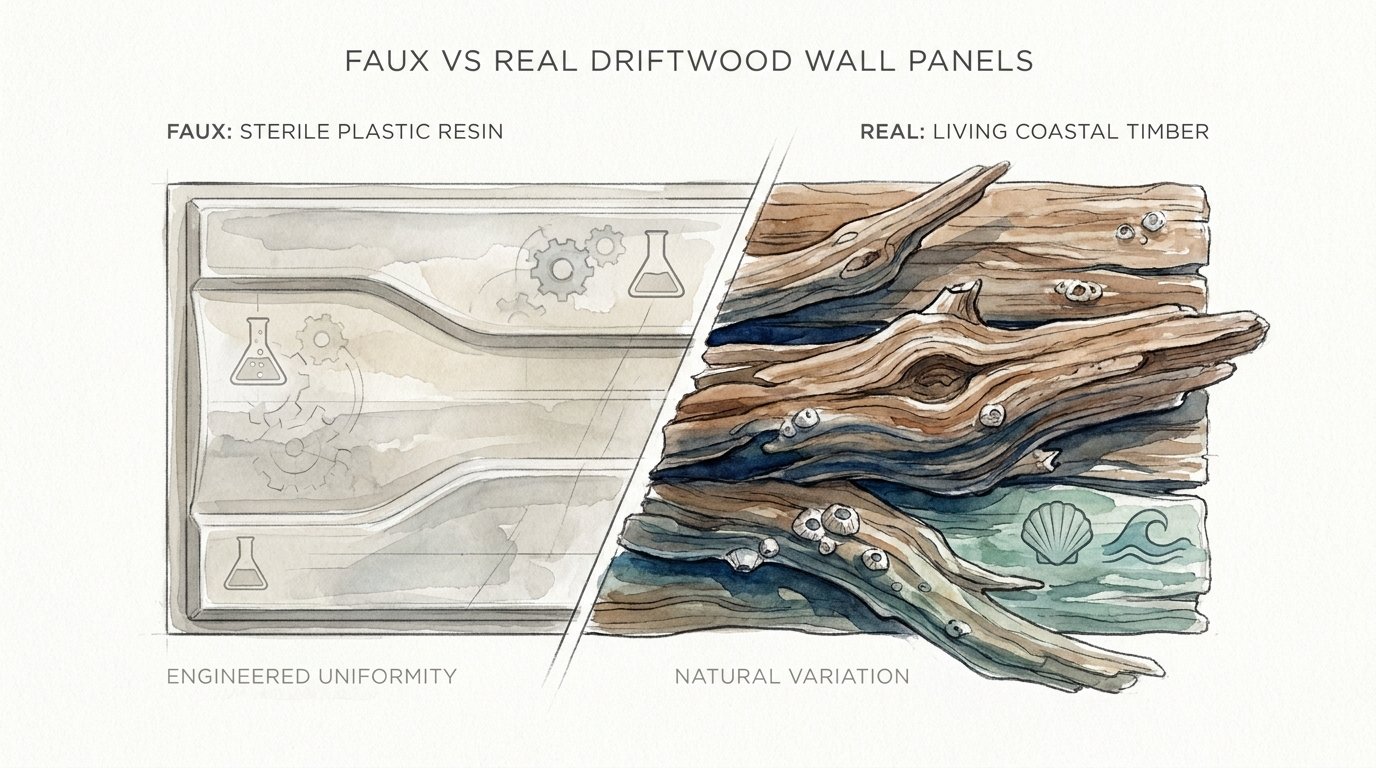
Faux Vs Real Driftwood Wall Panels
Your home can either be a plastic imitation of nature or a living sanctuary for the ocean’s own history. We have been conditioned to accept plastic molds as a substitute for real texture, but your brain knows the difference. Synthetic panels offer a dead, repeating loop of pattern, while authentic sea-sculpted timber provides a unique biological architecture that actually interacts with the light and air in your room. Don’t settle for a copy of the wild.
[affiai]Choosing the right material for your walls is not just about aesthetics; it is about the honesty of your environment. For decades, the construction industry has leaned toward convenience, pushing STERILE PLASTIC RESIN as the standard for “coastal” looks. While these products are easy to ship and install, they lack the pioneer-grit of LIVING COASTAL TIMBER. Real driftwood carries the scars of the Atlantic or the Pacific, forged by salt, sun, and sand.
This guide will walk you through the structural and psychological differences between faux and real driftwood wall panels. Whether you are a homeowner looking for a weekend DIY project or a professional designer planning a high-traffic commercial space, understanding the integrity of your materials is the first step toward building something that lasts.
Faux Vs Real Driftwood Wall Panels
Authentic driftwood panels are made from timber that has spent years, sometimes decades, at sea. The water leaches out the natural sugars and tannins, leaving behind a dense, fibrous skeleton that is naturally resistant to rot. This wood is then harvested from beaches or riverbanks, dried, and milled into thin planks for interior use. No two boards are identical because no two waves hit a piece of wood in exactly the same way.
Faux driftwood wall panels are a different breed entirely. These are usually manufactured from high-density polyurethane (PU) or PVC. A real piece of driftwood is used to create a master mold, which is then used to cast thousands of identical plastic copies. These panels are hand-painted or printed to mimic the gray, weathered patina of sun-bleached oak or cedar. They exist to solve problems of cost, weight, and consistency, but they do so by sacrificing the very irregularities that make wood feel alive.
In the real world, you see real driftwood in high-end residential homes, boutique hotels, and spaces where “authenticity” is a core brand value. Faux panels are more common in retail chains, themed restaurants, or exterior applications where the wood would be exposed to punishing rain that might rot untreated natural timber. Think of it like the difference between a hand-carved stone statue and a concrete cast; one holds the soul of the maker, while the other serves a functional purpose at a lower price point.
How the Materials Are Forged and Installed
The journey of a real driftwood panel begins with a storm. When trees fall into rivers or the sea, they are tumbled by currents. This process naturally “sands” the wood, removing the soft sapwood and leaving the hard, durable heartwood. Once collected, the wood must be “cured.” This involves a long drying process to bring the internal moisture content down to between 6% and 12%, which prevents the wood from warping once it is installed in your climate-controlled home. Professionals often treat this wood with a light borate solution to ensure no stowaway pests remain in the grain.
Faux panels are born in a factory. Liquid resin is injected into a mold under high pressure. Once it sets, the panel is popped out, cleaned of “flash” (excess plastic), and sent to a paint booth. The “how-to” of faux panels is remarkably simple: they are often sold in large 4×8 foot sheets that can be glued directly to drywall with construction adhesive. Because they are plastic, they do not need to acclimate to your room’s humidity. You simply measure, cut with a standard hand saw, and stick them up.
Installing real wood planks requires more patience. You must let the wood sit in the room for at least 72 hours to “acclimate.” If you nail a dry board to a wall in a humid room, it will swell and buckle. If you nail a damp board in a dry room, it will shrink, leaving ugly gaps between the planks. Real wood is typically installed using a “blind-nailing” technique into the wall studs, often over a plywood substrate to ensure the wall stays flat.
The Biological and Practical Benefits
The most significant advantage of real wood is rooted in biophilic design. Research has shown that humans have a physiological response to natural textures. Exposure to real wood surfaces can lower heart rates, reduce blood pressure, and decrease stress levels. Your brain recognizes the “fractal” patterns of real wood—the way the grain flows and repeats without ever being identical. Plastic imitations, even the expensive ones, often have a “repeating loop” every four or five feet that the subconscious mind flags as “unnatural,” which can subtly increase cognitive load in a space.
From a practical standpoint, real driftwood is incredibly durable. Because the “soft” parts of the wood were already scrubbed away by the ocean, what remains is the toughest part of the tree. It doesn’t show dents or scratches easily, and if it does, the damage usually blends into the existing weathered texture. Real wood also acts as a natural humidity regulator, absorbing and releasing moisture to keep your indoor air more comfortable.
Faux panels have their own set of victories, primarily in weight and moisture resistance. A 4×8 foot sheet of real driftwood can weigh 50 pounds or more, requiring two people for installation and a solid structural wall. A faux panel of the same size might weigh only 10 pounds. Furthermore, if you are designing a bathroom or a spa, faux panels are functionally superior. They are 100% waterproof. You can spray them down with a hose, and they will never grow mold or rot, whereas real wood in a high-moisture environment requires expensive marine-grade sealants and constant maintenance.
Challenges and Common Mistakes
The biggest pitfall with real driftwood is “biological instability.” Many beginners make the mistake of picking up a piece of wood from the beach and nailing it straight to their wall. This is a recipe for disaster. Beach wood is often infested with termites, powderpost beetles, or mold spores. Without proper kiln-drying or chemical treatment, you are essentially inviting a colony of wood-eating insects into your home. Always ensure your real wood source has been heat-treated or professionally cured.
Another common mistake is the “pattern trap” with faux panels. Because faux panels come in sets of molds, it is easy to install two identical panels side-by-side. This creates a mirrored effect that screams “fake” to anyone who looks at the wall. Professional installers always “stagger” their faux panels, cutting them at different lengths and flipping them upside down to break up the repeating grain patterns.
Cleaning is where many people fail. You should never use a soaking wet mop or heavy detergents on real driftwood. Water can seep into the deep cracks of the weathered grain and cause the wood to “fur” or become fuzzy. On the flip side, people often use abrasive scrubbers on faux panels, which can peel off the thin layer of paint and reveal the bright white or yellow plastic underneath. Both materials require a gentle hand: a soft brush vacuum attachment for dust, and a barely-damp microfiber cloth for spots.
Limitations of the Materials
Real driftwood is not a “uniform” product. If you are a perfectionist who wants every board to be the exact same shade of silver-gray, real wood will frustrate you. One board might have a brown core, while the next is almost white. This is the beauty of the material, but it is also a limitation for those seeking a highly controlled aesthetic. Additionally, real driftwood is expensive. The labor involved in sourcing, cleaning, and milling salvaged timber makes it a premium product.
Faux panels are limited by their chemistry. Polyurethane is a petroleum-based product. While modern versions are better than those of the 1970s, they can still “off-gas” Volatile Organic Compounds (VOCs) for several weeks after installation. In a small, unventilated bedroom, this can lead to headaches or respiratory irritation for sensitive individuals. Also, faux panels have a finite lifespan. Once the paint fades from UV exposure or the plastic becomes brittle from heat, there is no way to “refinish” them. You can’t sand a plastic panel back to its original beauty; you can only replace it.
Comparing Real and Faux Driftwood
The following table breaks down the measurable differences to help you decide which material fits your specific project needs.
| Feature | Real Driftwood Panels | Faux Resin Panels |
|---|---|---|
| Material | Sea-weathered reclaimed timber | High-density polyurethane or PVC |
| Weight | Heavy (1.5 – 3 lbs per sq ft) | Light (0.5 – 1 lb per sq ft) |
| Installation | Complex (nails, acclimation) | Easy (adhesive, no acclimation) |
| Health Impact | Positive (biophilic, stress-reducing) | Neutral/Negative (possible VOCs) |
| Durability | High (lasts generations) | Moderate (vulnerable to UV/Heat) |
| Cost | High ($15 – $40 per sq ft) | Low ($6 – $12 per sq ft) |
Practical Tips and Best Practices
If you choose real driftwood, the secret to a professional look is “waste management.” Always buy 15% more wood than you think you need. Driftwood planks often have “checked” ends (cracks) or knots that may fall out during shipping. Having extra allows you to cherry-pick the best pieces for eye-level areas and hide the less attractive boards near the floor or ceiling.
For those opting for faux panels, lighting is your best friend and your worst enemy. Because the texture of faux panels is molded, harsh top-lighting (like recessed “can” lights directly above the wall) can reveal the unnatural uniformity of the shadows. Instead, use “wash” lighting from the side or warm, diffused light. This softens the edges of the resin and makes the painted highlights look more like natural wood fibers.
Regardless of the material, always use a “black-out” technique behind the panels. If you are installing planks with small gaps between them (the “nickel gap” style), paint the wall behind the wood a dark charcoal or matte black. This ensures that any tiny gaps look like deep, natural shadows rather than showing bits of your original white or beige drywall.
Advanced Considerations: Fire Codes and Load
Serious practitioners must consider the structural and safety implications of these materials. In commercial environments, like a restaurant or office lobby, the fire rating of your wall panel is non-negotiable. Most raw wood is “Class C” fire-rated. You can treat it with fire-retardant sprays to reach a “Class A” rating, but this can sometimes change the color of the silver-gray patina. Faux panels are often “Class A” right out of the box because fire-retardant chemicals are mixed into the resin during manufacturing. Always check your local building codes before starting a large-scale project.
Structural load is also a factor in high-rise buildings. If you are installing real driftwood on a 20-foot tall feature wall, the total weight can be thousands of pounds. You cannot simply nail this into standard 1/2-inch drywall. You will need to “furr out” the wall with 2x4s or 3/4-inch plywood that is securely anchored to the building’s structural studs. Faux panels, being lightweight, can often be installed directly on existing drywall without any additional bracing, making them the superior choice for “retrofits” in older buildings.
Scenario: The Coastal Cafe vs. The Residential Bedroom
Imagine you are designing a high-traffic coastal cafe. You have salty air, high humidity from the espresso machines, and customers constantly bumping into the walls. In this scenario, a high-quality faux panel is actually the smarter choice. It can be scrubbed clean of coffee spills, it won’t warp from the steam, and the Class A fire rating keeps the fire marshal happy. The height of the walls also means most people won’t be touching the material close enough to realize it’s resin.
Now, imagine a master bedroom in a quiet home. Here, the goal is tranquility. The humidity is controlled, and the person sleeping there is only a few feet away from the wall. In this case, real driftwood is the only option. The faint scent of aged wood, the way the natural silver grain reflects moonlight, and the biophilic benefits of the material create a “living sanctuary” that a plastic panel could never provide. The investment in real wood here provides a direct return on the occupant’s mental well-being.
Final Thoughts
Choosing between real and faux driftwood wall panels is ultimately a choice between a story and a solution. Real driftwood is a record of time—a biological artifact that brings the unpredictable beauty of the ocean into your living space. It requires more care, more budget, and more technical skill, but the result is a room that feels grounded and honest.
Faux panels are a modern engineering marvel, offering a practical way to achieve a specific look in environments where real wood would fail. They provide consistency and ease of use that can be invaluable for commercial contractors or DIYers on a strict timeline and budget.
Experiment with your space. If you can afford the weight and the cost, choose the real thing; your brain and your home’s value will thank you. But if the environment is harsh or the budget is tight, lean into the best faux options available, and use clever installation and lighting to bridge the gap between the mold and the mountain.
Sources
1 apawood.org (https://www.apawood.org/designerscircle-nature-in-design-the-biophilia-effect) | 2 thermoryusa.com (https://thermoryusa.com/2021/02/01/the-benefits-of-biophilic-design/) | 3 stugastudio.com (https://stugastudio.com/blogs/inspiration/wood-wellbeing-biophilic-design) | 4 urestonepanels.com (https://urestonepanels.com/why-faux-wood-over-real-wood/) | 5 centennialwoods.com (https://centennialwoods.com/blogs/news/how-to-clean-wood-paneling) | 6 aquariacentral.com (https://www.aquariacentral.com/forums/threads/fake-wood-vs-real-wood.71934/) | 7 stikwood.com (https://www.stikwood.com/blogs/workbench/how-to-install-wood-planks-on-your-wall) | 8 youtube.com (https://www.youtube.com/watch?v=LBGEVMfPT_4)