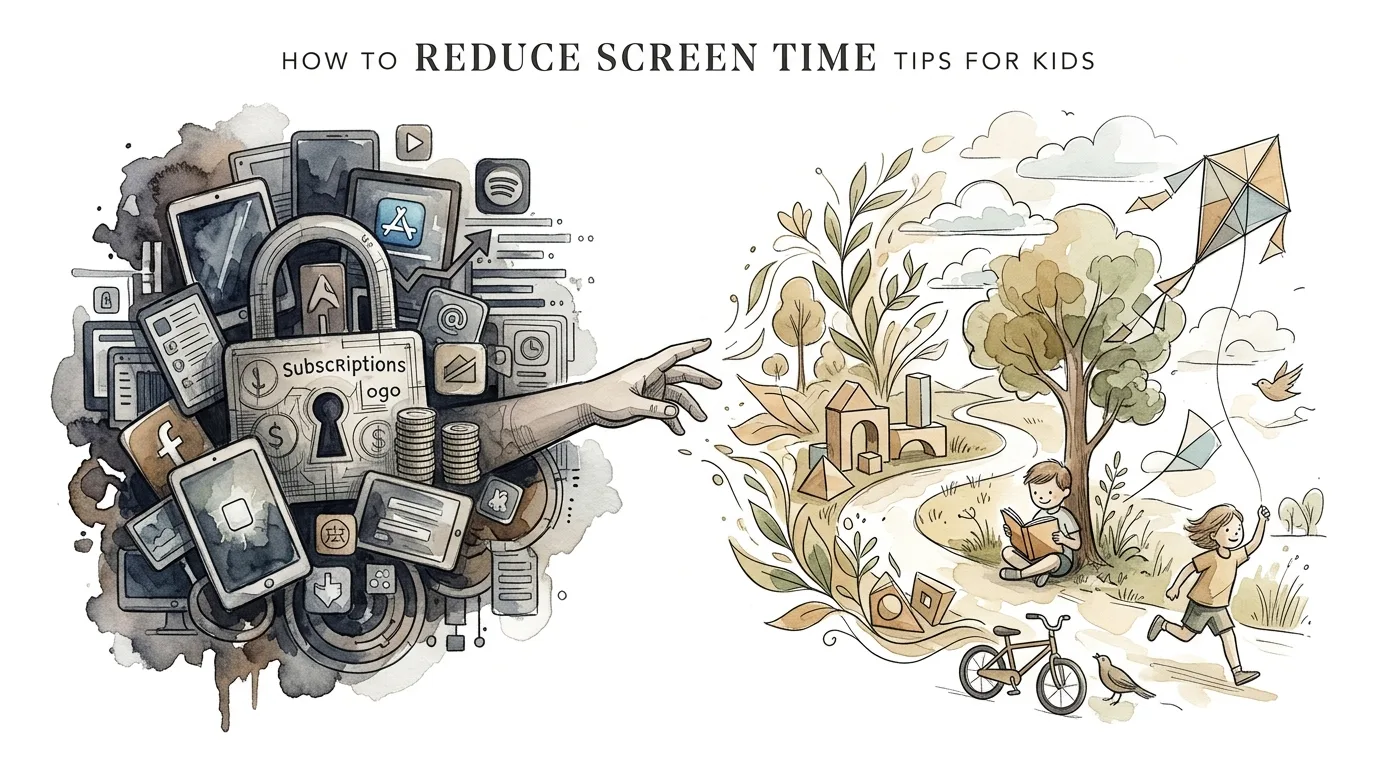
how to reduce screen time tips for kids
The best entertainment for a child’s brain hasn’t changed in a thousand years, and it’s completely free. We pay hundreds for ‘educational’ apps, but the backyard is the world’s best classroom. Reduce the screen time and the monthly bills at the same time. Here is our ‘Free Play’ checklist.
[affiai]Everything you need for a genius-level education is sitting right outside your back door. For decades, parents have been sold the lie that high-tech gadgets are the key to a child’s future success. However, recent research suggests the opposite is true. Deep, immersive learning happens when a child interacts with the physical world, not a glowing rectangle.
Transitioning from a screen-heavy lifestyle to a play-based one can feel daunting. You might worry your child will be bored or that they are falling behind their peers. In reality, you are giving them a massive cognitive head start. This guide will show you exactly how to swap the tablet for the sandbox without the usual power struggles.
how to reduce screen time tips for kids
Reducing screen time is not just about taking away a device; it is about reclaiming the primary way children learn. The human brain is a sensory-processing machine that thrives on three-dimensional feedback. Screens offer only two senses: sight and sound. When children spend hours on apps, they miss out on the critical tactile and spatial data their growing brains crave.
Experts now warn that excessive screen use affects mental health, sleep, and overall development. For children between ages 2 and 5, the American Academy of Pediatrics recommends no more than one hour of high-quality programming per day. Yet, many toddlers are exposed to much more, leading to a “displacement” effect where digital media replaces vital human interactions and physical exploration.
Screens are designed to be addictive. They provide instant dopamine rewards with every swipe or click. This high-frequency stimulation can make the real world seem “slow” or “boring” by comparison. To fix this, we have to rebuild their tolerance for slower, more meaningful engagement through child-directed play.
The goal is to shift from a “consumer” mindset to a “creator” mindset. In the backyard, there are no levels to beat or pre-programmed rules to follow. The child must invent the game, set the rules, and solve the problems. This is where true intelligence is forged.
The Magic of Loose Parts Play: How It Works
If you want to reduce screen time, you need to understand the “Theory of Loose Parts.” This concept, first introduced by architect Simon Nicholson in 1971, suggests that the more flexible materials a child has, the more they will learn. A plastic toy car can only be a car. A cardboard box, however, can be a spaceship, a grocery store, or a dragon’s den.
Loose parts are open-ended materials that children can manipulate, combine, and transform. These materials do not have a “right” way to be used. They invite children to ask, “What can I do with this?” instead of “What does this do?” This subtle shift in thinking triggers divergent thinking, which is a key component of high-level problem-solving.
Setting up a “Free Play” environment is surprisingly simple. You do not need to buy expensive Montessori kits. You simply need to gather materials that are “unscripted.” These can include natural items like sticks, pine cones, and stones, or synthetic items like PVC pipes, old tires, and buckets.
When a child enters a space filled with loose parts, their brain enters a state of high engagement. They begin to experiment with cause and effect. They learn about gravity as they stack stones. They learn about volume as they pour sand. This hands-on engagement builds the brain’s “air traffic control” system, also known as executive function.
Benefits of Choosing Dirt Over Digital
The practical, measurable benefits of unstructured play far outweigh anything a subscription app can offer. Cognitive scientists have found that children who approach problems through play can often solve logic puzzles that are considered beyond their age-level abilities. Play is a powerful technique for building empathy and complex social groups.
Physical health is the most obvious advantage. Running, climbing, and balancing strengthen muscles and improve coordination. Unlike the sedentary nature of screen time, outdoor play builds stamina and long-term health. It also reduces the risk of nearsightedness (myopia), which is increasingly common in children who spend too much time on “near” activities like tablets.
Emotional regulation is another massive win. Screens often lead to “digital tantrums” when the device is taken away because the brain’s dopamine levels crash. In contrast, free play helps children learn to manage frustration. When a stick bridge collapses, the child must regulate their emotions and try a different strategy. This builds resilience that lasts a lifetime.
Socially, free play is a masterclass in negotiation. When kids play together without adult-imposed rules, they have to communicate. They have to decide who gets to be the captain and how the “imaginary gold” is shared. These are the soft skills that future employers value more than the ability to navigate a touch-screen interface.
Challenges and Common Parent Mistakes
The biggest obstacle to reducing screen time is often parent guilt. We feel like we are “mean” for saying no to the iPad, or we worry that our child is bored. Boredom is actually a developmental necessity. It is the vacuum that forces a child’s imagination to switch on. When you provide a screen every time a child is bored, you are effectively “short-circuiting” their creative engine.
Another common mistake is the “helicopter” approach. Parents often feel the need to jump in and show the child “how to play.” If you tell a child that a stick is a sword, you have just limited that stick’s potential. Let the child discover what the stick is for themselves. Your role is to be a quiet observer, not the director of the play.
Safety concerns also lead to “play deprivation.” We live in a culture that is terrified of “risky play.” While you should always keep an eye on safety, minor scrapes and dirty fingernails are the price of a healthy childhood. A child who never climbs a tree never learns how to assess their own physical limits.
Finally, do not expect an instant transition. If your child is used to high-octane video games, the backyard will feel quiet and uninteresting at first. They might stand there and ask what to do for twenty minutes. Resist the urge to give in. Give their brain time to “re-calibrate” to the slower pace of nature.
Limitations: When This Method Faces Hurdles
The “backyard classroom” is powerful, but it does have realistic constraints. Not every family has a private yard. Urban living can make outdoor play a challenge. In these cases, you have to get creative. Local parks, community gardens, or even a dedicated “messy corner” on a balcony can serve the same purpose.
Weather is another frequent barrier. Many parents shut down outdoor play the moment it starts to drizzle. However, there is a famous saying in Scandinavia: “There is no such thing as bad weather, only bad clothing.” Investing in a good pair of rain boots and a waterproof suit can turn a rainy day into a massive sensory learning experience with mud and puddles.
Time is the final constraint. We live in a world of packed schedules and extracurricular activities. Free play requires large blocks of uninterrupted time. If a child only has 15 minutes between soccer and tutoring, they will never reach the state of “deep play” where the real brain-building happens. You may need to cut back on some scheduled activities to make room for nothing at all.
Expensive Subscriptions vs Free Abundance
Many parents fall into the trap of thinking that a paid educational app is “better” because it has a curriculum. Let’s look at how a free backyard experience stacks up against an expensive digital subscription.
| Feature | Educational Apps ($15+/mo) | The Backyard (Free) |
|---|---|---|
| Cost | Recurring monthly bills | Zero cost |
| Sensory Input | Visual and Auditory only | Sight, sound, touch, smell, and balance |
| Problem Solving | Pre-programmed puzzles | Real-world physics and logistics |
| Social Interaction | Isolated play | Collaboration and negotiation |
| Physical Health | Sedentary; potential eye strain | Gross and fine motor development |
Practical Tips for Setting Up a Free Play Space
You do not need to be a landscape architect to turn your backyard into a world-class learning center. Start small and focus on variety. The goal is to create a “yes space” where the child is allowed to move things, get dirty, and experiment without constant correction.
* Gather Loose Parts: Collect old tires, wooden planks, milk crates, and buckets. Check local community groups for people giving away “junk” that kids love.
* Create a Digging Zone: Dedicate a small corner of the yard where it is okay to dig holes. Dirt is the ultimate open-ended toy.
* Add Water: A simple hose or a bucket of water changes the entire dynamic of play. It introduces concepts of fluid dynamics and makes the dirt a lot more interesting.
* Provide Storage: Use large bins or a simple shed to store parts. This helps children learn to “curate” their space at the end of the day.
* Rotate Materials: If interest starts to wane, take a few items away and bring them back a week later. They will feel like brand-new toys.
Advanced Considerations for Serious Practitioners
For those who want to go beyond the basics, consider the concept of “risky play.” Research shows that children who engage in age-appropriate risks—like climbing a bit higher or using real tools—actually have fewer accidents. They develop a “risk-assessment” muscle that helps them make better decisions as they grow into teenagers.
You can also lean into “scaffolding” rather than “directing.” If you see a child trying to build a fort but the roof keeps falling, don’t fix it for them. Instead, ask a question: “What do you think would happen if we used a wider base?” This guides their thinking without taking away the victory of the final result.
Consider the “1,000 Hours Outside” movement. This challenge encourages families to spend as much time outdoors as they do on screens. For the average American child, that means shifting about 1,200 hours of screen time back into nature. Keeping a log of your outdoor hours can be a great way to stay motivated as a family.
A Saturday Morning Without Screens: A Practical Example
Imagine a typical Saturday morning. Usually, the kids are on the couch with iPads while you try to drink your coffee. This time, you’ve prepped the backyard with a pile of old cardboard boxes and a bucket of water.
The children complain for the first ten minutes. “We’re bored!” they shout. You stay firm. You suggest they check out the boxes. Slowly, the complaints stop. Thirty minutes later, you look out the window. The boxes have become a multi-level castle. They are using sticks to “guard” the entrance.
By noon, they have added a “moat” using the garden hose. They are covered in mud, breathing fresh air, and their brains are firing on all cylinders. They have practiced engineering, leadership, and sensory processing—all for the price of some recycling and a little bit of laundry. When they finally come inside, they are tired and ready for a nap, rather than “wired” and irritable from screen overstimulation.
Final Thoughts
The best investment you can make in your child’s future is often the one that costs the least. Reducing screen time is not about being a “luddite” or hating technology; it is about respecting the way the human brain was designed to grow. Every hour spent in the backyard is an hour spent building a more resilient, creative, and healthy mind.
Start small by picking one “Screen-Free Sunday” or a designated hour after school for outdoor play. Watch how your child’s behavior changes as they reconnect with the physical world. You will likely find that they become calmer, more focused, and much better at entertaining themselves.
The backyard is waiting. It is the only classroom where the lessons change every single day, and the tuition is always free. Grab the ‘Free Play’ checklist, open the back door, and let the real learning begin.
Sources
1 compasschildcare.com (https://www.compasschildcare.com/child-care-near-me/nature-vs-screens-how-outdoor-learning-environments-shape-child-development) | 2 cacfp.org (https://www.cacfp.org/2025/07/07/reducing-screen-time/) | 3 youtube.com (https://www.youtube.com/watch?v=wk7VH_3Z6Lg) | 4 mayoclinic.org (https://www.mayoclinic.org/healthy-lifestyle/childrens-health/in-depth/screen-time/art-20047952) | 5 ccrcca.org (https://www.ccrcca.org/parents/strengthening-families-blog/item/a-parents-practical-guide-to-managing-screen-time-for-kids/) | 6 lillio.com (https://www.lillio.com/blog/the-benefits-of-loose-parts-play-for-young-children) | 7 mybrightwheel.com (https://mybrightwheel.com/blog/loose-parts-play) | 8 waldorfeducation.org (https://www.waldorfeducation.org/the-essential-benefits-of-play-a-research-based-perspective/) | 9 miriambeloglovsky.com (https://miriambeloglovsky.com/unleashing-creativity-using-loose-parts-for-toddlers/) | 10 mortonmichel.com (https://www.mortonmichel.com/news/the-importance-of-loose-parts-play) | 11 nicca.us (https://www.nicca.us/post/let-your-imagination-loose-with-loose-parts-play) | 12 joes-kids.org (https://www.joes-kids.org/blog/the-power-of-free-play-in-childhood/) | 13 harvard.edu (https://magazine.hms.harvard.edu/articles/free-play-shapes-childs-brain-and-bestows-lifetime-benefits) | 14 childrensmercy.org (https://www.childrensmercy.org/parent-ish/2025/08/free-play/) | 15 childcare.gov (https://childcare.gov/consumer-education/support-my-childs-health-development/supporting-childrens-learning-through-play) | 16 c4l.net (https://c4l.net/the-cognitive-benefits-of-free-play-why-unstructured-time-matters/) | 17 sbm.org (https://www.sbm.org/healthy-living/how-to-cut-down-screen-time-for-kids) | 18 montclair.edu (https://digitalcommons.montclair.edu/cgi/viewcontent.cgi?article=1188&context=teaching-learning-facpubs) | 19 nih.gov (https://pmc.ncbi.nlm.nih.gov/articles/PMC9687100/) | 20 medlineplus.gov (https://magazine.medlineplus.gov/article/7-tips-for-managing-screen-use)