Storm Proof Driftwood Deck Railings
While store-bought lumber rots in the salt air, this timber is only getting stronger. Standard hardware store lumber is a ‘foreigner’ to the coast—it fights the salt and loses every time. Driftwood is the native. It was forged in the surf and sun-hardened by the elements. It doesn’t just survive the gale; it thrives in it.
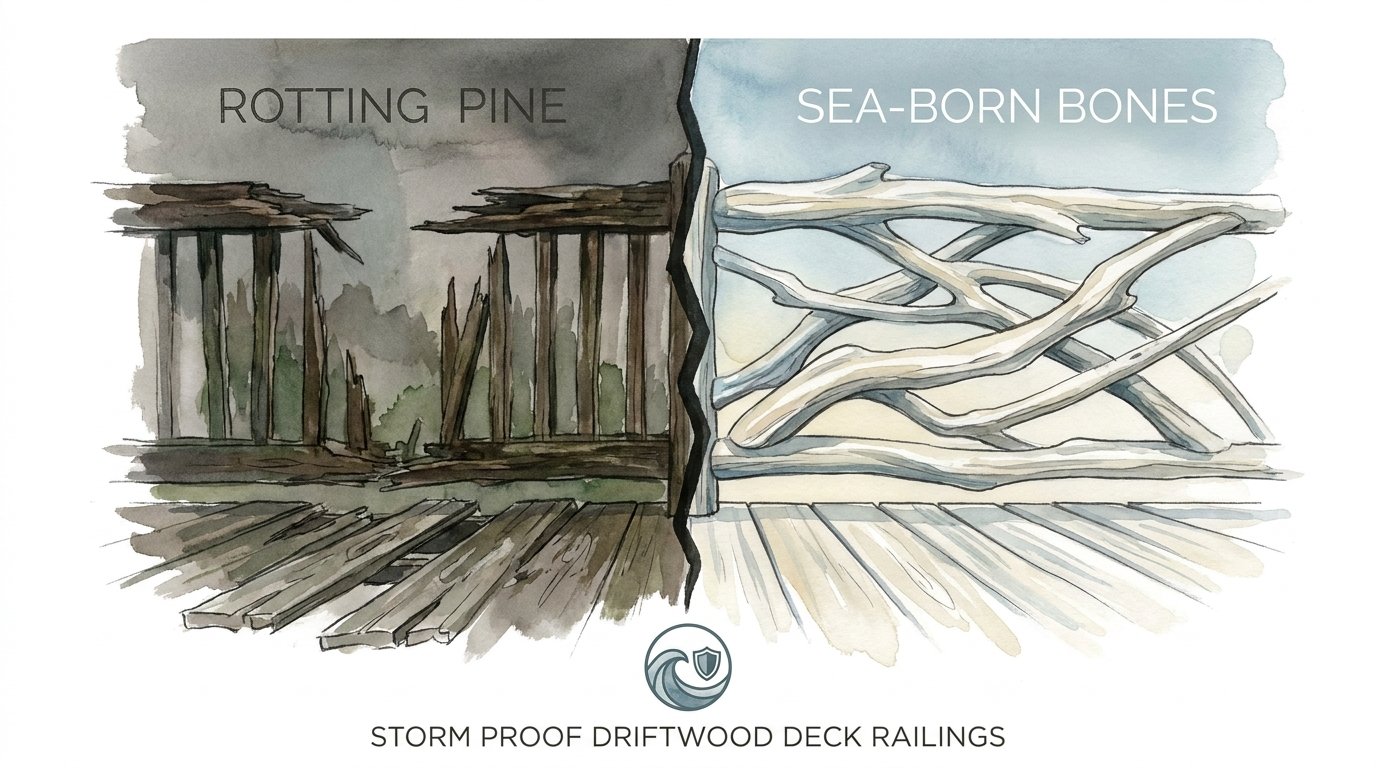
[affiai]Building on the edge of the world requires a different kind of grit. When you’re standing on a deck facing the Atlantic or the Pacific, you realize that the wind doesn’t just blow; it carries teeth made of salt and sand. Most builders try to fight this with chemicals and plastic coatings. They miss the point. The ocean has already done the hard work for you, curing “sea-born bones” into timber that laughs at a category four storm.
In this guide, we are going to look at why driftwood is the ultimate coastal building material and how you can harness these weathered giants to build a railing that outlasts the house it’s attached to. We’re moving past the “rotting pine” mentality and into a world where structural integrity meets the raw, unyielding beauty of the coast.
Storm Proof Driftwood Deck Railings
A storm-proof driftwood railing is more than a safety barrier; it is a structural marriage between your home and the environment. Unlike dimensional lumber, which is cut from young, fast-growing trees and then “pickled” in copper-based chemicals to resist rot, driftwood has been naturally selected. Only the densest heartwood of species like Western Red Cedar, Juniper, or tropical hardwoods survives years of tumbling in the surf.
By the time a piece of driftwood reaches the shore, the salt has penetrated its fibers, acting as a natural desiccant and preservative. The sun has bleached and hardened the exterior into a silver-grey armor that reflects UV radiation rather than absorbing it. When you use these pieces for deck railings, you aren’t just building with wood; you are building with the skeletal remains of trees that have already survived the worst the ocean could throw at them.
In real-world terms, these railings are used in high-exposure zones—bluffs, beachheads, and island docks—where traditional pressure-treated wood would warp and peel within five seasons. A driftwood railing built with the right joinery and fasteners isn’t just a design choice; it is a tactical decision for longevity.
How to Sconce and Secure the Sea-Born Bones
Building with irregular timber requires a departure from the “square and plumb” world of the hardware store. You cannot simply butt-joint a curved branch to a 4×4 post and hope it holds. You have to work with the wood’s natural geometry.
1. Sourcing and the “Thump Test”
Before you even pick up a saw, you must vet your material. Not all driftwood is created equal. Avoid “punky” wood—timber that feels light for its size or gives way under a thumbnail. You are looking for heartwood. Give the timber a sharp rap with a hammer; it should ring with a high-pitched “clink” rather than a dull “thud.” This indicates the lignin is still intact and the fibers are dense.
2. The Art of Scribing
Because driftwood is rarely straight, you must use a technique called “scribing” to join it to your vertical posts. Scribing involves holding the driftwood rail in its final position and using a compass to transfer the profile of the post onto the rail (or vice versa). You then use a coping saw or a sharp chisel to carve a “saddle” that fits perfectly against the post. This maximizes surface-to-surface contact, which is essential for structural stability.
3. Hidden Strength with Lag Bolts
Never rely on deck screws alone for driftwood railings. The density of salt-hardened wood makes it prone to splitting if you don’t pre-drill. For the primary structural connections—the top and bottom rails—you should use 316 Stainless Steel lag bolts. Drill a pilot hole slightly smaller than the bolt’s diameter, then counter-sink the head so it can be plugged with a sliver of the same wood for a seamless, “blind” connection.
Benefits of Building with Driftwood
The primary advantage of driftwood is its unrivaled resistance to salt-induced decay. While standard lumber eventually succumbs to “pitting” and fungal rot because its chemical treatments leach out over time, driftwood has already been “purged” of its soft sapwood.
- Structural Resilience: Naturally weathered wood is less likely to warp or “check” (split) after installation because it has already reached a stable moisture content in equilibrium with the coastal air.
- Zero Chemical Leaching: Unlike pressure-treated wood, which can bleed chemicals into the surrounding soil and sand, driftwood is 100% natural and environmentally inert.
- Aesthetic Integration: A silvered driftwood railing disappears into the coastal landscape, making the deck feel like a natural extension of the beach rather than a foreign platform.
- High Friction: Salt-hardened wood often has a unique, grippy texture that remains safe even when soaked by sea spray, unlike slick, planed lumber.
Challenges and Common Mistakes
The biggest mistake a builder can make is treating driftwood like a decorative “overlay” rather than a structural component. If your driftwood is just nailed to the outside of a 2×4 frame, the wind will eventually vibrate those fasteners loose.
Mistake: Using 304 Stainless Steel or Galvanized Nails. In a coastal environment, galvanized coatings are eaten away in a single season. Even 304-grade stainless steel can develop “tea staining” (surface rust). For a storm-proof build, you must use 316 Marine Grade Stainless Steel. It contains molybdenum, which specifically resists chloride-induced corrosion.
Mistake: Ignoring Building Codes. Just because it’s “artistic” doesn’t mean it’s exempt from safety. In most jurisdictions, a railing must be at least 36 inches high and unable to pass a 4-inch sphere through any gap. When working with irregular driftwood branches as balusters, you must carefully map out your spacing to ensure a child cannot slip through.
Limitations: When Driftwood Isn’t the Answer
Driftwood is a champion of the coast, but it has its boundaries. It is not ideal for ground-contact foundations. While it resists rot above the surface, burying driftwood in wet, anaerobic soil can still lead to decay over decades. Use concrete footings or pressure-treated pilings for the foundation, and save the driftwood for everything above the deck boards.
Furthermore, if your local building code requires “stamped” lumber for structural beams, your inspector might reject raw driftwood for the main joists of the deck. Driftwood is best utilized for the railing system, stairs, and decorative structural accents where visual inspection can confirm its density and strength.
Comparison: Rotting Pine vs. Sea-Born Bones
To understand the value proposition, look at how these materials perform over a 10-year span in a high-salt environment.
| Feature | Pressure-Treated Pine | Salt-Hardened Driftwood |
|---|---|---|
| Salt Resistance | Low (leaches and cracks) | Extreme (naturally cured) |
| Maintenance | High (needs staining/sealing) | Minimal (occasional wash) |
| Fastener Life | Reactive (corrodes fasteners) | Neutral (protects SS 316) |
| Lifespan | 7–12 Years | 30+ Years |
Practical Tips for a Better Build
When you are ready to assemble your railing, keep these veteran tips in mind to ensure the structure stays “pioneer-strong.”
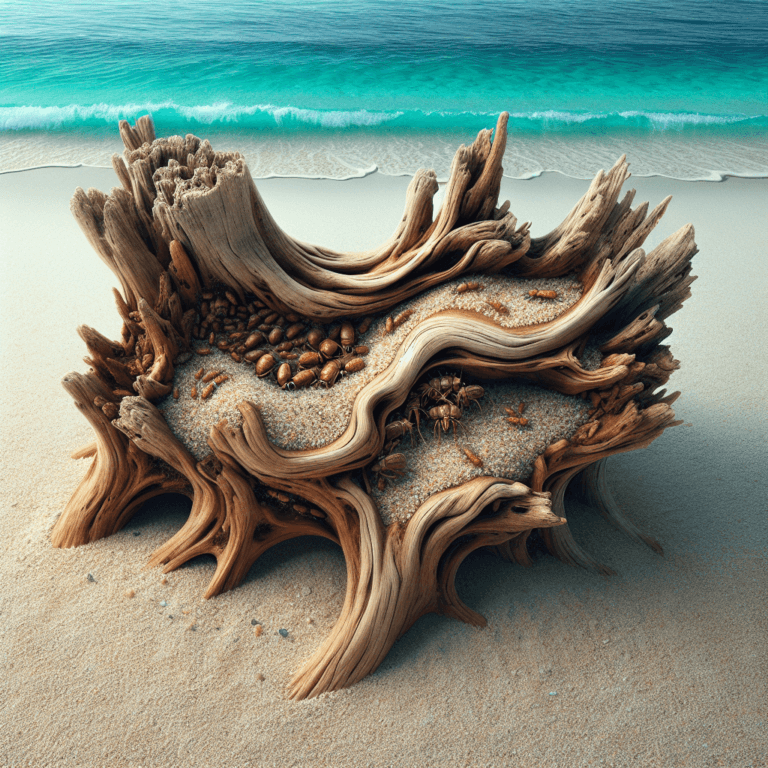
- The Bleach Bath: Even though the ocean has cleaned the wood, it may still harbor salt-loving microbes or insect eggs. Soak your pieces in a solution of 1 part bleach to 9 parts water for 24 hours, then let them sun-dry for a week. This kills any biological hitchhikers and lightens the wood to a beautiful, uniform silver.
- Bevel Your Cuts: Never leave a flat, horizontal cut exposed to the sky. Water will sit on it and eventually find a way in. Always cut the tops of your posts and rails at a slight angle (at least 5 degrees) to shed rainwater.
- Avoid “Plastic” Finishes: Do not use polyurethane or thick varnishes. They will peel under the intense coastal UV. If you want to preserve the wood, use a penetrating linseed oil or a high-quality tung oil. It soaks into the fibers and allows the wood to “breathe” without cracking the finish.
Advanced Considerations: The 200-Pound Test
Most building codes require a railing to withstand a concentrated force of 200 pounds applied to the top rail. With standard 2×4 construction, this is easy to calculate. With driftwood, it requires a bit of “over-engineering.”
If you are using a particularly long or curved piece of driftwood for a top rail, you should integrate “intermediate supports”—vertical sticks that connect the middle of the rail directly to the deck joists. This prevents the rail from flexing under load. Think of your railing not as a series of individual pieces, but as a “web” of interconnected triangles. Triangles are the strongest shape in nature, and by weaving your driftwood balusters into a triangulated pattern, you can create a railing that feels as solid as a stone wall.
Example Scenario: The Bluff-Side Observation Deck
Imagine a deck built on a 50-foot limestone bluff overlooking the Atlantic. The owner originally used “clear” Cedar for the railings, but after five years of salt spray, the wood began to “fur” and the joints opened up, allowing the wind to whistle through the gaps.
To fix this, the builder harvested three large Cedar root-balls and several long, salt-bleached branches from the beach below. By using the root-balls as the “corner posts” and the long branches as the handrails, the new construction utilized the wood’s natural “crooks” to wrap around the deck’s corners. Because these pieces were already hundreds of years old and cured by the sea, the new railing hasn’t moved an eighth of an inch in three gale seasons.
Final Thoughts
Building with driftwood is a return to a more honest way of construction. It requires you to listen to the wood, to understand its curves, and to respect the forces that shaped it. While the rest of the world is busy replacing rotted pine every decade, a driftwood railing stands as a silent sentinel, getting harder and more resilient with every passing storm.
If you choose to take this path, remember that your greatest tools are not your power saws, but your patience and your fasteners. Use 316 stainless steel, take the time to scribe your joints properly, and let the natural beauty of the wood speak for itself. You aren’t just building a railing; you are giving a new life to the sea-born bones of the coast.
As you move forward, consider looking into other coastal building techniques, such as copper-capped posts or sand-anchored footings, to further fortify your home against the elements. The coast is a harsh master, but for those who build with the “native” timber, it is a partner that offers beauty that lasts a lifetime.
Sources
1 aprettyfix.com (https://aprettyfix.com/disinfect-driftwood/) | 2 eagleclawco.com (https://www.eagleclawco.com/blogs/news/304-vs-316-stainless-steel-which-is-better) | 3 mtcopeland.com (https://mtcopeland.com/blog/deck-railing-ideas-styles-materials-and-code-requirements/) | 4 quora.com (https://www.quora.com/What-exactly-is-driftwood-and-why-does-it-not-rot-when-it-s-sitting-in-water) | 5 decks.com (https://www.decks.com/resource-index/railing/deck-railing-codes/)